Are Rewards Necessary When Potty Training? Potty Training in Classrooms
Potty training at school is a completely different experience than potty training at home. In the classroom, you’re juggling anywhere from 2 to 20 kids, one bathroom, changing schedules, and sometimes even a bit of parent pressure.
As a former child care provider, been there. As a current pediatric speech-language pathologist and early intervention specialist who services children in child care centers, preschools, and homes every week, I’ve seen a lot of different approaches (A. LOT.). Some strategies work great… others… not at all.
One of the most common questions teachers ask me when potty training is: “Should we use rewards to potty train in a classroom?”
The answer is not a clear yes or no, so lets talk about it.
What the Research Says
There is no single “right” potty training method. Not stickers. Not timers. Not consequences. Not going commando. (You get the point, there is no “right way.”) But there are some things we know make potty training better for all involved. They are:
Follow the child’s lead
Be responsive
Have correct developmental expectations
Remain calm and consistent
Focus on internal body awareness
Is There A Problem With Rewards?
Using prizes feels intuitive when potty training. Child goes potty➡️child gets reward. And children like rewards so they are more motivated to keep going on the potty. Yes, for some kids this is true. But in group care, rewards can have the potential to create new problems:
Kids focus on earning the reward, not learning the skill.
Some children feel pressure to perform, especially anxious or sensitive kids.
Others don’t care about rewards at all, creating power struggles.
You end up managing the reward system instead of the toileting routine.
Accidents feel like failures instead of part of learning.
Takes the focus aware from noticing internal body cues.
Instead of noticing:
“My tummy feels full.”
“I feel pressure.”
“My body is telling me something.”
…The child starts focusing on:
“What do I get?”
“Is my teacher proud?”
“Do I get a sticker?”
This interrupts the development of intrinsic motivation- the drive to do something because it is personally rewarding and not for an actual reward.
What Can I Try Instead?
A Routine-Based & Body-Awareness Approach
The best part? This method is easier for YOU. Easier for group care. Easier for families. And easier for kids. It reduces stress and removes the pressure to “perform” on command.
Here’s what it looks like:
First Build Body Awareness
This is the foundation of toileting. Kids need to connect ‘that feeling I get in my tummy’ is my body saying, ‘I need to poop.’ Here is how to help kids make the connection:
YOU model simple and descriptive language to talk about both your and their body awareness:
“Friends, I’m reading a book but my tummy got a tickle feeling. I am going to stop reading and pee in the potty.” (YOU modeling body awareness on yourself)
“Kelly, you stopped playing and crossed your legs. Your body is saying you need to pee or poop.” (You modeling body awareness for THEM)
2. Use Natural Routines
Instead of timers, look at your schedule and see where you are already transitioning- then put your potty break there. Less disruption of play AND less transitions are going to make the day smoother. Trust me! Build your potty breaks in:
On arrival child goes right to potty and then washes hands
Before meals- go potty, wash hands, sit for meal
Before nap (you are already transitioning to set up cots)
Before going outside or when you come back in
Whenever you notice cues (wiggling, hiding, grabbing pants)
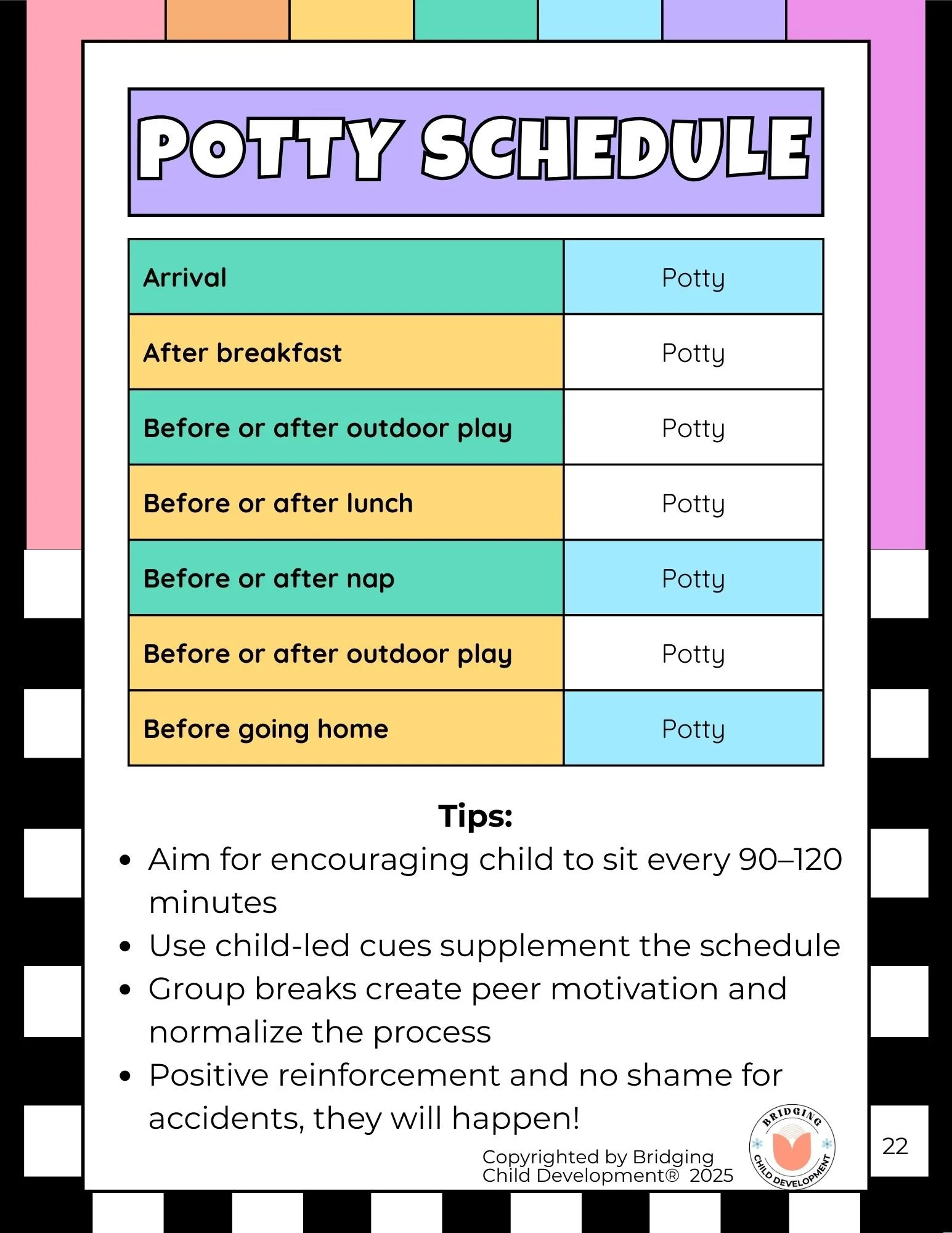
Page taken from handbook included in training!
3. Acknowledge Learning, Not Performance
Try phrases like:
“You sat even though you felt nervous. That was brave.”
“You told me you needed to pee, your body is learning!”
“You pooped in the potty, your tummy feels better now.”
“You had an accident and told me. Thanks for letting me know.”
This helps children see accidents as information, not mistakes.
4. Respond to Accidents With Compassion and Calm
Accidents aren’t failures, they’re part of the learning process.
A simple, neutral response works best: “Your body had an accident. Let’s clean up and try again later.”
No shame, just matter-of-fact support. BUT my number 1 tip with accidents (which could also be a little hot take)- DO NOT sit them on the potty after an accident. They just went, they don’t need to go now- this often feels like a time out.
5. Communicate Clearly With Families
Families may ask:
“Are you doing rewards?” or “How do you handle accidents?”
You can say something along the lines of: “We use a body-awareness approach that helps children develop independence. We follow natural routines and use simple language to help kids listen to their bodies.”
Teacher Tip: When Home and School Use Different Systems
Home and school don’t always match and that’s okay. Families might use stickers or treats, while your classroom focuses on routines and the language around body awareness.
If a child asks, “Do I get a treat?” you can respond in a way that’s positive, clear, and respectful of both environments:
“Oh! At home you get m & m’s, that’s really special. At school, we do something different. Here, I say, ‘You sat on the potty!’. Different places have different ways to do things, and you’re doing a great job learning both.”
Rewards aren’t necessary and in a busy classroom, they often make things harder. The good news? Your calm presence, daily routines, and a little shift in language helps kids learn to use the potty because they feel safe, supported, and understand their body.