Fine Motor Activities for Your 3’s Class
If you teach a 3s class, I know you have heard about the importance of supporting fine motor skills in early childhood. You have also probably noticed that your kids are all over the map when it comes to their fine motor development. One child is threading beads like a champ while another is still trying to figure out how to maneuver the bead in their hand to get it onto the pipe cleaner! As an Early Intervention Specialist, I am in a lot of child cares and something new that keeps coming up with my seasoned teachers is just how different kids are now versus 10 years ago when it comes to things they can do with their hands.
So that's exactly what this post is for. Our Occupational Therapist and I wrote this blog to:
Help you understand what fine motor skills in early childhood develop and when
Give you practical ideas for fine motor skills activities
TL;DR — Too Long, Didn't Read
The quick version for busy teachers:
Fine motor skills in early childhood are key to later academic success
By the end of age 3, most children can copy basic lines and a circle, manipulate playdough, use their helper hand to stabilize objects, and cut paper in half with scissors.
You are likely already creating fine motor opportunities throughout your day (snack, play, outdoor time) but ways to be more intentional are in this blog
At age 3, drawing is the name of the game. Ways to work it into your day without extra prep are included
What "Fine Motor Skills in Early Childhood" Actually Means
Fine motor skills refer to the movements of the hands and upper extremities — reaching, grasping, releasing, and manipulating objects. That’s a lot of technical terms- in real talk- it's everything your 3-year-olds do when they do things like roll play doh, pick up a crayon, squeeze glue, zip a jacket, or pick up a piece of food.
As a child care provider, you play a key role in supporting fine motor development and these skills are really the foundation of preschool success.
Fine Motor Milestones for 3-Year-Olds:
What to Look for in Your Classroom
Before we talk about fine motor activities, let's talk about what's typical. Here's what most children can do by the end of age 3:
Builds a tower with 10 small blocks and begins building simple structures like a 3-block bridge
Copies a vertical line, horizontal line, and circle — these are the foundational pre-writing shapes
Imitates lines, a plus/cross shape (+), and a circle when shown a model
Begins drawing a face with a couple of features
Manipulates playdough — rolling it into balls, making snakes, pinching it apart
Uses their non-dominant hand to stabilize objects while the dominant hand works
Cuts a piece of paper in half with child-safe scissors
Notice what's not on this list: Writing letters, writing their name, cutting on a line. Those skills come later. If you have 3-year-olds in your class who aren't there yet, that's developmentally appropriate. And if they're already doing all of these things, that's great — you can start offering activities from the 4-year milestone list to challenge them further.
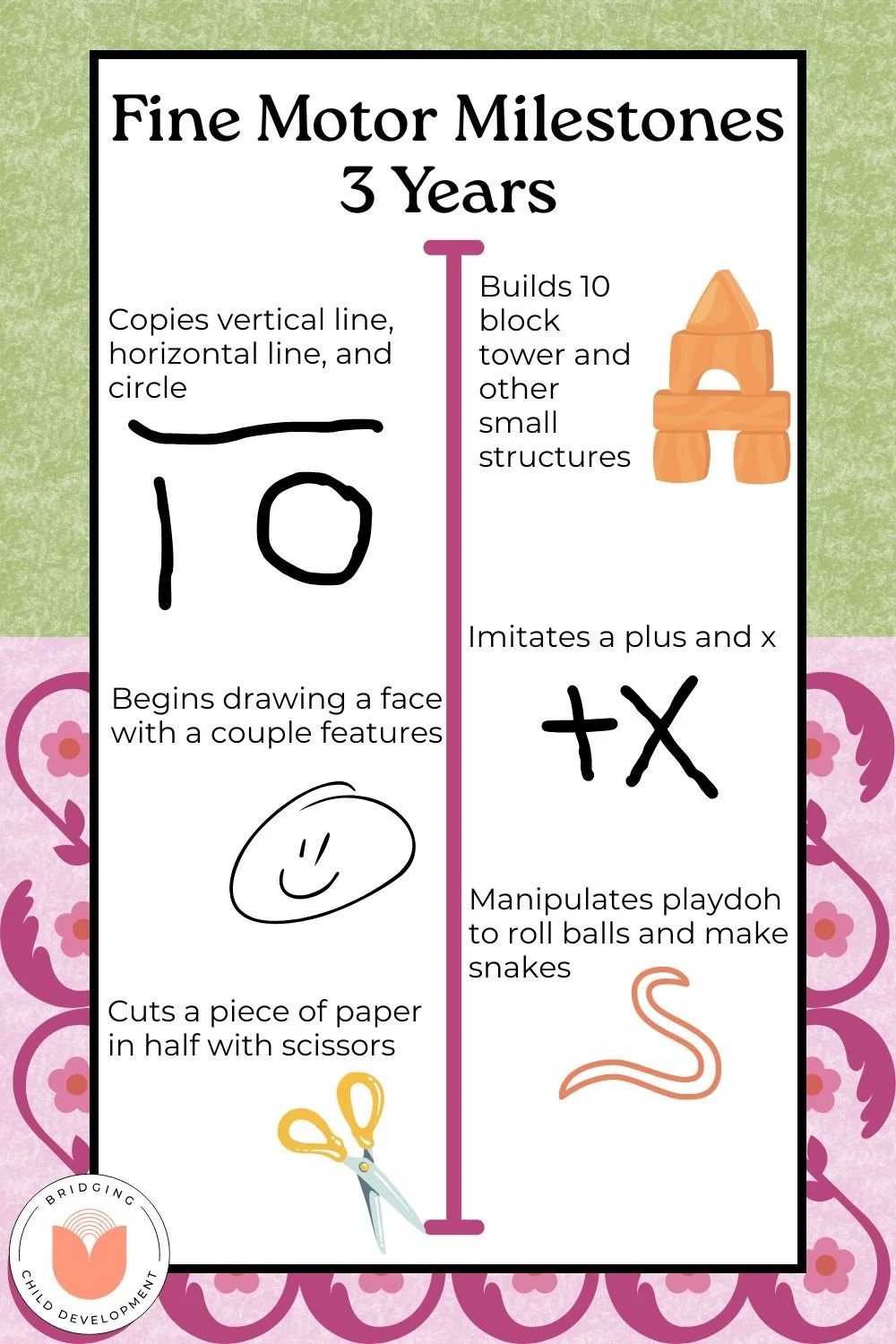
screen shot and reference
Why do milestones matter for teachers? They help you see what skills a child has already mastered, what to work on next, and when it might be time to have a conversation with families about Early Intervention. Think of them as a roadmap, not a report card.
What Can Happen When These Milestones Are Delayed
When a 3-year-old isn't meeting fine motor milestones by the end of their third year, you may start to see:
Frustration or avoidance of pencil-and-paper tasks (refusing to draw, pushing materials away)
Hand fatigue — Tight grip on drawing or art tools, less interest in activities like stringing beads on threading so they get up and wander away from those activities sooner than others
Delayed drawing skills
If you're noticing these patterns, it may not mean that something is seriously wrong. It could mean the child is not getting a lot of opportunities at home so they just don’t have as much practice. That’s where you can offer more opportunities for fine motor skill activities to specifically work on skills the child may be missing. Of course if things don’t improve over time, then you will want to have a conversation with families and connect them with Early Intervention.
Fine Motor Skills Activities for Your 3s Classroom
First and foremost, the fine motor activities I recommend are 100% NOT designed to add extra work to your day, we are too busy for that! These are simple things you can do every day that help your 3’s meet their fine motor milestones in developmentally appropriate ways.
Play-Based Activities
Building with blocks
Working with clay or playdough
Completing puzzles
Using a play kitchen to chop play food (or child safe knifes and let them cut real food for snack time)
Lacing beads
Playing with a tool/workbench set
These activities are the foundation — before pencils, cutting complex shapes out of paper, and before writing letters, children need massive amounts of unstructured hand play.
Outdoor Play
Climbing (yes, climbing builds grip strength and shoulder stability which is important to have when they do start more formal writing activities)
Building sandcastles or digging for “treasure” in sand (e.g., toss some loose parts in the sand box)
Drawing with sidewalk chalk
Using spray bottles to water the plants
Picking up nature items with clothespins!
Manipulative Play
Pegboards
Lacing cards
Building with magnetic tiles and snap cubes
Threading beads on pipe-cleaners or fruit loops on spaghetti noodles stuck in a playdough ball
Arts and Crafts Play
Tearing paper for collages
Using liquid glue (take a breath, we need them squeezing clue to strengthen their hands and this is something they are likely not using at home)
Stamping
Using stickers
Folding paper
Opportunities to use scissors (another deep breath- again this sis something parents might be skipping- start with cutting play doh, then snipping paper, and last cutting across the paper)
Sensory Exploration
Sensory bins with beans, sand, water, taste-safe pudding or Oobleck (cornstarch and water — messy but worth it!).
Finger painting but ass some sand to the paint for more texture.
Scented playdough.
These tactile experiences are particularly important for children who are avoidant of manipulative tasks because they help build sensory tolerance while developing the hands.
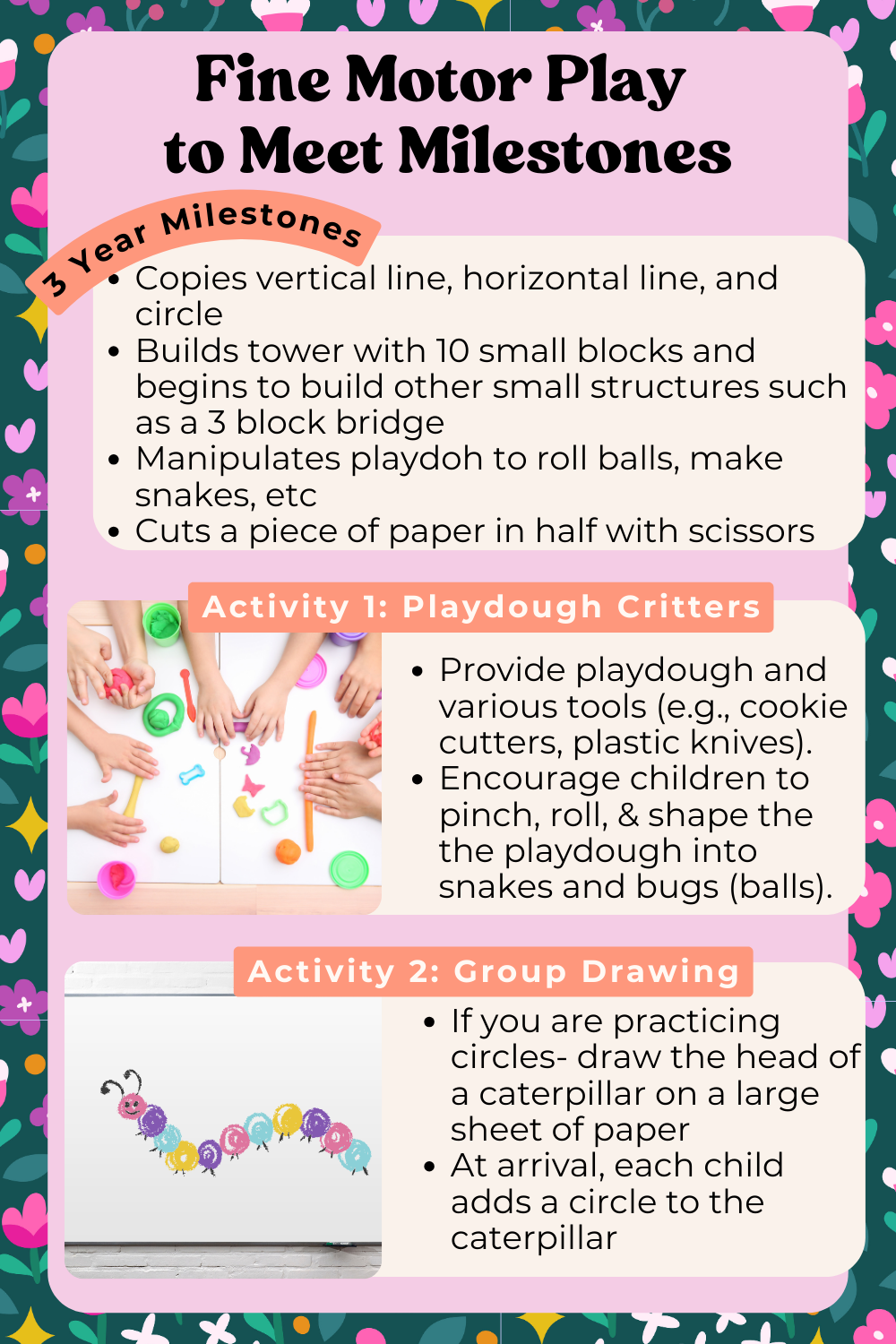
screen shot to reference
Fine Motor Skills Activities Hidden in Your 3’s Classroom
Seriously you don't have to overhaul your day to build fine motor skills in early childhood. The opportunities are already woven into your schedule. Let's look at a typical classroom day through a fine motor lens.
During Morning Arrival
As kids come in, have a group drawing activity. If you are practicing drawing circles, you draw the caterpillars head, as a child enters the room, they add a circle for the body. Not ready for circles? You draw the caterpillar, they add vertical lines for legs! You can do this with anything, just get the picture started and at 3, we’re focusing on circles, vertical, and horizonal lines!
At Snack Time
Peeling a banana, opening a snack bag, pouring from a small pitcher, unscrewing a water bottle cap — try really hard to give them to opportunity and don’t do it for them.
During Dramatic Play Center Time
Look for ways you can add some paper and pencil time naturally in the dramatic play center area. Here are some ideas.
Restaurant: Add an order pad and some golf pencils
Vet: Add a prescription pad or a “well check up” form with crayons
Flower shop: Add some greeting cards so they can “write” a note to go with the flowers
Blocks: Add some “blue print” paper to your construction center and let them draw what they are going to build or what they did build
Why Fine Motor Skills Matter (More Than You Think)
Drawing, writing letters, turning book pages, using scissors, and even taking glue caps on and off all depend on the coordination of small muscles in the hands and fingers.
Without a strong foundation of fine motor skills in early childhood, children may tire easily, avoid certain tasks, or fall behind in early learning. Fine motor skills impact nearly every part of a child’s day and development of these skills at a young age sets the stage for later preschool success.
FAQ’s
When should a 3-year-old hold a pencil correctly and How can I help them with pencil grasp?
Later than most people think. A mature, dynamic tripod grasp — the one we picture as "correct" isn't typically established until ages 5–6. If a 3-year-old is still fisting their crayon, the most effective intervention is not a pencil grip, it's breaking crayons into short pieces or give them a golf pencil. This prevents a fisted grasp because their hand can't wrap around it.
Are fat crayons better for 3-year-olds?
This is a very common misconception. Fat or jumbo crayons can actually make it easier for children to use a fisted grasp (think about trying to hold/write with a rolling pin using a tripod grasp- you are going to fist it!) Short, broken crayons, thin pip-squeak markers, and golf pencils are what you want to look for!
Should 3-year-olds be practicing writing letters?
Generally, no — not formally. The sequence of skills goes: fine motor play → drawing pre-writing shapes (lines and circles) → drawing a person → copying letters. (All while continuing fine motor play of course, the play never stops!). Most children aren't ready for formal letter instruction until after age 4, and only after their drawing skills are solid. At age 3, the focus should be on drawing vertical lines, horizontal lines, and circles — which are the actual strokes that letters are built from. Rushing to letters before drawing is in place skips the foundation.
How do I know if a 3-year-old in my class needs an OT evaluation?
Occasional struggle or inconsistency in fine motor skills is expected and normal at age 3. A referral conversation with a family might be appropriate if a child is consistently avoiding all fine motor tasks rather than just some, shows significant hand fatigue or frustration during activities, or demonstrates skills well below the 3-year milestone range after consistent opportunities to practice skills. You don't need to diagnose — just share your observations with the family and suggest they speak with their pediatrician. For children ages 3–5, free evaluations are available through Child Find services at local elementary schools.
What's the difference between fine motor and gross motor skills?
Gross motor skills involve the large muscles of the body — walking, running, jumping, climbing. Fine motor skills in early childhood involve the small muscles of the hands and fingers — gripping, pinching, cutting, drawing. Both develop together, and gross motor strength (especially core and shoulder stability) actually supports fine motor development. And both gross motor and fine motor development supports speech development too!
Looking for more fine skills and activities in early childhood? Check out our training for infant, toddler, and preschool childcare providers — built by a pediatric SLP and OT who has spent years in classrooms just like yours.
This training is designed for child care providers and preschool teachers who want practical, play-based fine motor skills activities to strengthen little hands and set the stage for writing, cutting, and school readiness. Come away with ideas you can use the very next day in your classroom!