As prior directors- Sam, a prior director of a large center and myself, the prior owner of a home child care- we know that building a strong team is the heart of a successful program, and that recruiting and hiring great early childhood teachers is where it all starts. The right teacher can transform a classroom, while the wrong hire can increase turnover, lower morale, and make you literally dread work (IYKYK).
Finding qualified, dedicated, and genuinely caring preschool and child care teachers can feel overwhelming:
- Where do you even find candidates who want to work in early childhood setting like a preschool, daycare, or child care center?
- How can you truly assess a candidate’s readiness, personality, and values in just a few interviews?
- And once you do find and interview someone, how do you quickly figure out who’s the right fit?
The good news? Great teachers are out there, you just have to know where to look and how to identify them.
In this blog, we'll cover the best places to recruit qualified infant, toddler, and preschool teachers, strategies to attract stronger applicants, and tips for identifying candidates who are the right fit for your program.Even the best interview process won’t help if the right people never see your job posting.
Here are the six most effective places to post child care jobs and hire early childhood education teachers, plus simple ways to help your listings stand out. (Number 6 is my personal favorite!!)
General job sites like Indeed, ZipRecruiter, and LinkedIn reach a huge number of job seekers.
Tips to get better candidates:
- Use clear job titles like “Lead Preschool Teacher – 3-Year-Old Classroom.”
- Highlight your center’s mission, values, and benefits.
- Add a photo or two of your classrooms or team if possible. It helps candidates visualize the environment.
- Refresh your posting every few days to stay near the top of search results.
Full disclosure- I have heard child care directors and owners share some positives with these boards but also some horror stories so before you spend a dollar, I am just going to break down what these big job boards may cost.
The large boards can work and get you some really good leads, but "free" rarely stays free, and the fees can add up fast for a single-site or small-center budget. Here's what to watch for:
Indeed. Posting a job is technically free, but free listings get buried within a day or so as newer jobs come in and free posts are capped (around three per month). This means to stay visible you have to "sponsor" the post, which runs on a pay-per-click auction, roughly $0.10 to $5.00+ per click whether or not that person ever applies. I've seen some Facebook group chats saying they spent anywhere from $150 to $1,000 a month with mixed results of getting a hire and some people reported burning through thousands of dollars without any good leads.
ZipRecruiter. ZipRecruiter doesn't publish its prices, you get a custom quote only after talking to sales, which is one of the most common complaints about the platform. I saw some directors reporting $300 to $900 a month, per job slot. The "free trial" is short (often just 2–4 days), requires a credit card up front, and automatically converts to a paid plan.
The takeaway: I feel like this is not really selling these larger job boards so I want to say again, I have seen and heard where these big boards can and do work but I would just be careful when setting them up and make sure you have the budget because this will likely be a paid option, not your default.
For many small centers, the free and low-cost channels we're going to talk more about below in tips 2-6 deliver more aligned candidates for a fraction of the price.
These niche sites attract people who already have ECE experience. That means less screening and more aligned candidates.
Post on platforms like:
- NAEYC's Early Childhood Career Center can be accessed here
- ChildCareCareers.com is the largest job board for early educators. Check it out here
- State or regional early learning job boards (many state associations host them).
Why it works: You’ll reach a smaller but more targeted pool of qualified, passionate educators.
Building partnerships with community colleges and universities is one of the best long-term hiring strategies you have. A college pipeline fills seats for years because you're not just finding one candidate, you're building a steady stream of trained, passionate early childhood educators who already know your name before they graduate.
Four-year universities, Community colleges, CDA and ECE certificate programs, high school career-and-technical-education (CTE) tracks, and even Child Development Associate cohorts are full of people actively training for this work. Tap into all of them!
ECE students often look for:
- Assistant teacher roles
- Classroom aide positions
- Internships or practicum hours (many need these to graduate and you can host them)
How to build the relationship:
Reach out to department chairs, ECE faculty, or career services. Ask to:
- Post on their internal job board
- Visit classes to do a short "what it's like to teach here" talk
- Attend career fairs
- Invite students for center tours
- Become an approved practicum or student-teaching site
A few other tips for getting the most for this:
- Offer to be a guest speaker or host a Q&A because face time builds trust faster than a flyer.
- Treat your practicum students like recruits, not free help. A great experience turns into a great hire (and great word-of-mouth back on campus).
- Stay in touch with faculty year-round, not just when you're desperate. Department Chairs refer their strongest students to the centers they actually know and trust.
- Consider a small "grow your own" perk. This might be a sign-on bonus or a clear path from aide to lead teacher so you win students choosing between offers.
Why it works: You’re meeting candidates before they hit the job market and offering opportunities that can grow into full-time positions.
Your social media isn’t just for families, it’s also a powerful recruiting tool. Instead of only posting job openings, let potential candidates see what it's like to work at your center.
Share:
- Your Facebook and Instagram- Share moments of teamwork, classroom setups, staff appreciation celebrations, classroom activities, birthday parties, and field trips. Tag and celebrate your teachers by name (with permission). When your current staff feel seen, they share those posts and their friends might be your next great hire.
- LinkedIn- Post professional content: teacher testimonials, staff milestones and anniversaries, awards, and "a day in the life" of your classrooms. LinkedIn reaches educators who are quietly open to a change but aren't scrolling job boards.
- Facebook Groups- Local parenting groups, community boards, and ECE-specific groups often allow job postings and reach people already invested in early childhood. Search for groups in your town plus "early childhood educators [your state]."
A few simple tips when posting on these channels:
- Add a clear call to action: "We're growing our team! DM us or tap the link to apply."
- Pin a short "Why teachers love working here" post to the top of your page.
- Ask your current teachers to share openings to their own networks because referrals from happy staff are some of your strongest candidates.
- Keep a highlight reel or saved story of staff celebrations so visitors land on culture first, not just a job ad.
Why it works: Authentic posts showing your center’s culture and team spirit help candidates picture themselves working there.
Current teachers often know other great teachers. This means some of your best hires will come from your current team. The catch? Most teachers won't think to refer someone unless you make it easy and worth their while. A real referral system does both.
First set up the system:
- Offer a referral bonus and make it meaningful. Pay it in two parts (some at hire and the rest after the new teacher stays 90 days) so it rewards quality, not someone cheating the system.
- Tell your team exactly what you're looking for. "We're hiring a lead teacher for our 3s, know anyone warm, reliable, and great with families?" is far more effective than a general "we're hiring."
- Make sharing one-tap easy. Email staff a ready-made post or graphic they can drop on their own social media in seconds.
Then widen the net beyond staff:
- Encourage families to share your openings. Parents are often your biggest fans and know other families, sitters, and former teachers.
- Keep simple flyers or business cards handy in case you bump into a person you meet around town and they happen to be looking for employment.
Stay consistent:
- Announce every referral hire and thank the teacher publicly (with permission). Visible appreciation keeps referrals coming.
- Remind the team a few times a year of your referral program. A quick mention at a staff meeting beats a one-time email everyone forgets.
Why it works: Referred hires tend to stay longer, fit the culture faster, and come in with a realistic view of the work because someone they trust already gave them the honest version. You spend less on job boards, screen fewer unqualified applicants, and build a team that actually likes working together.
Since I (Kelly) work for Early Intervention, I can tell you first hand, this is the channel most directors completely overlook.
If you are not sure what Early Intervention is, it's a free or reduced cost program provided by your state consisting of developmental specialists that serves families with children birth to age five with developmental delays. One part of Early Intervention many people don't know about is we are a family service plan, meaning if a parent shares they are looking for new employment, we can support them in that process. Also, we are surrounded by all different educators which is where connecting with your local program comes in.
Here's what you can try:
- Find your local program. Search your state's Part C and Part B/ Early Intervention program, or just call your local home school and ask to be connected to your area's early intervention team. (Note: It may be a part C, 0-3 year old team and a part B, 3-5 year old team, so make sure to get connected with both)
- Introduce your center. Share your philosophy, your inclusive practices, and the ages you serve and let them know you currently have job openings (and any child openings, too).
- Ask to be added to their provider list. Request that your center be included on any childcare or daycare list they share with families (as both a place of employment and for child care).
Why it works: Early Intervention staff are deeply networked, we are with parents looking for employment, paraeducators that may be looking for a change, preschool teachers that want to get out of the public school system and go private or move to a new facility, and even recent retirees or grandparents looking for a part time job. Getting your program on their radar carries far more weight than a job board click and it helps fill both your classrooms and your rosters.
Marketing gets applicants in the door but the real work is figuring out who will truly thrive in your classrooms. A great interview separates the candidate who
interviews well from the one who will
teach well, and the questions you ask a lead teacher should look different from the ones you ask an assistant.
Instead of asking only traditional interview questions like: Tell me about yourself...
Ask scenario-based questions that reveal how candidates think.
For example:
- What would you do if two children were fighting over a toy?
- How would you respond to a parent upset about biting?
- Describe a time you had to build a relationship with a challenging child.
These questions tell you much more than simply reviewing a resume.
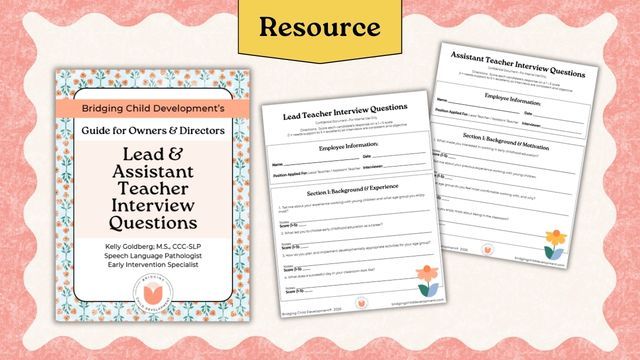
Skip the guesswork. This ready-to-use Lead and Assistant Teacher Interview Questions Guide includes dozens of carefully designed interview questions for both lead and assistant teachers, helping you confidently identify candidates who are the right fit for your program. Print it, hand it to your interview team, and start every interview consistent and prepared. Click below to learn more!