You've posted the job, the applications are coming in (hopefully!), and now the next step is figuring out who is truly the right fit.
(Not sure where to find applicants yet? Start with this blog first.)When hiring, it's important to look beyond the résumé. Education and experience matter, but character, attitude, and classroom presence often matter even more.
The goal is a detailed yet welcoming interview process that helps you genuinely get to know each candidate.
If you are looking for a child care and early childhood education setting specific interview question tool, keep reading and
download the resource at the bottom of this blog.We all know, turnover in our field is steep. A
2026 analysis from the Buffett Early Childhood Institute at the University of Nebraska looked at workforce registry data across eight states and found that only
56% of educators active in 2023 were still in the field two years later. That's a
44% turnover rate, and a
loss of nearly 90,000 early childhood educators in just two years across those states alone. The decline hit teaching staff hardest, with
center-based assistant teachers the most likely to leave.
Why should that shape how you interview? Because that churn impacts the children. The single biggest factor for outcomes for children is the quality of adult interactions. When teachers cycle in and out, kids lose the chance to form the steady, trusting bonds that fuels their development.
Here's the encouraging part: Training and credentials act as a "protective factor" for retention. In the same analysis, educators with an early childhood–specific associate degree stayed at a 70% rate, those with a Child Development Associate (CDA®) credential at 65%, and those with a general associate degree at 63%, all well above the 56% average. Basically, when hiring, the first thing we want to look for are these because that staff tends to stay.
A thoughtful interview isn't just about filling a slot. It's your best, lowest-cost tool for protecting classroom quality, spotting the candidates most likely to stay, and avoiding a costly do-over a few months from now.
Zoom interviews are great for quick screenings, but they can't replace learning about someone's energy and interaction style in real time.
During an in-person interview, you can observe:
- How they communicate
- How they connect
- How they show warmth
- Their professionalism and presence
Encourage candidates to complete as much of the application as possible at home so your time together focuses on meaningful topics rather than paperwork. Have their résumé and any supporting documents ready to review alongside your interview questions (hello, resource!).
After digging into some research about interview questions I learned
how you ask matters as much as
what you ask. Basically,
when you ask every candidate the same structured questions, you're far better at guessing who will actually do the job well than when you just have a casual, go-with-the-flow conversation. Research showed
consistent, structured interview questions are about twice as accurate at picking strong employees. And this may come as a surprise:
How many years experience a candidate has worked turns out to be one of the worst clues for how good they'll be on the job.
"Structured" doesn't mean stiff. It simply means you ask every candidate the same core, job-relevant questions and evaluate their answers against the same yardstick, so you're comparing apples to apples instead of going on gut feeling alone.
The most useful structured questions in our field are
scenario-based questions, because they show you how a candidate thinks through real classroom moments.
Examples:
- "How would you approach a child struggling with separation at drop-off?"
- "Can you share a time you navigated a disagreement with a co-teacher?"
- "How do you build relationships with families?"
Pay attention to more than the content. Listen for empathy, reflection, and genuine care. You want a candidate who pauses, considers the child's perspective, and reflects honestly on what they'd do differently.

A trial gives you and your team a chance to observe how a candidate interacts with children and coworkers in your actual environment.
This feedback is invaluable because you may notice things you would not have in the interview alone. This can be done a couple different ways and depends on what works best for you and your policies.
- 1. Have the candidate do a quick 15-20 minute activity with a class. Maybe they read a book and lead an arts and crafts activity or maybe they just join for a play rotation.
- 2. Have the candidate rotate through a couple rooms for a total of about 15 minutes where they observe and join the children where possible.
Note: I would let them know prior to interview this is a possibility. Also, I would write this in your policy that potential new hires may observe or do a brief activity with the children. Again, there my be some regulations around this, so make sure you do what works within your regulations.
If you are not able to have them join in a classroom, it's ok. Another option is to ask for quick sample lesson plan or activity idea. This helps you see:
- Their understanding of child development
- Creativity
- Classroom organization
- Their ability to plan developmentally appropriate activities
It's a small step that reveals a lot. (In hiring research, this kind of "work sample" is one of the strongest performance predictors there is, right alongside the structured interview itself.)
Before making an offer, double-check state qualifications. There’s nothing more frustrating than hiring someone for a lead role only to later find out they don’t meet the required credentials. I (Sam), have been there, and it’s not fun! Confirm credentials, clearances, and any required training hours before you fall in love with a candidate, not after.
The interview is a two-way street. Help candidates see what makes your center special.
Share:
- Your mission
- Your approach to teaching
- How your team collaborates
- Opportunities for growth
When candidates connect with your "why," they're far more likely to become invested, long-term team members. And given how much that first year predicts retention, that connection is worth building from the very first conversation. Educators who feel positive about their work environment are consistently the ones who stay.
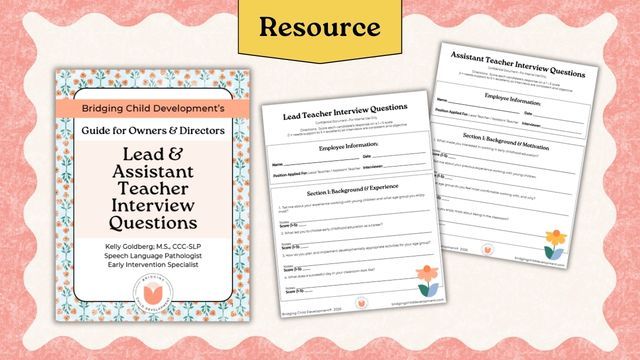
The interview questions you ask matter! We built to make consistency effortless. This resource includes two templates, one for lead teachers and one for assistant teachers, designed specifically for child care centers and early education settings.
Lead with scenario-based questions that reveal mindset, such as how they'd handle a tough drop-off, a conflict with a co-teacher, or a difficult conversation with a parent. Pair those with a couple of values questions about why they chose early childhood and what a great day in the classroom looks like to them. Ask every candidate the same core set so you can compare answers fairly.
Beyond credentials, look for warmth, emotional regulation, reflectiveness, and genuine curiosity about children. The best predictor of classroom quality is the quality of teacher–child interactions, so notice how a candidate talks about children and how they actually engage with them during a trial.
Watch for candidates who speak about children with frustration or detachment, who can't reflect on a past mistake, who are vague about child development basics, or whose energy with children during a trial feels flat or forced. Trust your team's instincts here.
Hiring for fit is step one, but retention is built afterward through a supportive work environment, realistic expectations set during the interview, and strong onboarding. The clearer you are about your "why" up front, the more likely a new hire is to stay past that critical first year.