Story time is more than just reading the words on the page, it’s a chance to help children truly understand the story. As a speech-language pathologist who works in child cares and preschools every week, I often see teachers struggle with knowing which questions to ask.
Many are surprised to learn that not all questions are created equal, some questions have a much bigger impact on building story comprehension than others.
Before we talk about what to do, lets first talk about what NOT to do.
Many teachers default to questions like:- "What color is this?"
- "How many are there?"
- "Do you see the dog?"
These are perfectly fine for children who are still learning basic concepts, and for many toddlers, that's exactly where they are. But if your preschoolers already know their colors, numbers, and animals, these questions do very little for their literacy development. The child answers, you move on, and no real reading comprehension was built
To truly help children understand stories, we need to ask questions that make them think about how story structure works, not just name facts they already know.
The key is asking questions that align with story grammar, the predictable parts every story contains. I organize these with the CSPAS framework: Character, Setting, Problem, Attempts to solve the problem, and Solution. I call these "Read in the Lines" questions.
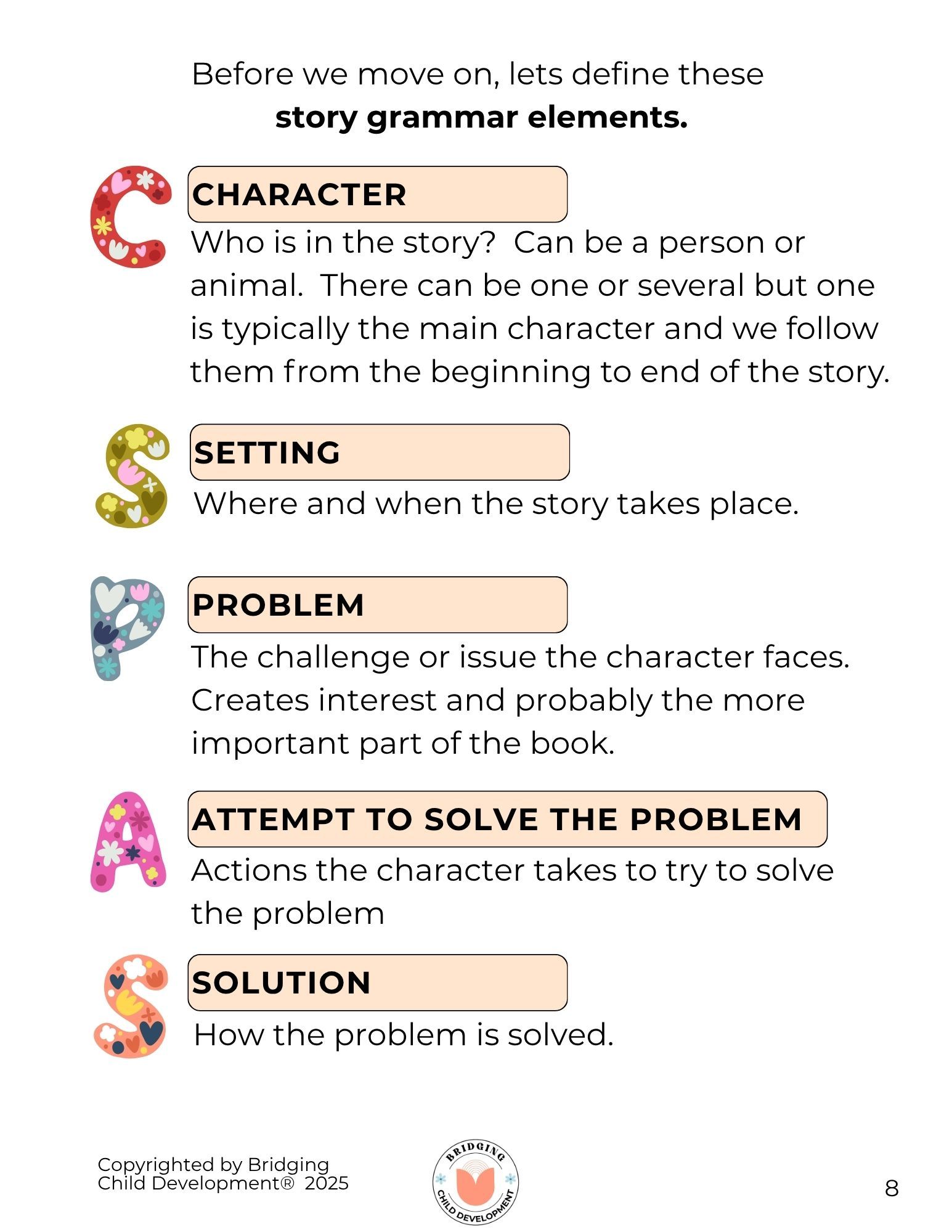
Page 8 of handbook included in your training!
This isn't just a cute acronym. Decades of early-literacy research show that a child's narrative skills, their ability to follow and retell the parts of a story, are one of the strongest early predictors of later reading comprehension.
When you ask story-grammar questions during a read-aloud (a practice often called dialogic reading), you're building the exact thinking skills children will lean on when they start reading on their own.
Read-in-the-Lines questions are directly answered in the text and align with
Character, Setting, Problem, Attempts to Solve the Problem, and Solution (CSPAS). They are highly effective for building early literacy skills because they help children:
- Identify and remember key story elements.
- Stay engaged and participate actively.
- Build vocabulary while strengthening narrative skills.
- Create a foundation for higher-order thinking and later comprehension.
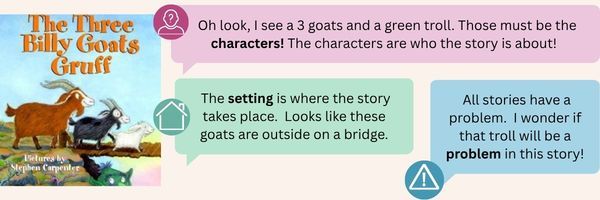
Before Reading (1 minute):Option 1: Talk about the cover. Are there any CSPAS elements you can pick out just from the cover? Here is an example from The Three Billy Goats Gruff:
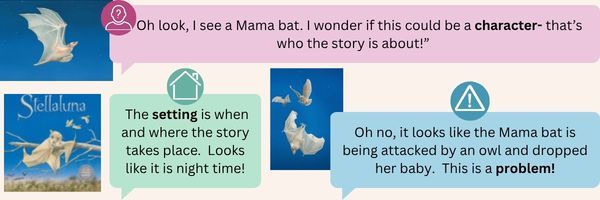
Option 2: Do a picture walk. You are not reading, you are just flipping through the pages and point out some things happening on each page using the CSPAS terms. Here is an example from Stellaluna:
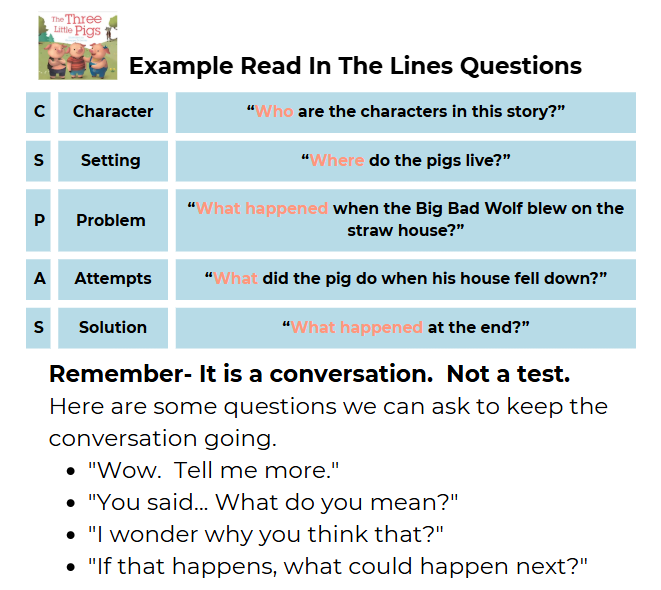
During Reading (5-7 mins)- Pause at key moments during the story and ask CSPAS questions. Here is an example from the 3 Little Pigs:
After Reading (2 mins):- Review the story using CSPAS terms: character, setting, problem, attempts, solution
- Toddlers: 2–5 minutes, very interactive, and totally fine to cut short when attention fades
- Whole-group PreK read-alouds: 5–10 minutes
- Small groups with focused comprehension time: 10–15 minutes
No matter the age or classroom you are in, repeated readings are your friend! You do not, and should not, cover everything in one reading. Reading the same book over several days lets you focus on different story elements each time and helps children understand the story on a deeper level. Toddlers especially thrive on the comfort of a familiar book.
- Keep questions short and conversational. We're teaching comprehension skills, not testing them.
- Use visual aids to reinforce and teach the CSPAS elements.

One of my favorite tricks: I cut these visuals out (above), glue them to popsicle sticks, and give each child a set.
They hold up the matching card when we reach a new CSPAS element in the story. It keeps little hands busy and turns passive listening into active thinking.
Read-alouds are incredible opportunities to build children's language, thinking, and reading comprehension, especially when we ask the right questions. "Read in the Lines" questions help toddlers and preschoolers become active story thinkers, not just passive listeners.
If you're excited to bring this into your classroom but want the whole system, every CSPAS question example, the ready-to-print visuals, the book lists, and the step-by-step coaching to make it second nature, that's exactly what I built the Read Between the Lines training for.
Fewer than you'd think. Aim for a small handful of meaningful CSPAS questions rather than a question on every page. Story time should feel like a conversation about the book, not a quiz. Over-questioning can actually pull children out of the story.
Choose books with a clear character, a simple problem, and an obvious solution, which is why classic and fairy tales (Three Billy Goats Gruff, Three Little Pigs, Stellaluna) work so well. Predictable, well-structured stories make the CSPAS elements easy for children to find and remember. In the training you will get a whole book list!
Give their hands and bodies a job. Story-grammar visuals on popsicle sticks, simple gestures for each CSPAS element, or a "turn and tell your neighbor" moment all turn wiggly listeners into active participants. Short, conversational questions keep the energy up far better than long ones.