Remember the old days when it was just called arts and crafts? I really miss those days! Instead, early childhood educators are trapped in this ongoing and often polarizing debate between process art (“arts”) and product art.(“crafts”) There is a difference between arts and crafts and one is not better than the other.
- Art is open-ended exploration with no expected outcome
- Crafts are structured activities with a shared outcome and/or model
Somewhere along the way, crafts (or product art) has become the villain. If projects look the same, they must be bad. If there’s an example, creativity is out the window. And art (process art) where there is no picture and kids create freely with materials is the only way children can be creative.
As a pediatric speech-language pathologist and early intervention specialist, I am in a lot of early childhood centers every week and a few programs have banned,
banned crafts altogether.
I have a problem with this. Arts and crafts serve different purposes and both belong in early childhood classrooms. Arts and crafts support critical developmental skills including:
- Following multi-step directions with location words (children have to listen to and understand language- “Put on.” “Glue next to the…” “Stick the eye ball above…”)
- Fine motor development (hand strength, grasping, using their hands together, moving their fingers, and more!)
- Using classroom tools (cutting with scissors, taking glue stick caps on and off, holding crayons and markers) BTW we have a blog on cutting with scissors here!
- Sensory development (tolerating that their hands are messy or sticky)
These happen to be some of the exact skills we look for in our early intervention assessments! Learning is happening, and a lot of it, even with a craft!
Some children thrive with structure. Others need more open-ended options. Many benefit from a mix of both and that’s okay. We don’t need to ban crafts or polarize early childhood education even further.
Below are four winter crafts that support language development, fine motor skills, and creativity, with the specific skills and vocabulary each one builds.
Finding it hard to keep little ones at the craft table? Try a big movement activity first! Here's why that works so well, plus a few more craft ideas for winter!
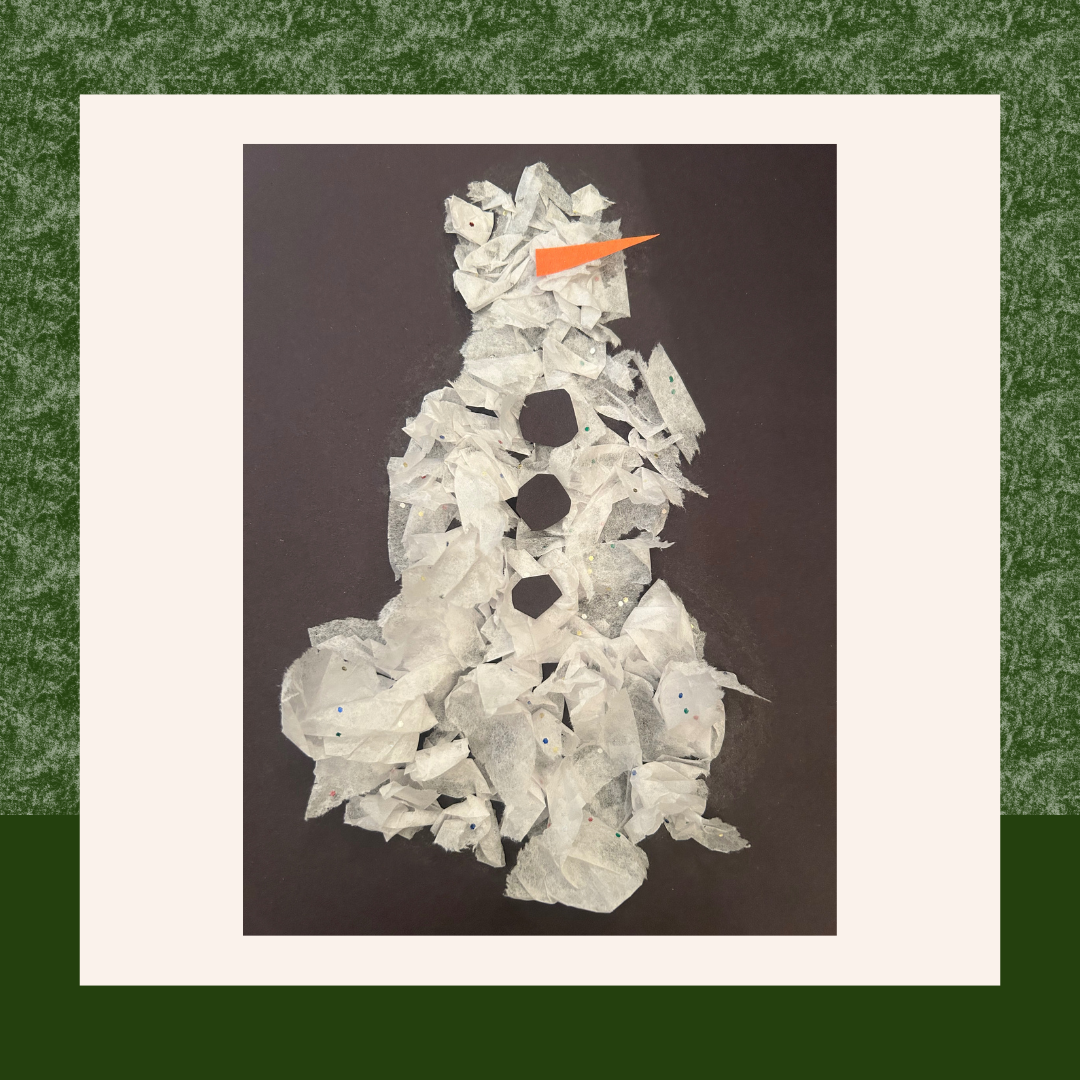
Directions: - Draw 3 circles on construction paper prior to starting craft with children
- Give each child a choice of which color they would like
- Provide tissue paper for the child to rip
- Then have them scrunch the tissue paper with their fingers into loose balls
- Repeat ripping and scrunching a few times
- Have them rub glue all over the top, middle, or bottom circle and put the scrunches pieces of paper on the glue.
- Repeat until they have a snowman
- Cut black buttons from construction paper and an orange triangle for a nose and glue on
- Add googly eyes
What skills the craft works on:
Fine Motor:
- Bilateral coordination (using 2 hands together)
- Pincer grasp
- Hand strengthening
Vocabulary you can use during the craft:
- Model verbs: ripping, sticking, tearing, gluing
- Point out size & location concepts: big, small, top, bottom
In order for toddlers to start combining 2 and 3 words together, they need a mix of nouns, verbs, location words, and descriptions! Crafts naturally lend themselves to creating this language rich environment
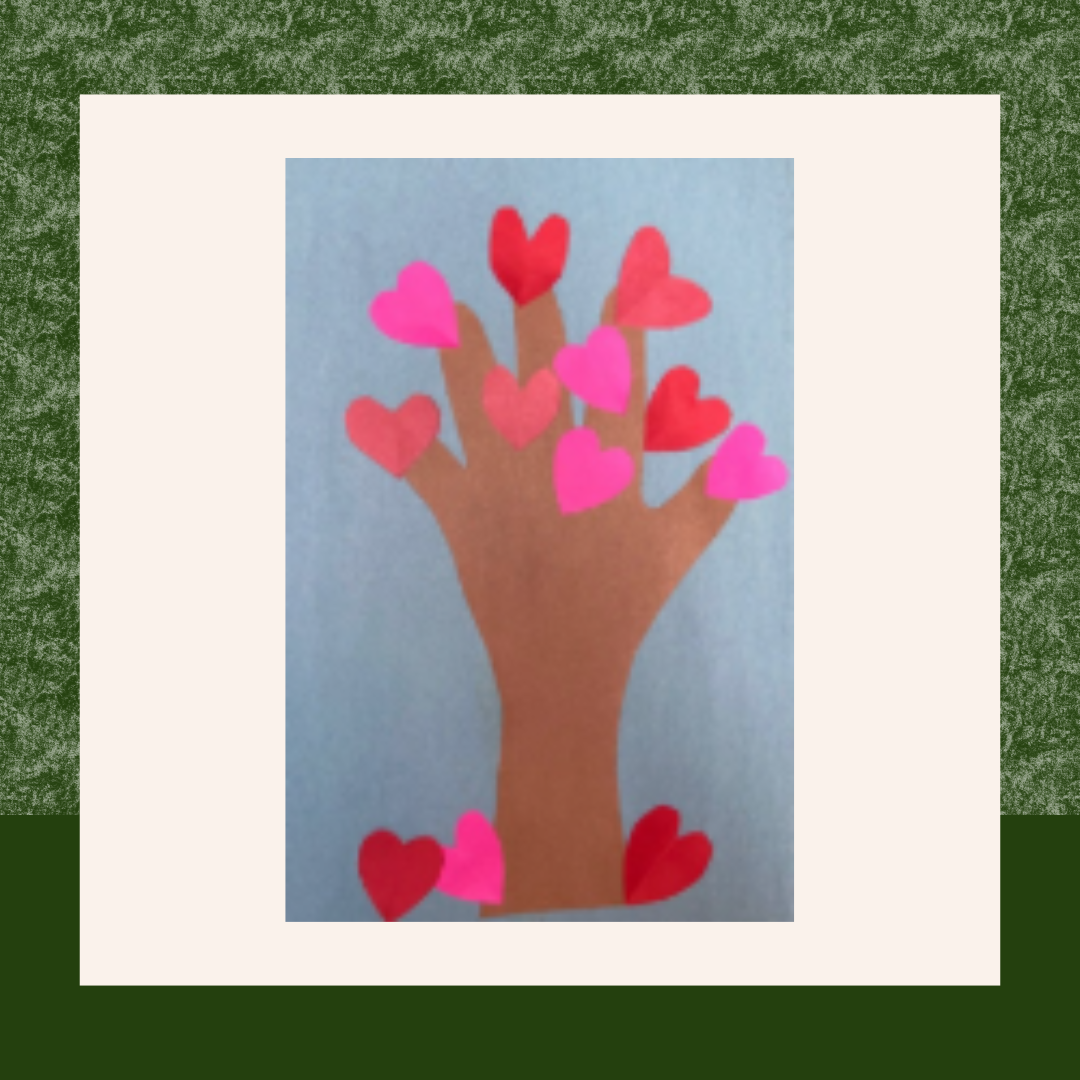
Directions: - Lay the child’s hand with part of their arm flat on the brown construction paper and trace
- You cut out their hand while they rip and scrunch the pink and red tissue paper
- Have them add spots of glue all over the tree (at the top and bottom) and press the tissue paper on the glue
- Optional: Instead of tearing paper you can use heart stickers for them to peel
What skills the craft works on:
Fine Motor
- Hand strengthening
- Eye hand coordination
Vocabulary to model:
- Model location words: Top and bottom when they are gluing the pink and red paper. Understanding these location words in a structured activity will help them understand the words later when you say, “Put the puzzle on the top shelf”

Directions:- Provide children with a tree page (next page) to color
- While they are coloring, draw a circle on the blue construction paper and a trapezoid on a variety of different color papers
- Help your toddlers and encourage your prek age children to cut the circle
- Let them pick their “base” color and help your toddlers cut / encourage your preschoolers to cut the base
- Have them glue the circle on the base while you cut their trees out
- Then have them glue the trees on
- Provide cotton balls for “snow” and have them glue on, next to, or under the trees
- Add glitter!
What skills the craft works on:
Fine Motor:
- Bilateral coordination (using 2 hands together)
- Pincer grasp
- Cutting
- Eye hand coordination
Vocabulary to model:
Language:
- Model spatial concepts: on, next to, above, under, between when describing where they glued the “snow”
- Cut out a small and large tree and use these words too! These are early math concepts we want littles to understand and use!
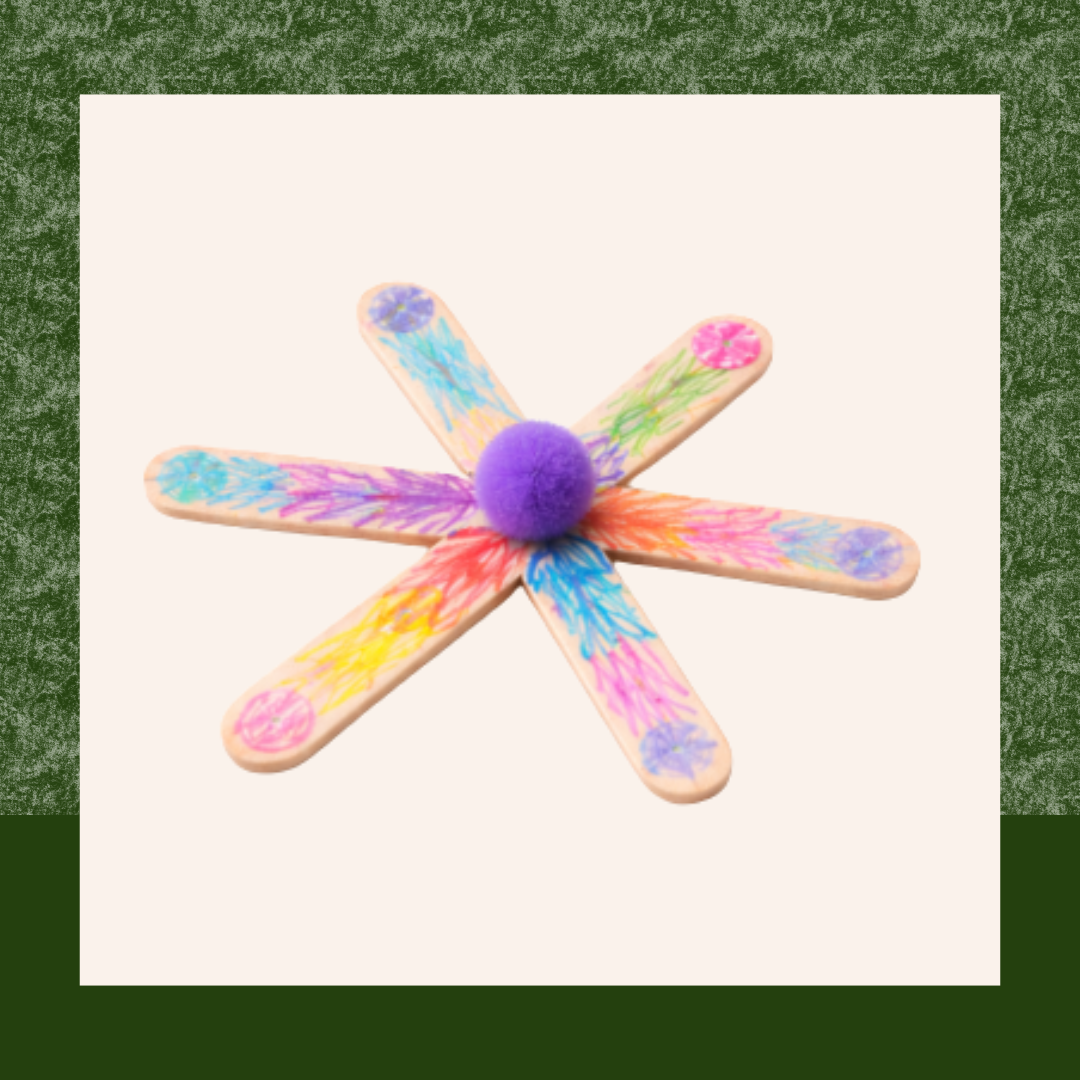
Directions:- Provide the children with popsicle sticks or tongue depressors
- Have them decorate the sticks with marker or crayons of any color
- Help children add glue to the center of the stick. Then glue a second stick on top in opposite direction
- Then glue a third stick on top in a different direction
- Have children glue a pom pom in the center of the snow flake
- Optional: Add a little glue and glitter!
What skills the craft works on:
Fine Motor:
- Eye hand coordination
- Holding writing utensils / grasp
Vocabulary To model: Language:
- Model requesting and commenting: “I need glue”, “I am coloring”, “This is fun!” “I like snow!”
If we want kids to use these words, we first have to model them! The child does not have to repeat you, no need to say, “Use your words.” or “Say please.” Kids learn language best in a pressure free language rich environment!
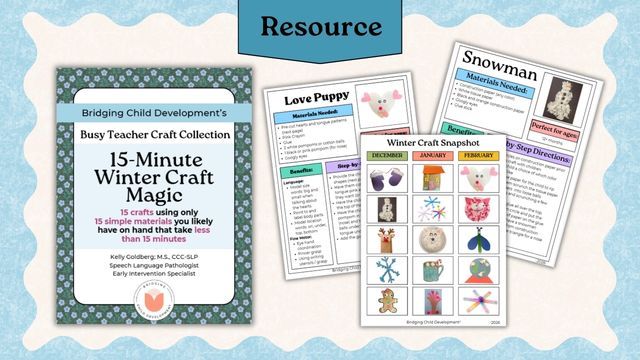
Love the idea of using crafts to build real skills but short on prep time? I pulled together my favorite low-prep, developmentally appropriate winter crafts into one done-for-you resource: 15 Minute Winter Craft Magic.
Art is not better. Crafts are not the enemy. We just need to step back and ask ourselves two questions:
1. What skills am I supporting? Whether it's an open-ended art project or a structured craft, it's simply a tool we use to support the development of a variety of skills.
2. What am I taking away when I don't allow crafts? Some children learn best with clear steps and visual models. When we remove crafts, we remove access for those children.
Process art is open-ended, with no set outcome, the focus is on exploring the materials. Product art (a craft) is more structured, with a shared model or end result. Both are valuable; they simply build different skills.
No. Crafts aren't bad, and they aren't the enemy of creativity. They build fine motor skills, language and direction-following, tool use, and sensory tolerance, many of the exact skills assessed in early intervention. The key is using them intentionally alongside open-ended art, not choosing one and banning the other.
Both. Some children thrive with the structure of a craft, others with the freedom of process art, and most benefit from a mix. Rather than picking a side, ask what skills you're supporting with each activity.
Fine motor development (hand strength, pincer grasp, bilateral coordination), language (verbs, location and spatial words, following directions), tool use (scissors, glue, crayons), and sensory development (tolerating messy hands). Crafts are a surprisingly rich learning opportunity.