Training card for Is Stuttering Normal, a preschool stuttering training for child care providers

Preschool Stuttering | Online Training for Child Care Providers

Is Stuttering Normal?  And How To Help!  

Most stuttering begins before a child is 4 years old. They’re repeating sounds, getting stuck on words, and seem to struggle to get their thoughts out.
How you respond in those moments matters! Know exactly what to look for, what to say (and what not to say), and how to support children when their sounds and words get stuck.
In this self-paced training taught by a speech language pathologist and early intervention specialist, you’ll:
  1. Tell the difference between a normal disfluency vs stuttering (Typical disfluencies are normal!) and look different than true stuttering.
  2. Understand how to help a child who stutters (and what makes stuttering worse).
  3. Make simple shifts to how you respond in the moment so you and the child feel confident communicating.

Help children (and you!) feel confident communicating in the classroom with simple, supportive ways to respond to preschool stuttering.
resourceS

Includes a 25+ page downloadable handbook, yours forever! 

The handbook includes:
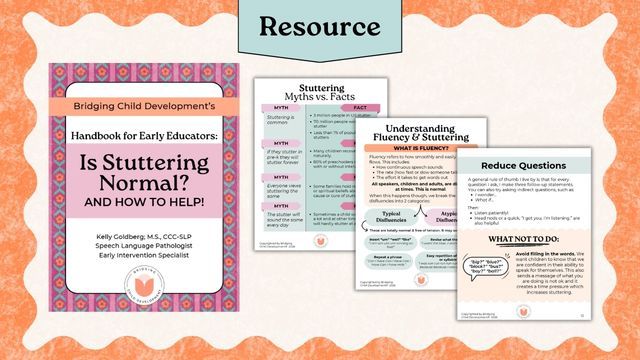
  Myths vs. facts breakdown on toddler and preschool stuttering

  Visuals for recognizing typical vs. atypical disfluencies and scripts you can use right away in the classroom 

  A resource you can share with parents that answers questions like “Is stuttering bad?”, “Is stuttering normal for a 3 year old or 4 year old?”, and “What do I do if my child stutters?”
Preview of the stuttering handbook included with the training
Training outcomes

By the end of this 2 hour | 0.2 CEU training, participants will be able to:

  • Identify what preschool stuttering is (and is not)
  • Identify the cause of preschool stuttering
  • Name a supportive communication strategy that can be used in the classroom when a child stutters

See what early childhood educators are saying

"I liked how nice and open the trainer was it wasn’t just boom boom information all at once she was very smooth and didn’t make anything boring.

The presenter was kind, she answered questions well, it was very interesting."
"I took your trainings at MSCCA Conference in Maryland and shared with my staff. We’ll be taking a lot more soon! You’re so knowledgeable and helpful!

I enjoyed flow of interactive sections and videos.”
"I thought all of the information was presented in a logical way. I liked the tips that can easily be applied in the classroom. The handout was informative and will be a great resource.


Kelly is always prepared with information that I can use."

You don’t have to fix stuttering. You just have to know how to respond.

Know Exactly What To Say
Clear examples of what TO say and what NOT to say - Like how “slow down” or “take a deep breath” can actually make stuttering worse!
Support Families Too
Guidelines for when and how to talk to families, including what to share and when to suggest additional support if their child is stuttering.
Simple Strategies That Work
Six simple fluency strategies you can start using right away in your child care setting that support smoother communication for the child.

Frequently Asked Questions:

Is this training only for preschool teachers?

No. Stuttering in early childhood is the main focus. Most stuttering begins before age 4, so it’s just as helpful for toddler teachers, directors, and family child care providers.

Is stuttering normal for a 3 year old?

It can be! Many children go through a stage of developmental stuttering between ages 2 and 5, when their language is growing faster than their speech can keep up. Repeating whole words (“I-I-I want that”) or adding “um” is very common. This training shows you what’s typical and what may need a closer look.

When should I be concerned about toddler stuttering?

Some signs to watch for: Stuttering that lasts longer than 6 months, physical tension or struggle when talking, the child seeming frustrated or avoiding talking, or a family history of stuttering. You’ll learn when to keep monitoring toddler stuttering and when to suggest families look into additional support.

Will this help me talk to families about stuttering?

Yes! You’ll get guidance on what to share and when, plus a parent-friendly resource with stuttering strategies for parents so families can support their child at home the same way you do at school.

Meet Your Trainer

Hi, I'm Kelly
A licensed Speech Language Pathologist, Early Intervention Specialist, Child Care Trainer, and Former Family Child Care Owner


I work alongside teachers every day caring for children with developmental delays, feeding challenges, speech and language disorders, and more.

I kept hearing the same thing:
"Our trainings don't teach us this." So I created trainings that do! 

No fluff. Just practical strategies designed to fit naturally into everyday routines with infants, toddlers, and preschoolers.
Speech-language pathologist working on professional development resources for early childhood educators decorative decorative decorative

Training requirements so you get your CEU's: 

Free!