Oct 11 • Kelly Goldberg
Best Books for Teaching Print Awareness
Before a child can read or write, they have a lot to learn about print. You may hear Print Awareness called "concepts of print" or "print knowledge" These are all pretty synonymous and mean the understanding that print has meaning, that it works in a specific, predictable way, and that books and written language follow rules.
In this blog, you will find:
In this blog, you will find:
- What print awareness is
- What to expect at each age
- Our favorite books for building print awareness
- Exact things you can say while you read
What Is Print Awareness?
Print awareness is a child's understanding of how print works. It's knowing that those squiggles (letters) on the page mean something. That we read the words, not the pictures. That those words start at the left and move to the right and then we jump down to the next line and keep going. That a book has a front and a back. We have an entire blog on how to teach print awareness using the P.R.I.N.T Framework.
Print awareness is one of the strongest early predictors of how well a child will learn to read. Research shows it helps children with letter recognition, print concepts, name writing, reading, spelling, and comprehension (Piasta, Justice, McGinty, & Kaderavek, 2012; Justice, Kaderavek, Fan, Sofka, & Hunt, 2009).
Print awareness is one of the strongest early predictors of how well a child will learn to read. Research shows it helps children with letter recognition, print concepts, name writing, reading, spelling, and comprehension (Piasta, Justice, McGinty, & Kaderavek, 2012; Justice, Kaderavek, Fan, Sofka, & Hunt, 2009).
Print Awareness Milestones by Age
Children's knowledge about print follows a loose developmental sequence. Some children are curious about print as early as age one, and that is wonderful. Include them in the activities. But here is what is developmentally expected.
2 to 3 years: Noticing print in the world
Children begin to respond to and interact with print that occurs naturally in their environment. You will see them point out signs, labels, logos, and the golden arches.
What it sounds like: "That says STOP!" "That's my name!" (pointing to their cubby label)
3 to 4 years: Interacting with print in books
Children begin to interact with print in storybooks and learn how to handle a book. They start using simple print words like "read," "page," and "story."
What it sounds like: "Turn the page!" "Read this story again."
4 to 5 years: Understanding words and letters
Children start to understand that words are separate building blocks of both speaking and writing. They notice that words follow patterns and are made of letters in a specific order. They often recognize when words start with the same letter.
What it sounds like: "Mommy and Monday both start with M!" "That's a long word."
Around 6 years: Connecting letters and words
It is not until about age six that children are expected to understand how letters and words relate to one another.
Remember, this sequence is loose. Children move through it at different speeds, and a wide range is normal.
What Makes a Great Print Awareness Book?
Any book can build print awareness. But some books do half the work for you because the print is hard to miss. Look for books with:
- Print that stands out. You want text that has big words, bold words, colorful words, and words that wiggle across the page.
- Speech bubbles. Look for books with speech bubbles! They show children that print is what someone is saying.
- Print inside the pictures. It's not just the words on the pages. Look for books with street signs, labels on food, lists, and notes.
- Clear punctuation. Exclamation points and question marks you can act out with your voice and explain their meaning.
- Repeated lines. Children can "read" along once they know what is coming.
The Best Books for Print Awareness
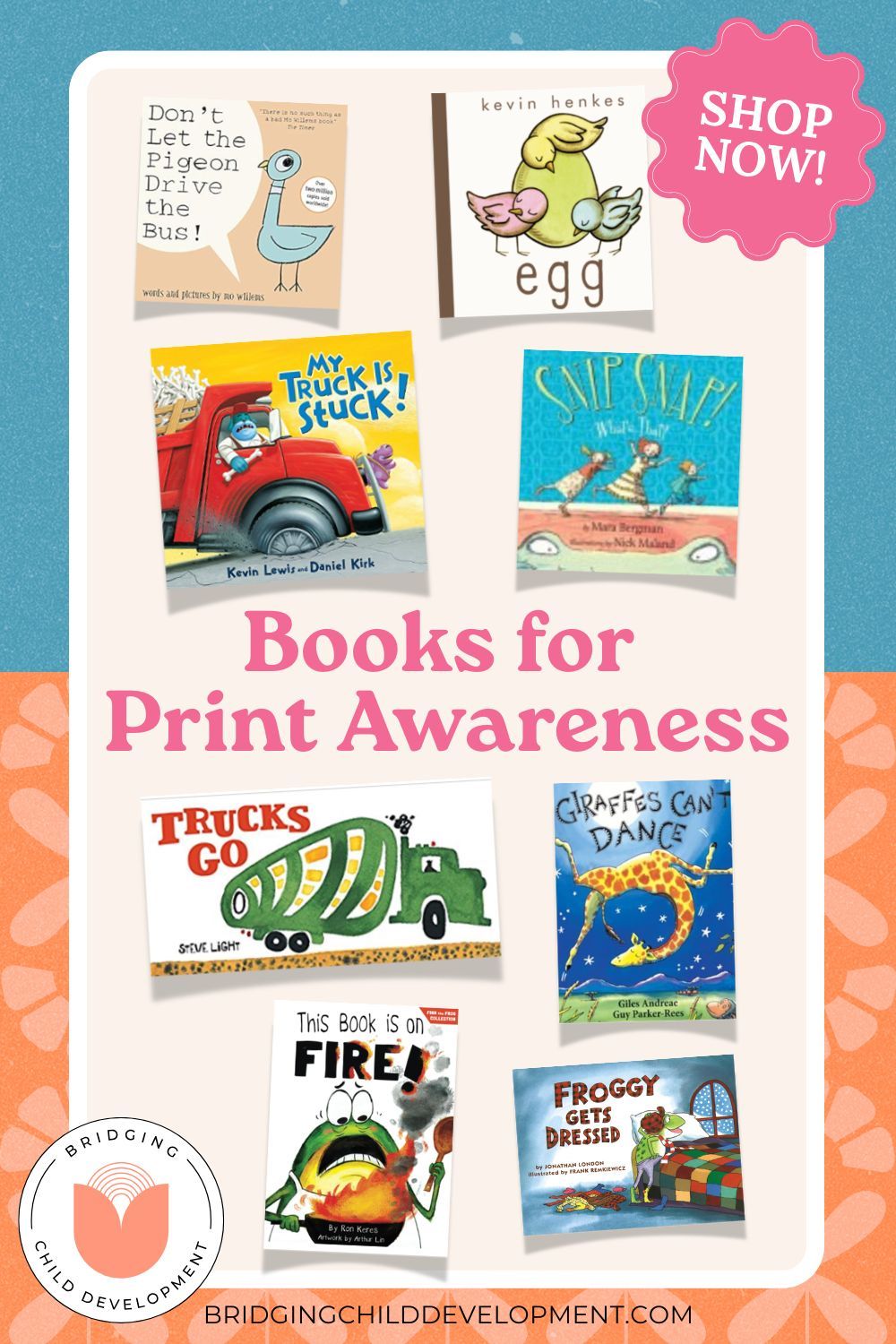
Click the image to see all our book suggestions or click here. Start building your class library. Affiliate link.
These are books where the print is part of the fun. Each one comes with a theme, why we like it, the print skills it supports, and exact words you can use.
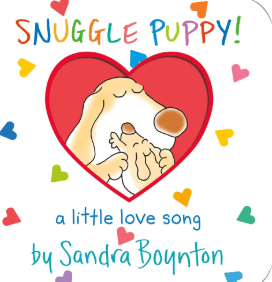
Snuggle Puppy! by Sandra Boynton
Theme: Love, family, Valentines,
Best for: Toddlers and 2's
Why we like it: It is full of print that stands out. The words change size and color so you sing the song louder and sillier so even very young children see that print can look different. Also, it's a short book which will meet the children where they are when it comes to attention span.
Print Awareness Skills:
P – Print Has Meaning: Point to the words once or twice and say, "These are the words I'm singing." Toddlers begin to see that the song comes from the print.
Best for: Toddlers and 2's
Why we like it: It is full of print that stands out. The words change size and color so you sing the song louder and sillier so even very young children see that print can look different. Also, it's a short book which will meet the children where they are when it comes to attention span.
Print Awareness Skills:
P – Print Has Meaning: Point to the words once or twice and say, "These are the words I'm singing." Toddlers begin to see that the song comes from the print.
I – Identify Letters and Words: The giant "OOO" is an easy first look at letters. "Look at these big round O's!"
N – Navigate Books: A board book is perfect for practicing the front cover, holding the book right side up, and turning pages.
Try this when reading:
Try this when reading:
- Point to the title. "This says Snuggle Puppy. That's the name of our book."
- Run your finger under the big "OOO" and stretch your voice to match. "Look how big those letters are. Big letters means use a big voice!"
- Hold the book upside down and see if the kids notice. Let the child fix it, then say, "You turned it the right way. Now we can read it."
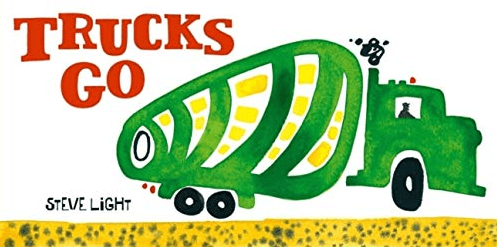
Trucks Go! by Steve Light
Theme: Trucks, vehicles, transportation
Best for: Toddlers and 2's
Why we like it: This book gives each truck its own page and its own sound. It is all about print that stands out. The sound words are big, hand-lettered, and stretch across the page, so toddlers see that those marks are the noise you are making.
Print Awareness Skills:
P – Print Has Meaning: The big words are the truck sounds. "These words tell me the sound the truck makes."
P – Print Has Meaning: The big words are the truck sounds. "These words tell me the sound the truck makes."
R – Read in a Specific Direction: The extra-wide pages make it easy to model one long sweep from left to right with your finger.
N – Navigate Books: Toddlers practice opening the book, turning pages one at a time, and reaching the end.
T – Take Print Beyond the Book: Look for words on toy trucks and on real trucks outside. "That truck has words on its side!"
Try this:
1. Let the child open the book and turn the pages. "You opened it. Turn the page to see the next truck."
2. Slide your finger under the sound word as you say it, from left to right. Stretch your voice as long as the word is.
3. Name what you just did. "These words tell me the sound the truck makes."
4. Pause before the sound and point to the word. Wait for the child to fill it in, then say, "You read it with me!"
Barnyard Banter by Denise Fleming
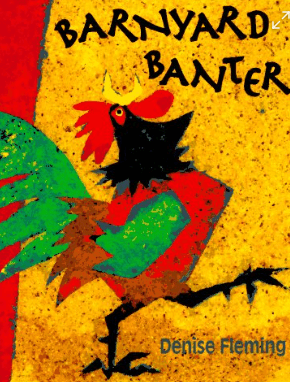
Theme: Farm animals
Best for: Toddlers and 2's
Why we like it: Short and simple, perfect for short attention spans. Children love hunting for the goose that is hiding on each page. It has print that stands out: Every animal sound is in big, bold letters that tumble across the picture. It also has repeated lines so children can join in quickly.
Print Awareness Skills:
P – Print Has Meaning: The big words are the animal sounds. "These words tell me what the cow says."
R – Read in a Specific Direction: Touch each sound word in order, left to right, as you say it.
I – Identify Words and Spaces: "Moo. Moo. Moo. Three words. They look the same because it's the same word." Point to the spaces between them.
T – Take Print Beyond the Book: Add animal name labels to your farm toys or block area so children see the same words outside the book.
Try this:
R – Read in a Specific Direction: Touch each sound word in order, left to right, as you say it.
I – Identify Words and Spaces: "Moo. Moo. Moo. Three words. They look the same because it's the same word." Point to the spaces between them.
T – Take Print Beyond the Book: Add animal name labels to your farm toys or block area so children see the same words outside the book.
Try this:
1. Track the animal sound with your finger as you read it. "Moo, moo, moo." Touch each word once.
2. Count them. "Moo. Moo. Moo. Three words. They all look the same because it's the same word."
3. Comment on the big print. "These letters are so big. That tells me the cows are loud." But look, the repeated line, "But where's Goose?" is small so I know to say that line softer.
4. On a later read, point to the sound word and wait. Let the children "read" it to you.
Go Away, Big Green Monster! by Ed Emberley
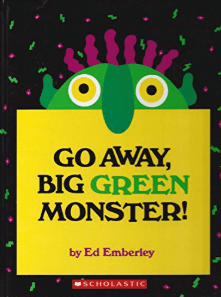
Theme: Halloween, colors
Best for: Ages 2 to 4
Why we like it: Cut-out pages build a monster one piece at a time, then send him away one piece at a time. The second half has the repeated line "Go away" in capital letters on every page, so children can say it with you while you point, teaching them letters and the difference between lower and uppercase. It also has clear punctuation, with exclamation points you can act out in your bossiest voice.
Print Awareness Skills:
P – Print Has Meaning: The words are what make the monster leave. "These words say Go away. That's what we tell him."
I – Identify Words, Spaces, and Punctuation: "Go away" looks the same every time. Children see two words with a space between them and an exclamation point at the end.
N – Navigate Books: Every page turn changes the monster, so children are eager to turn pages in order, front to back.
P – Print Has Meaning: The words are what make the monster leave. "These words say Go away. That's what we tell him."
I – Identify Words, Spaces, and Punctuation: "Go away" looks the same every time. Children see two words with a space between them and an exclamation point at the end.
N – Navigate Books: Every page turn changes the monster, so children are eager to turn pages in order, front to back.
Try this:
1. Point to the title on the cover. "This says Go Away, Big Green Monster! That's the name of our book."
2. Each time you reach "Go away," touch the two words as you say them. "Go. Away."
3. After a few pages, point and pause. Let the children shout "Go away!" while your finger is on the words.
4. Comment on the pattern. "Look, here it is again. Go away. Same words, same letters."
My Truck Is Stuck! by Kevin Lewis
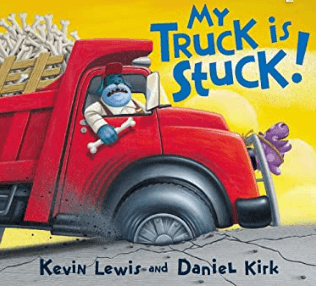
Theme: Vehicles, transportation, kindness
Best for: Ages 2 to 4
Why we like it: A truck full of bones gets stuck in a hole and one vehicle after another stops to help. It has repeated lines: The rhyme comes back on every page, so children join in fast. It has print inside the pictures, with signs, words on the sides of vehicles, and license plates. It has clear punctuation and different size text.
Print Awareness Skills:
P – Print Has Meaning: The words tell us the problem. "These words say the truck is stuck."
P – Print Has Meaning: The words tell us the problem. "These words say the truck is stuck."
I – Identify Words and Punctuation: Children spot the word stuck again and again, and they see what an exclamation point does to your voice. The truck sounds are written in different colors and sizes too.
T – Take Print Beyond the Book: The print on the vehicles and signs leads right into print outside. On your next walk, point out words on trucks and street signs.
Try this:
1. Point to the title and tap each word. "My. Truck. Is. Stuck. Four words."
2. When the driver calls for help, point to the words. "This says Help! See the mark at the end? That's an exclamation point. It means he's calling out loud in a loud voice."
3. Each time the word stuck comes up, touch it. "There's that word again. Stuck." Later, pause and let the children say it.
4. Find print in the pictures. "Look, there are words on the side of this truck. They tell us what kind of truck it is." "He's holding a sign. There are words on the sign too."
The Three Billy Goats Gruff
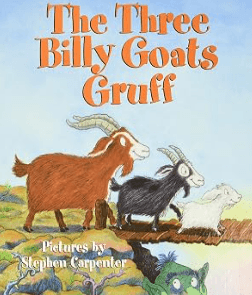
Theme: Animals, Folk Tales, Farm
Best for: Ages 3 to 5
Why we like it: The same lines repeat three times, so children know what is coming and can "read" along with you. Many versions print the troll's words bigger and the goats' "trip, trap" in three sizes.
Print Awareness Skills:
P – Print Has Meaning: The words tell us who is talking and what they say. "These words are what the troll says."
R – Read in a Specific Direction: "Trip, trap, trip, trap" is perfect for finger tracking from left to right. Ask, "Where should I start reading?"
I – Identify Words, Spaces, and Punctuation: Count the words in the title, point out the spaces between them, and name the question mark at the end of the troll's question. Also point out, "Some words are capitalized. That means I read them loudly!"
Try this when reading:
Best for: Ages 3 to 5
Why we like it: The same lines repeat three times, so children know what is coming and can "read" along with you. Many versions print the troll's words bigger and the goats' "trip, trap" in three sizes.
Print Awareness Skills:
P – Print Has Meaning: The words tell us who is talking and what they say. "These words are what the troll says."
R – Read in a Specific Direction: "Trip, trap, trip, trap" is perfect for finger tracking from left to right. Ask, "Where should I start reading?"
I – Identify Words, Spaces, and Punctuation: Count the words in the title, point out the spaces between them, and name the question mark at the end of the troll's question. Also point out, "Some words are capitalized. That means I read them loudly!"
Try this when reading:
- Before you start, point to the title and count the words. "The. Three. Billy. Goats. Gruff. Five words in our title."
- Each time you reach "trip, trap, trip, trap," touch each word as you say it. By the third goat, pause and let the children say it while you point.
- Compare print sizes (If you have a version of the book with different text sizes). "These letters are tiny for the littlest goat. These are HUGE for the big goat." If not, you can point out words that are lowercase and words that are capitalized.
- Point out the troll's question. "See this mark at the end? It's a question mark. The troll is asking who is on his bridge."
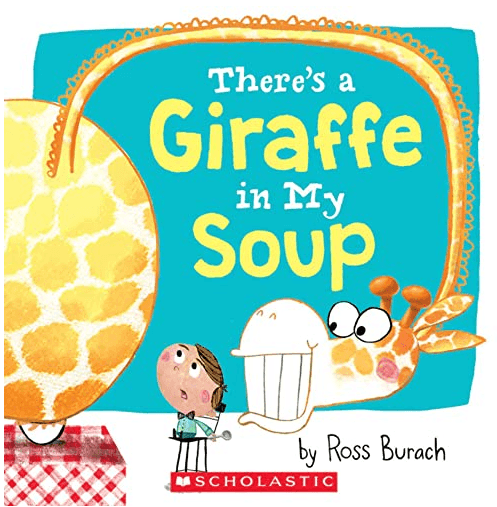
There's a Giraffe in My Soup by Ross Burach
Theme: Animals, Food
Best for: Ages 3 to 5
Why we like it: A boy orders soup and the restaurant keeps bringing him animals instead. It has print that stands out: The animal names are printed in different colors, sizes, and spots on the page, so single words are easy to pick out. It also has clear punctuation, with plenty of exclamation points for the boy's big reactions. There is also print within the pictures!
Print Awareness Skills:
P – Print Has Meaning: The colorful word matches the animal in the picture. "This word says giraffe, and there's the giraffe." The animal sounds also match in color.
I – Identify Letters and Words: A word that stands out is easy to talk about as one unit. Count its letters, name its first letter, and compare a long word to a short one.
T – Take Print Beyond the Book: The story happens in a restaurant. Add menus and an order pad to dramatic play and write down what the children "order."
Try this:
1. First read: Enjoy the story and track the words with your finger. That is all.
2. Second read: Comment on a word that stands out. "This word says giraffe. It's orange, just like the giraffe."
Count the letters together. "Let's count the letters in giraffe. One, two, three..."
3. Third read: Invite a child to find it. "Can you show me where it says giraffe?" If they are not sure, show them. "Here it is. It sticks out from the other words."
Best for: Ages 3 to 5
Why we like it: A boy orders soup and the restaurant keeps bringing him animals instead. It has print that stands out: The animal names are printed in different colors, sizes, and spots on the page, so single words are easy to pick out. It also has clear punctuation, with plenty of exclamation points for the boy's big reactions. There is also print within the pictures!
Print Awareness Skills:
P – Print Has Meaning: The colorful word matches the animal in the picture. "This word says giraffe, and there's the giraffe." The animal sounds also match in color.
I – Identify Letters and Words: A word that stands out is easy to talk about as one unit. Count its letters, name its first letter, and compare a long word to a short one.
T – Take Print Beyond the Book: The story happens in a restaurant. Add menus and an order pad to dramatic play and write down what the children "order."
Try this:
1. First read: Enjoy the story and track the words with your finger. That is all.
2. Second read: Comment on a word that stands out. "This word says giraffe. It's orange, just like the giraffe."
Count the letters together. "Let's count the letters in giraffe. One, two, three..."
3. Third read: Invite a child to find it. "Can you show me where it says giraffe?" If they are not sure, show them. "Here it is. It sticks out from the other words."
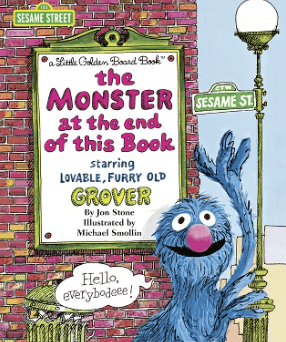
The Monster at the End of This Book by Jon Stone
Theme: Construction
Best for: Ages 3 to 5
Why we like it: Grover reads the title, learns there is a monster at the end of the book, and begs the reader not to turn the pages. Children cannot turn them fast enough. The whole story is about how a book works. It has print that stands out: Grover's words get bigger, bolder, and more colorful as he panics. It also has clear punctuation, with exclamation points you can act out every time he shouts.
Print awareness skills:
P – Print Has Meaning: Grover finds out about the monster by reading the title. The words gave him information.
P – Print Has Meaning: Grover finds out about the monster by reading the title. The words gave him information.
I – Identify Letters and Punctuation: Giant letters and exclamation points show that Grover is yelling. "Big letters, big voice."
N – Navigate Books: This is the best book we know for teaching pages, page turning, front to back, and that every book has an end.
Try this:
1. Read the title slowly and track each word. "The title tells us what's going to happen. There's a monster at the END of this book."
2. Talk about pages. "Grover doesn't want us to turn the page. Every page we turn gets us closer to the end."
3. Point out the print when Grover yells. "Look how big these letters are. Grover is shouting. YOU TURNED THE PAGE!"
4. Near the end, hold up the pages that are left. "Only a few pages to go. We're almost at the end of the book."
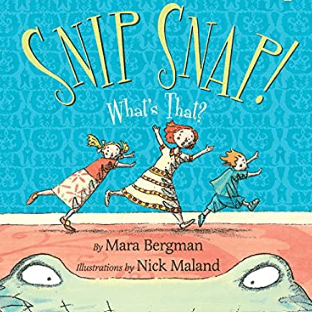
Snip Snap! What's That? by Mara Bergman
Theme: Animals, being brave
Best for: Ages 3 to 5
Why we like it: An alligator creeps up the stairs toward three children. It has repeated lines: the same question comes back again and again (were the children scared?), and children shout the answer every time. It has clear punctuation, with a question mark and an exclamation point you can act out and explain. And it has print that stands out, because the answer is printed big and bold.
Print Awareness Skills:
P – Print Has Meaning: The words ask us a question, and more words give the answer.
R – Read in a Specific Direction: Track the repeated line with your finger each time it appears. By the third time, ask, "Where do I start?"
I – Identify Punctuation: "This is a question mark, so my voice goes up. This is an exclamation point, so I say it loud."
P – Print Has Meaning: The words ask us a question, and more words give the answer.
R – Read in a Specific Direction: Track the repeated line with your finger each time it appears. By the third time, ask, "Where do I start?"
I – Identify Punctuation: "This is a question mark, so my voice goes up. This is an exclamation point, so I say it loud."
Try this:
1. Point to the title. "See this mark at the end? It's a question mark. The title is asking us a question. What's that?"
2. When the repeated question comes up, point to the question mark and let your voice go up. "Were the children scared?"
3. Point to the answer. "These letters are big, and there's an exclamation mark. That tells me to say it loud. YOU BET THEY WERE!"
4. By the third time, point to the words and pause. Let the children say the answer while you track it with your finger.
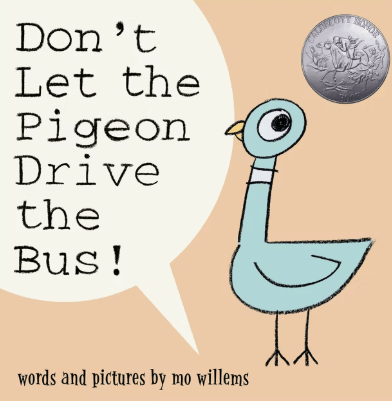
Don't Let the Pigeon Drive the Bus! by Mo Willems
Theme: Big feelings, transportation, birds
Best for: Ages 3 to 5
Why we like it: The bus driver asks the children to watch the bus, and the pigeon spends the whole book begging to drive it. Children get to answer back. This is our top pick for speech bubbles: everything the pigeon says is in one, which shows children that print is what someone is saying. It has print that stands out, because when the pigeon finally loses it, the letters take over the whole page. And it has clear punctuation, with question marks and exclamation points on almost every page.
Print awareness skills:
P – Print Has Meaning: Speech bubbles make it obvious that print is talk written down. "These are the words the pigeon is saying."
P – Print Has Meaning: Speech bubbles make it obvious that print is talk written down. "These are the words the pigeon is saying."
I – Identify Letters and Punctuation: Compare the small letters when the pigeon is being sweet to the giant letters when he is yelling. Count the exclamation points.
T – Take Print Beyond the Book: Add a speech bubble to a child's drawing. Ask, "What is your person saying?" and write their words inside.
Try this:
1. Explain the speech bubble. "See this bubble with the point? It points to the pigeon. These are the words the pigeon is saying."
2. Track a short line inside the bubble with your finger while you read it in the pigeon's voice.
3. On the tantrum page, stop and look. "Whoa. Look at these giant letters. The pigeon is yelling as loud as he can."
4. Count the exclamation marks. "One, two, three exclamation marks. That means REALLY loud."
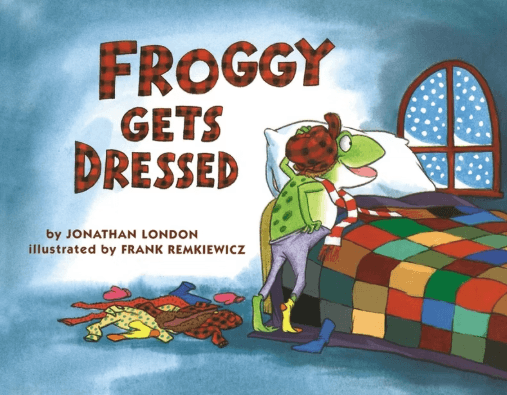
Froggy Gets Dressed by Jonathan London
Theme: Winter, clothes
Best for: Ages 3 to 5
Why we like it: Froggy wants to play in the snow, but he keeps forgetting part of his outfit. It is perfect for the weeks when your whole class is practicing coats and boots. It has print that stands out: each piece of clothing has its own silly sound word, and his mother calls his name in big, stretched-out letters. It also has repeated lines. The same call and the same answer come back each time he forgets something, so children can "read" along.
Print Awareness Skills:
P – Print Has Meaning: The sound words tell us what Froggy is putting on. "This word is the sound his coat makes."
Best for: Ages 3 to 5
Why we like it: Froggy wants to play in the snow, but he keeps forgetting part of his outfit. It is perfect for the weeks when your whole class is practicing coats and boots. It has print that stands out: each piece of clothing has its own silly sound word, and his mother calls his name in big, stretched-out letters. It also has repeated lines. The same call and the same answer come back each time he forgets something, so children can "read" along.
Print Awareness Skills:
P – Print Has Meaning: The sound words tell us what Froggy is putting on. "This word is the sound his coat makes."
I – Identify Letters and Words: Froggy's stretched-out name shows that more letters make a longer word. When I read it, I stretch these sounds out really long. It also starts with an upper case F, like every name.
T – Take Print Beyond the Book: Point out the names on cubbies and coat hooks at dressing time. "Can you find your name?"
Try this:
Try this:
- Point to each sound word as Froggy gets dressed. "This word says zip. That's the sound his coat makes."
- When his mother calls, run your finger slowly under his name and stretch your voice. "FRRROOGGYY! Look at all those extra letters. That makes the word long, so I say it long."
- Find the first letter. "Froggy starts with a big F. Names start with upper case letters."
- Connect it to the children. "Who else has an F in their name?" Then at dressing time, borrow the sound words. "Zip! goes your coat."
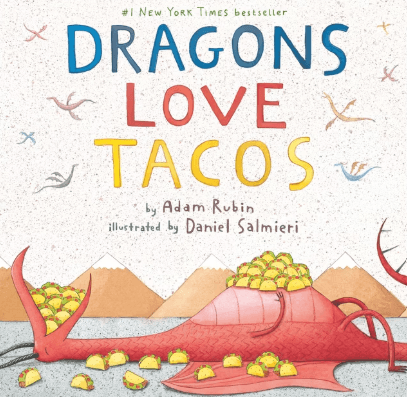
Dragons Love Tacos by Adam Rubin
Theme: Food
Best for: Ages 3 to 5
Why we like it: Dragons love tacos but cannot handle spicy salsa. This is our favorite example of print inside the pictures. It's not just the words on the pages: the whole problem in the story happens because nobody read the tiny print on the salsa jar label. Children see that print gives us important information.
Print Awareness Skills:
P – Print Has Meaning: Print communicates information. The label on the jar told us what was inside, and it mattered.
P – Print Has Meaning: Print communicates information. The label on the jar told us what was inside, and it mattered.
N – Navigate Books: The cover has two names, which makes it easy to talk about the author (who wrote the words) and the illustrator (who drew the pictures).
T – Take Print Beyond the Book: Read food labels together at snack and lunch. "This label says crackers."
Try this:
1. On the cover, point out the title and the two names. "Adam Rubin wrote the words. Daniel Salmieri drew the pictures."
2. When you reach the salsa jar, lean in. "Look at these teeny tiny words on the label. Let's read what they say."
3. Connect it to the story. "Uh oh. The words told us there were spicy peppers inside. Nobody read the label!"
4. Carry it into snack or lunch. Hold up a container and say, "Let's read the label so we know what's inside. This word says milk."
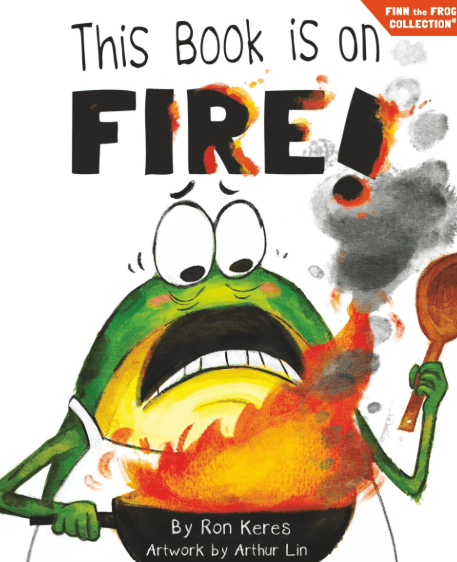
This Book Is on FIRE! by Ron Keres
Theme: Food
Best for: Ages older 3's to 5
Why we like it: Finn the Frog tries to cook for his readers and gets it wrong in funny ways. It has print that stands out: when Finn has a big feeling, the words get bigger, bolder, and more colorful. It has clear punctuation, with question marks and exclamation points you can act out and explain. And it has print inside the pictures, because Finn's kitchen is full of jars and packages with labels on them.
Print Awareness Skills:
P – Print Has Meaning: The labels in Finn's kitchen tell us what is inside each jar. Different kinds of print have different jobs.
P – Print Has Meaning: The labels in Finn's kitchen tell us what is inside each jar. Different kinds of print have different jobs.
I – Identify Letters and Punctuation: Words in all upper case letters show that Finn is yelling. Question marks show he is asking us something.
N – Navigate Books: Start with the cover. "These words tell us the title."
T – Take Print Beyond the Book: Follow a simple recipe together and point to the words. "It says we need two cups of flour."
Try this:
1. Start with the cover. "These words tell us the title. It's called This Book Is on FIRE!" Track each word with your finger. You can point out capital and lowercase letters too!
2. Point out a big word. "This word says FIRE! The letters are so big. I think Finn is yelling."
3. Name the punctuation. "This is an exclamation mark. It tells me to say the word louder. HOT!"
4. Read a label in the pictures. "This word on the jar says butter. That's how we know what's inside."
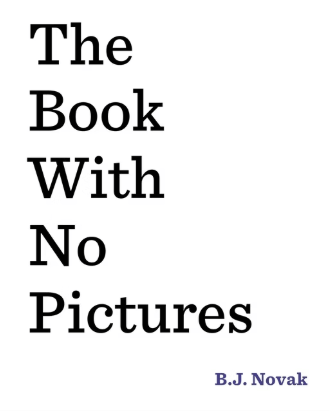
The Book With No Pictures by B.J. Novak
Theme: Animals? Honestly, this book does not totally fit a theme
Best for: Ages 4 to 5
Why we like it: There is not a single picture in this book and children beg for it anyway. The rule of the book is that the reader has to say whatever the words say, no matter how silly. It is nothing but print that stands out: Big words, little words, colorful words, and silly words in every size. Lots of punctuation too. Children see very quickly that the print is in charge.
Print Awareness Skills:
P – Print Has Meaning: This is the clearest book we know for showing that we read the words, not the pictures. "No pictures at all. The story is in the words."
Best for: Ages 4 to 5
Why we like it: There is not a single picture in this book and children beg for it anyway. The rule of the book is that the reader has to say whatever the words say, no matter how silly. It is nothing but print that stands out: Big words, little words, colorful words, and silly words in every size. Lots of punctuation too. Children see very quickly that the print is in charge.
Print Awareness Skills:
P – Print Has Meaning: This is the clearest book we know for showing that we read the words, not the pictures. "No pictures at all. The story is in the words."
R – Read in a Specific Direction: With nothing else on the page, children watch your finger. Ask, "Where should I start reading?"
I – Identify Letters and Words: Pick one silly word, point to it, and name its first letter. Talk about why some words are bigger or a different color.
Try this:
1. Flip through a few pages before reading. "Hmm. No pictures at all. So where is the story? It's in the words."
2. Blame the print. "I have to say it. That's what the words say!"
3. Match your voice to the print. "These letters are huge and red, so I'm going to read them in a big, loud voice."
4. Pick one silly word and point to it. "This word says BLORK. It starts with a B." On the next read, ask a child to find BLORK on the page.
Try this:
1. Flip through a few pages before reading. "Hmm. No pictures at all. So where is the story? It's in the words."
2. Blame the print. "I have to say it. That's what the words say!"
3. Match your voice to the print. "These letters are huge and red, so I'm going to read them in a big, loud voice."
4. Pick one silly word and point to it. "This word says BLORK. It starts with a B." On the next read, ask a child to find BLORK on the page.
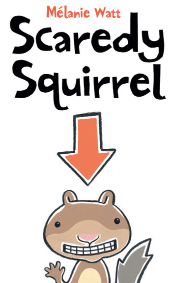
Scaredy Squirrel by Mélanie Watt
Theme: Woodland animals
Best for: Ages 4 to 5
Why we like it: Scaredy Squirrel never leaves his nut tree, and he has a plan for everything. This book is packed with print inside the pictures. It's not just the words of the story: the pages are full of lists, labels, schedules, and diagrams. Children see print doing real jobs.
Print Awareness Skills:
P – Print Has Meaning: Different types of print have different purposes. A list helps us remember, a label tells us what something is, and a schedule tells us what comes next.
Best for: Ages 4 to 5
Why we like it: Scaredy Squirrel never leaves his nut tree, and he has a plan for everything. This book is packed with print inside the pictures. It's not just the words of the story: the pages are full of lists, labels, schedules, and diagrams. Children see print doing real jobs.
Print Awareness Skills:
P – Print Has Meaning: Different types of print have different purposes. A list helps us remember, a label tells us what something is, and a schedule tells us what comes next.
R – Read in a Specific Direction: Lists are a great way to show top to bottom. Run your finger down the list as you read.
T – Take Print Beyond the Book: Compare Scaredy's schedule to your classroom schedule, then write a list together for something real, like what to bring outside.
Try this:
1. Point out a list. "This is a list. Scaredy wrote down everything he is afraid of. Lists go from the top to the bottom." Run your finger down it.
2. Read the labels. "Each thing in his emergency kit has a word next to it. The word tells us what it is."
3. Look at his daily schedule. "This tells us what Scaredy does and when. We have one of those in our classroom too!" Walk over and point to yours.
4. Make your own. Write a short list with the children, saying each word as you write it. "Things we need for outside time. Hats. H for hats."
Try this:
1. Point out a list. "This is a list. Scaredy wrote down everything he is afraid of. Lists go from the top to the bottom." Run your finger down it.
2. Read the labels. "Each thing in his emergency kit has a word next to it. The word tells us what it is."
3. Look at his daily schedule. "This tells us what Scaredy does and when. We have one of those in our classroom too!" Walk over and point to yours.
4. Make your own. Write a short list with the children, saying each word as you write it. "Things we need for outside time. Hats. H for hats."
Tips for Pointing Out Print in Any Book
You do not need these exact titles. These habits work with whatever is on your shelf.
1. Read it for fun first. On the first read, just track the words with your finger. Save the print talk for the second and third reads.
2. Keep it to two or three comments. More than that and you lose the story.
3. Follow the child's interest. If they point at a word or a letter, that is your moment.
4. Read it again. Children notice new things about print every time they hear a familiar book. Repeated readings are a good thing!
5. Take it off the page. Point out names on cubbies, labels on bins, and the word on the exit sign. Print is everywhere in your room.
Learn More About Print Awareness In A Training and Earn CEUs
Print Awareness FAQ's
At what age should I start working on print awareness?
You can start as soon as you are sharing books, even with infants and toddlers. At that age it looks like letting them hold the book, turn the pages, and hear you say, "Let's read!"
Most children begin noticing print in their environment between ages 2 and 3, and print in storybooks between ages 3 and 4. You are not teaching reading. You are helping children notice that print is there and that it means something.
Most children begin noticing print in their environment between ages 2 and 3, and print in storybooks between ages 3 and 4. You are not teaching reading. You are helping children notice that print is there and that it means something.
How often should I point out print during a read-aloud?
Three times or so per book is plenty. Read the story for fun the first time, then add a few print comments on the second and third reads. If you stop on every page, children lose the story and their interest. A quick comment like "This word says STOP" takes five seconds and keeps story time enjoyable.
What if a child isn't interested in letters or words yet?
That is okay. Children move through print awareness at different speeds, and a wide range is normal. Skip the quizzing and start with what they already care about: their name on their cubby, the logo on their favorite snack, or a book with big, silly print like Don't Let the Pigeon Drive the Bus! Keep making short comments without asking them to perform. Interest usually follows when print is connected to something they love.
References
https://pubmed.ncbi.nlm.nih.gov/22506889/
https://doi.org/10.1044/0161-1461(2008/07-0098)
https://doi.org/10.1044/0161-1461(2008/07-0098)
Prefer to learn these tips in a training?
Find a format that works for you.
Get your state-approved hours and CEUs, a comprehensive handbook you'll reference forever, and strategies that’ll make a difference in the children you’re caring for.
Live Virtual Trainings
Real-time interaction, community with other providers, and the energy of learning together.

Self-Paced Trainings
Flexibility to learn on your own schedule, pause and rewatch as needed, with opportunities to learn and engage with others.

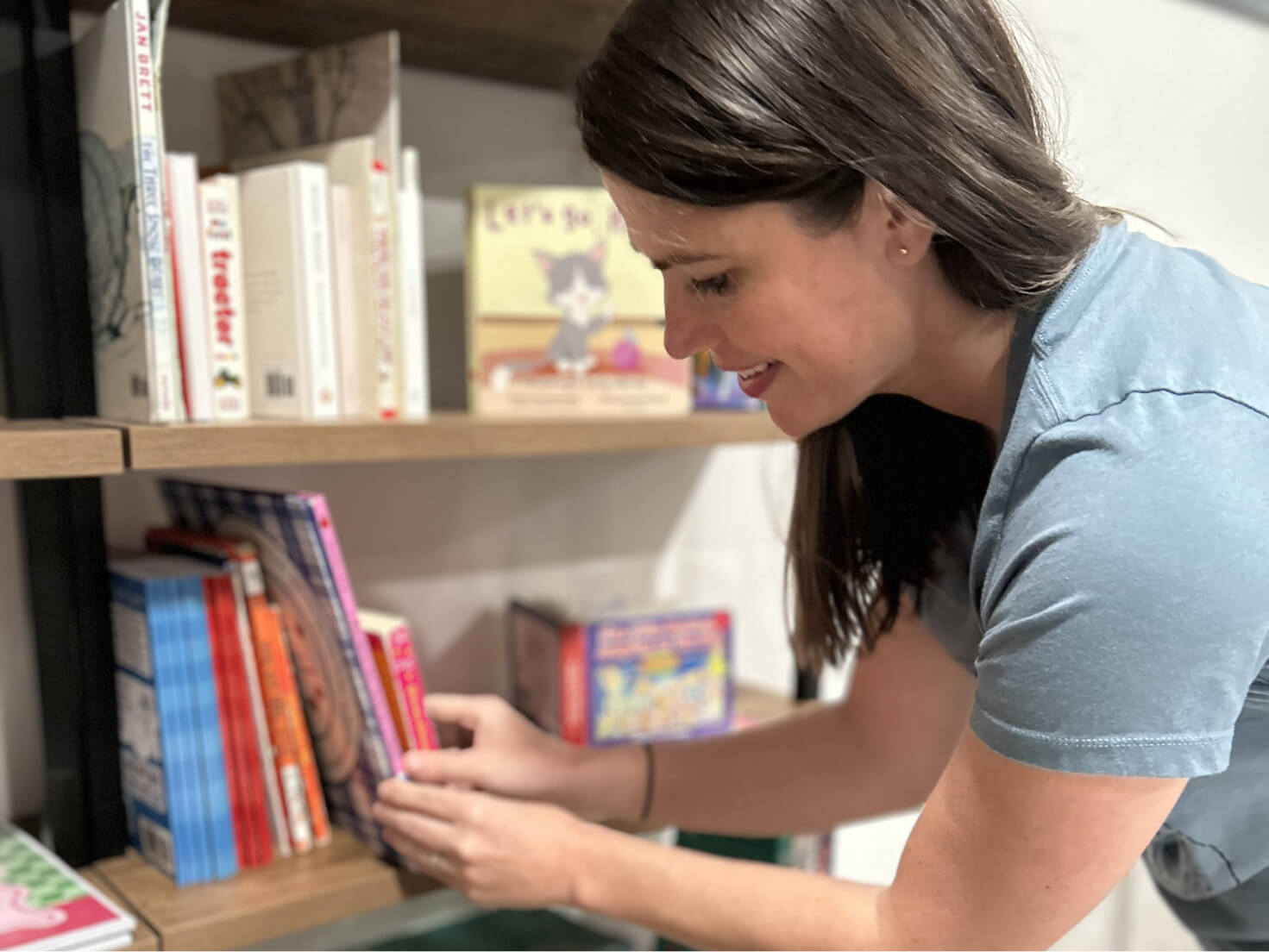

Hey, I’m kelly
Speech Language Pathologist, Early Intervention Specialist, Child Care Trainer, and Former Family Child Care Owner
I work alongside early childhood educators caring for children with a variety of needs. But these needs look very different than they did twenty years ago and you deserve trainings, resources, and tools that reflect that.
Trainings that are high quality, affordable, and worth coming back to.
That's why I built Bridging Child Development. Every training hour you earn here gives you strategies you can use the very next day in your classroom.

Subscribe to BCD's Teacher Tea Weekly Newsletter
One email, every Tuesday, with trainings updates, tips, and a monthly freebie!


Copyright © 2025 Bridging Child Development ® • All rights reserved