Want to create strong readers? Start with print awareness. Before children can read words and sentences in a book, they first need to understand how books and written language actually work.
If a child doesn't know the book gets held right side up and not sideways or that the words go from left to right, they are not going to be able to read. These may seem like obvious concepts to you because you have been reading for years but for toddlers and preschoolers, understanding how books work is brand new to them. But just being exposed to print (i.e., just reading books to your class) is not enough for children to develop print knowledge. They need to you to teach them about print by showing them and talking about it!
I really think print awareness is one of the most underrated parts of early literacy instruction. As a speech therapist and early intervention specialist, I am in child care centers every week and see so many teachers stressing letters but I rarely see teachers spending time on print awareness. Yet we know kids who develop strong print awareness skills are significantly more likely to become stronger readers.
The good news is that it is simple to teach, and you can start at your next story time. In this blog, we will cover what print awareness actually is and how to teach it intentionally using the P.R.I.N.T Framework.
Print awareness is the understanding that print has meaning, that it works in a specific and predictable way, and that books and written language follow rules. You may also hear it called "concepts of print" or "print knowledge." There is a lose developmental expectation of
when we expect these print awareness skills.Before a child can read or write, they have a lot to learn about print. Over the preschool years, children are building toward four big ideas and
by the time a child enters formal school- so K and beyond, they should know each of these concepts about print:
1. Print has meaning
- Represents spoken language
- Tells a story
- Communicates information
2. How to navigate books correctly
- Held right side up
- Read front to back
- They have beginning and end
- They have a title, author, and illustrator
3. We read in a specific direction / way
- Top to bottom
- Left to right
- From the end of one line to the beginning of the next
4. Print includes letters, spaces, words, and punctuation
- Letters have names
- Letters have sounds, and sometimes more than one sound
- Letters combined together make words
- Spaces separate a word Words make up sentences
- There are rules for how letters make up words
- Letters are upper and lower case
- Punctuation marks have meaning
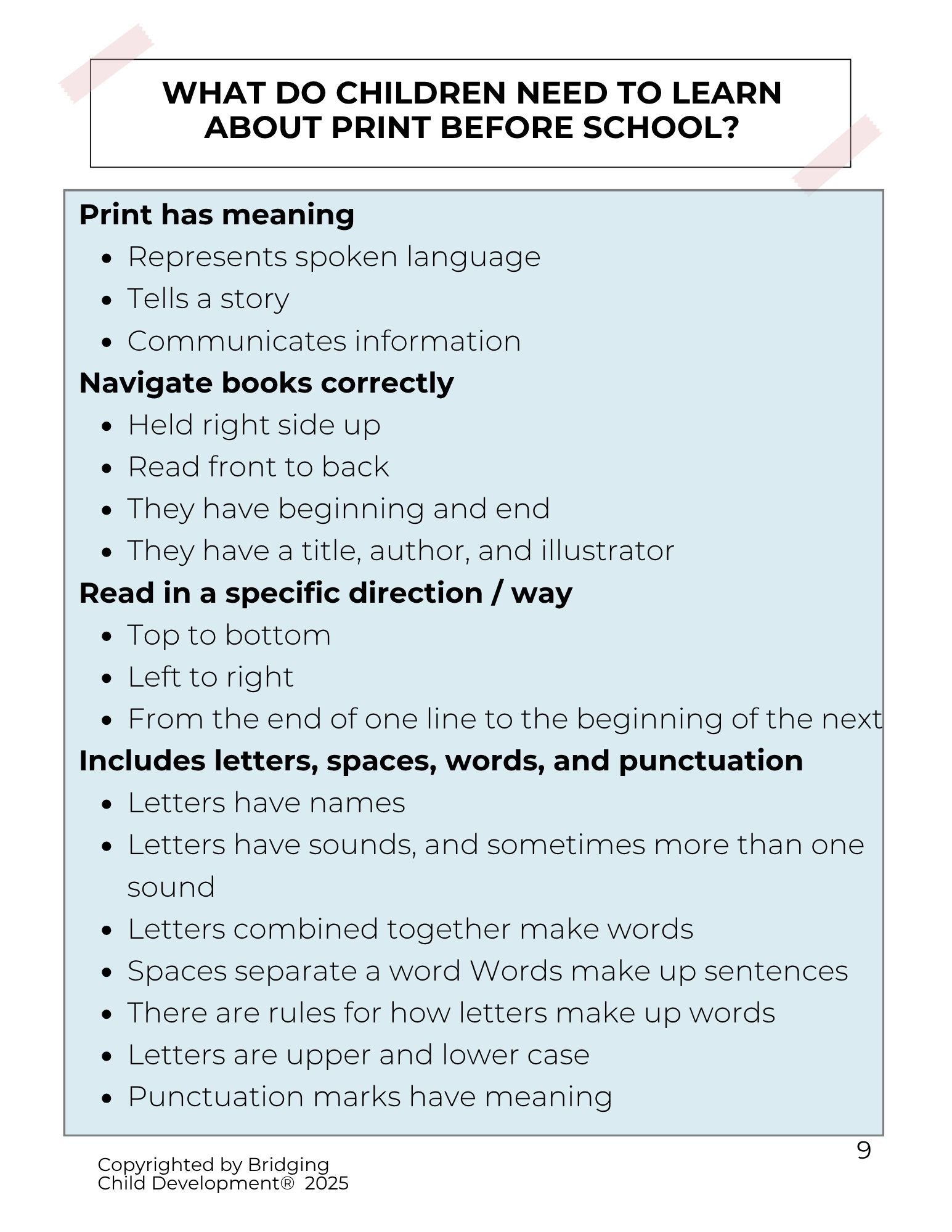
Page 9 of handbook included in CEU training
Print awareness is predictive of reading success. Kids who understand how books and print work develop stronger reading skills faster. Research also shows print referencing helps children with letter recognition, print concepts, name writing, reading, spelling, and comprehension (
Piasta, et al 2012).
But remember, just reading books to children isn't enough.
Exposure alone doesn't build print knowledge. Kids need you to point it out and talk about it.Rather than overwhelming you with dozens of print awareness skills, here's what matters most. I've organized it into five core areas using the P.R.I.N.T. acronym so it's easy to remember and you can use it in your classroom right now.
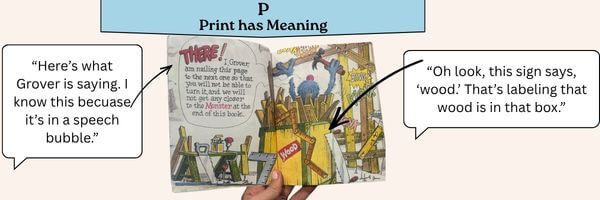
P – Print Has Meaning
R – Read in a Specific Direction
I – Identify Letters, Words, Spaces, and Punctuation
N – Navigate Books
T – Take Print Beyond the Book
The best part?
You don't need a separate lesson for each one. You'll naturally teach these concepts during story time, classroom routines, centers, and everyday routines. Want books that make this easy? See my list of the best books for building print awareness, with the P.R.I.N.T. skills and exact scripts for each one. Here are books!This is literally the foundation of all things reading.
Children first need to understand that the words, not the pictures, tell the story. Children naturally pay attention to illustrations because they're interesting and easy to understand. There's nothing wrong with that. But if we never draw attention to the words, children may assume the pictures are doing all the work.
Why this matters:
We want children to understand that:
- Print represents spoken language.
- Words tell stories.
- Print communicates information.
- We read the words, not the pictures.
- Different types of print have different purposes.
- Print is all around us
How to:
Your job is to help them discover that the printed words carry the message. As you read, occasionally point to the words and make simple comments like:
- "These are the words I'm reading."
- "The pictures help us understand the story, but the words tell us exactly what happened."
- "I wonder what these words are going to tell us next."
Notice you're not stopping every page. You're simply helping children notice something that's always been there.
Take it beyond the book:
Children should also see that print has meaning throughout the classroom.
For example:
- Labels tell us where materials belong.
- Name cards tell us who sits at each table.
- The schedule tells us what comes next.
- A recipe tells us what ingredients we need.
- A sign reminds us to wash our hands.
Once children understand that print has meaning, they begin learning how we read it.
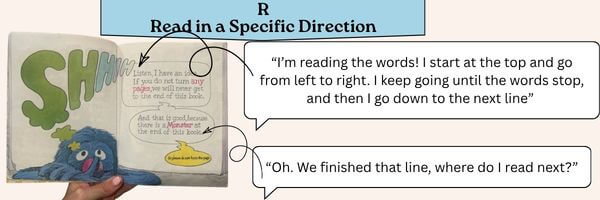
English follows predictable patterns. We read from left to right, top to bottom, and one page at a time
returning to the left when we move to the next line. These patterns seem automatic to adults but they're completely new for preschoolers.
Why This MattersImagine trying to read a page if you didn't know where to begin.
Children need repeated opportunities to watch someone model how reading moves across a page.
Over time, this becomes automatic.
How to:
- Track the words with your finger. You don't need to point to every word in every book.
Instead, use finger tracking intentionally when you're teaching print awareness.
For example, say:
"I'm starting over here because that's where we begin reading."
At the end of the line, you might add:
"Now I go back to this side to read the next line."
- Ask Questions Instead of Giving Answers. Rather than always telling children where to begin, let them help.
Try asking:
"Where should I start reading?"
"Which way do my eyes move?"
"Oops! I finished this line. Where do I go now?"
- Pick one or two moments per book. Don't interrupt a great story every few sentences to teach directionality.
Choose one or two moments during the book.
Your read-aloud should still feel enjoyable and engaging.
Print isn't just one long string of letters.
Children gradually learn that print is made up of different parts and each part has a purpose. We want them to notice letters, words, spaces, punctuation, and sentences.
Why This MattersUnderstanding these building blocks helps children make sense of written language. Children learn that letters have names, letters make sounds, uppercase and lowercase letters represent the same letter, and letters join together to make words. Children need to understand that words are separate units of meaning and they are separated by small spaces. Last, they should know that the small symbols around the text are punctuation and they also carry meaning.
How to:- Letters- Help children notice letters naturally throughout your day.
For example:
"Look! Your name starts with the letter M."
"Both of these words start with B."
"That's a lowercase a. Can you find another one?"
- Words- Help children see groups of letters called words. You might say:
"This word says dog."
"These two words are different."
"That word is much longer than this one."
- Spaces- Children often don't notice spaces until someone points them out.
Try saying:
"See the little space? That's how I know one word ended and another word begins."
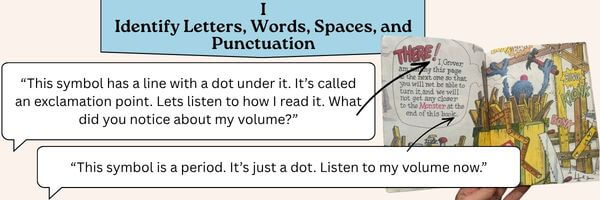
- Punctuation- Even preschoolers can begin noticing punctuation.
For example:
"There's an exclamation point! I think I should read this with excitement."
Or,
"This sentence ends with a question mark. I wonder if my voice should sound like I'm asking something."
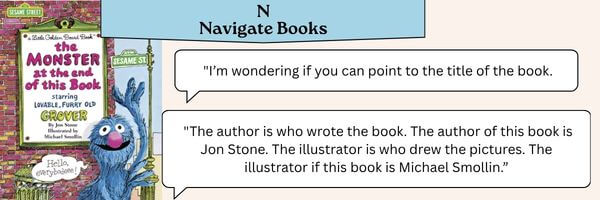
Children need to learn that books have a front cover, a back cover, pages that turn, a beginning, an ending, a title, an author, and an illustrator. They also need to know how to orient the book in order real by holding it right side up.
Why This Matters
Knowing how books work helps children become more confident readers because books begin to feel familiar.
How To:
- Start with the cover. Instead of immediately opening the book, invite children to look at the cover of the book. Ask: "Which side is the front?" "Can someone find the title?"
- Name the author and illustrator. "The author is who wrote the book. The author of this book is..." "The illustrator is who drew the pictures. The illustrator if this book is..."
- Make a mistake on purpose. Hold the book up side down and say, "Hmm...something doesn't look right." See if the children are able to orient the book for you.
Children shouldn't only notice print during story time. They should see that print helps us all day long.
Why This Matters
We want children noticing print all around them, this is called environmental print and often some of the first print children will read (Think about all the kids that can "read" McDonalds, Target, and Amazon logos.
How to:
Create Meaningful Print:
- Classroom schedules
- Attendance and sign-in sheets
- Helper charts
- Children's names and cubby labels
- Birthday charts
- Classroom rules
- Dramatic play menus, grocery lists, and recipes
- Maps and signs
- Labels on the bins children use every day
Follow Children's Interests:
Children are much more likely to notice print that's connected to what they're already excited about.
If your class is pretending to run a veterinary clinic this week, add:- appointment books
- pet forms
- waiting room signs
- prescription pads
- animal charts
Next month, when they're fascinated with construction vehicles, switch the print, add:
- blueprints
- road signs
- work orders
- maps
- safety signs
Use the moments you already have:
Think about all the opportunities during a typical preschool day.
- At arrival: "Can you find your name?"
- During snack: "This label says crackers."
- Outside: "That sign says Stop."
- In dramatic play: "Let's write today's specials on our restaurant menu."
- During cleanup: "Where do the puzzles go? Let's read the label."
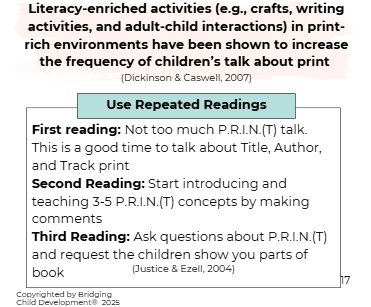
from handbook included with training
Now that you know the five core concepts of the P.R.I.N.T. Framework, here is how to teach them. Use these three strategies during read-alouds and throughout your day.
- Draw physical attention to print by touching it with your finger.
- Track your finger under the words as you read, going left to right to the end of the line, then moving to the next line
- Point out print on illustrations like signs and labels
- Point to words in speech bubbles
- Point to letters, spaces, and punctuation marks as you comment about them
Narrate what you're doing with the print or what you see in the print. Make observations that help children understand how it works.
- "These are the words that tell the story."
- "Oh look, here's what Piggie said. It's in a speech bubble."
- "I'm reading the words. I start at the top and go from left to right."
- "This is an uppercase M."
- "This space tells me one word ended and another word is starting."
Ask children questions that prompt them to notice and think about print.
- "What do you think these 'zzzzzz's mean next to the sleeping cat?"
- "Where do we start reading?"
- "Oh, we finished that line. Where do I read next?"
- "Can you find a word that starts with M?"
- "How many letters are in that word?"
- "I need a helper. Point to the words while I read."
Use repeated readings. There are so many benefits to repeated readings like building vocabulary and comprehension skills, but they are also important for teaching print awareness. Here's how:
1. First Read- Just read and enjoy the story. Save most of your print talk for the second and third reads.
2. Second Read- Lean on comments and talk about the different print features. Point things out like how the text is changing size or how you notice punctuation and so you read it with a loud or soft voice.
3. Third Read- Start asking some questions or "play dumb" and have the children help you with holding the book correctly or telling you where to start reading on each page.
You do not need to teach all five letters of P.R.I.N.T. in every book. You can pick one or a few and start there. Once you feel like you naturally include those in your read-a-louds, add another element.
If you're excited to bring this into your classroom but want the whole system, the ready-to-print visuals, the book lists, and the step-by-step coaching to make it second nature, that's exactly what I built the Sounds and Symbols Training. We cover P.R.I.N.T in addition to 2 other early literacy skills, alphabet knowledge and phonological awareness.
Fewer than you'd think. Aim for a small handful of meaningful print awareness questions rather than a question on every page. Story time should feel like a conversation about the book, not a quiz. Over-questioning can unintentionally put pressure on children and make them shut down.
Print awareness is about what children see. It is understanding how books, letters, words, and punctuation work on the page. Phonological awareness is about what children hear. It is noticing the sounds in spoken language, like rhymes, syllables, and the first sound in a word. Children need both to become readers, and you can build both during the same story time.
Watch for small signs during the day. A child turns a book right side up before opening it. They point to a sign and ask, "What does that say?" They find their name on their cubby. They "read" a favorite book to a friend and turn the pages in order. They notice that their name and a friend's name start with the same letter. Each of these tells you the child is figuring out how print works.Give their hands and bodies a job. Story-grammar visuals on popsicle sticks, simple gestures for each CSPAS element, or a "turn and tell your neighbor" moment all turn wiggly listeners into active participants. Short, conversational questions keep the energy up far better than long ones.