How Can Early Intervention Help Child Care Providers?
Jul 3
/
Kelly Goldberg
Whether you've been in the classroom for two months or twenty years, early intervention can feel like one of those "I should probably know more about this" topics.
Maybe you've noticed something about a child's development and thought, "Hmm… should I say something?"Or maybe a child who's already receiving services just started in your class and you're thinking, "Okay, so what does this mean? What happens now?"
As a pediatric speech-language pathologist and early intervention specialist, I'm inside child care centers, home cares, and preschools every single week so I hear these questions all the time.
This guide answers the most common questions child care providers have about early intervention and shows you exactly what your role looks like.
Understanding Early Intervention for Child Care Providers
1. What exactly is early intervention?
In general, many people refer to the umbrella term Early Intervention to describe providing services and supports to children ages birth to 5 years old that have a delay or disability (or in some cases are at risk for one.) Services might include speech therapy, physical therapy, occupational therapy, developmental support, and more.
Many child care providers and early childhood educators don't know that early intervention isn't just for the child. It's designed to support the adults in the child's life — parents, family members, and caregivers (Hello! That's you!) so that learning happens during everyday routines, not just during therapy time.
2. What ages are eligible for early intervention?
Birth - 5 but they are broken down into 2 different systems.
The system of services and supports for infants and toddlers, from birth to 36 months is called Early Intervention. You'll sometimes hear it called "Infants and Toddler Services" or "Part C" (that's the section of federal law that created it), but just know all these words, Early Intervention, Infants and Toddlers Program, and Part C all mean the same thing, services for children under 36 months. Early intervention is available in every state and territory in the US for free or at a low cost to families.
The system of services and supports for 3-5 year olds is called Preschool Special Education Services or you may hear it referred to as Child Find, or Part B (that's the section of federal law that created it). Child Find services are also available in every state and territory in the US and provided by the local school district for free.
How Child Care Providers Can Spot Developmental Delays
3. How do I know if I should be concerned about development?
It's time to be concerned when a child is not meeting their developmental milestones in speech and language, motor skills, social emotional development, feeding, cognition, or if they have sensory sensitivities. You should also be concerned if you notice a loss of skills a child previously had.
This is also a great tool to share with families at each age checkpoint so they can also track their child's development.
4. How much delay is "enough" to warrant a referral?
If a child is consistently behind in one or more developmental areas (or you think they are behind), it may be a sign of a developmental delay and is worth discussing with the family. Your role is to notice and share or I always say, "refer and see." Don't wait and see.
This whole wait and see advice is completely outdated, especially when we have study after study consistently showing the best outcomes are when children receive intervention earlier.
5. Should I write down what I notice?
Yes, before you even bring it up with the family, spend a week or two collecting dated, specific observations.
Try this:
Keep a notebook to jot down observation. For example, "7/3 Snack- Pointed and grunted for more crackers; no words used."
Note what you see across different routines, so what words (if any) is the child using during play, meals, transitions, outside time.
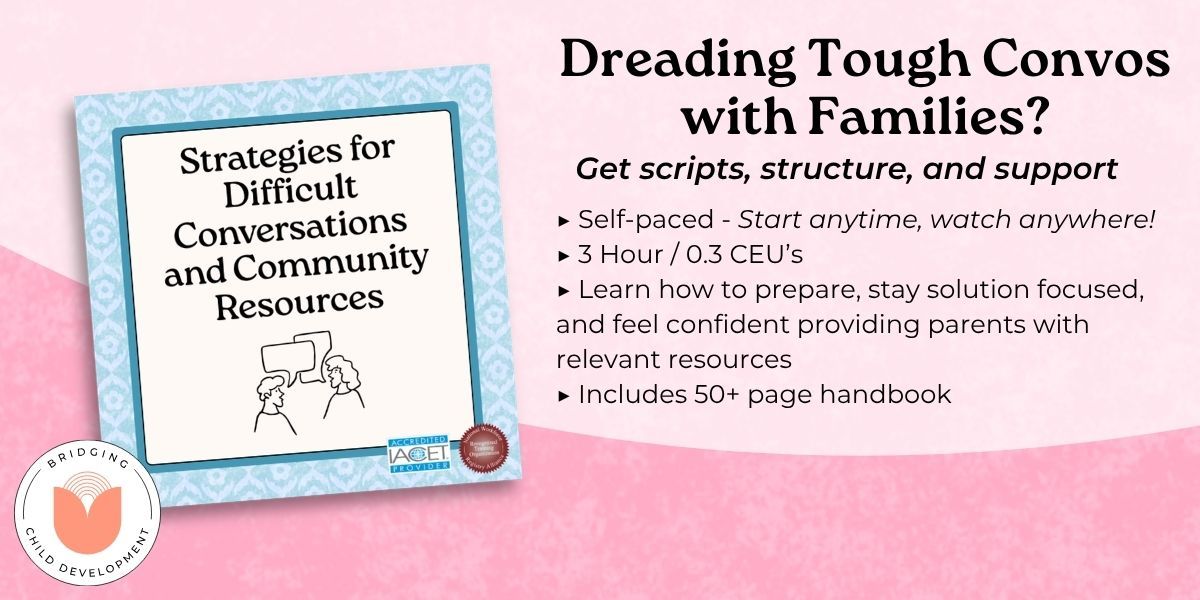
Loop in your director before the family conversation, so you're following your center's policy and have backup if the family has questions you can't answer.
When you have dates with times or various routines documented, it's harder for the parent to refute your concerns.
How to Talk to Parents About Developmental Concerns
6. How do I bring up concerns without making the parents mad?
Similar to above, describe what you see with specific examples and ground that in what is developmentally expected.
Instead of: "I think your child has a delay." Try: "I've noticed Kelly is using gestures and does not use any words yet. At 2, we expect children to have between 50-250 words. Have you heard any words at home?"
A lot of times parents have no clue what to even expect when it comes to development and are looking to you to be the expert on their child. This gives them that information in a factual non-judgmental way.
How Child Care Providers Can Make an Early Intervention Referral
7. Does the family need a doctor's referral?
Nope! This is a common misconception. Families can contact their local early intervention program directly and request a free evaluation, no doctor's note required. For most states this is an online referral process but some states still require a phone call. Here is the link for Early Intervention by state to make a referral.
8. I'm the child care provider, can I make an Early Intervention referral?
Yes! This is also something many parents and child care providers do not know. As long as the child is under 36 months, anyone can make a referral — a parent, grandparent, doctor, neighbor, and you, a child care provider!
But that does not mean this is Oprah's big gift giveaway and you are just throwing out referrals all over the place. Talk with the family first. It might sound like, "Thanks for hearing my concerns. I would love to get your family set up with an early intervention referral. I can share the online referral link with you or I'm happy to go online and fill it out for you."
Important note: You can make a referral if the child is under 36 months. Once the child turns 3, only a parent or legal guardian can make the referral.
9. What if the family says, "We don't see this at home."
If I had a dollar for every time I heard this, I would be rich! It is very common for parents to respond in this way and honestly, they may be right, they may see a totally different version of their child at home.
When a parent says they do not see what you see, you can respond:"Yes, that is very common. Home and child care are two totally different environments with two totally different expectations. That's why I am so happy we're able to talk and get him the support he needs to be successful in both environments."
Also, I often find that I will point something out to a parent and ask if they have noticed it as well, which they will say, "No." but then about 3 weeks later they say, now that you mentioned it, I notice it all the time. So sometimes just bringing awareness to something is all it takes.
What Happens After an Early Intervention Referral?
10. The family (or you) made the Early Intervention referral, now what?
Ok this might be slightly different based on where you live but here is a general roadmap for a child under 36 months.
Intake. A service coordinator contacts the family, explains the program, and gathers information about the child. They set up an evaluation.
Evaluation. A team of at least two professionals evaluates the child's development at their home or in some cases, the evaluation could also take place at child care.
Eligibility decision. The evaluation team determines if the child qualifies for services.
The IFSP. If the child is eligible, the family and team write an Individualized Family Service Plan.
Here is a general roadmap for a child 36 months and older:
Notice and Consent. The parent made a referral and now an IEP team meets with the parents to determine if an evaluation is actually needed.
Evaluation. The family brings the child to a public school building where the child is assessed in the areas of concern.
Eligibility decision. The IEP team determines if the child qualifies for services and if so, under what disability code.
The IEP. If the child is eligible, the family and team write an Individualized Education Plan.
11. What's an IFSP and an IEP?
An IFSP (Individualized Family Service Plan) and an IEP (Individualized Education Program) are both legally binding documents under the Individuals with Disabilities Education Act (IDEA).
Both plans outline specialized services for children with developmental delays or disabilities. The biggest differences between an IFSP and IEP are:
An IFSP is for children under 36 months and centered on the family's priorities and goals and services are provided in the child's natural environment via a coaching model.
An IEP is for children ages 3 - 21 years old and focuses on academic supports and provided in the child's least restrictive environment via a direct service model.
Will A Child Receive Early Intervention At Their Child Care?
Depending on the plan and what each plan says as far as where early intervention services will be provided, yes, they may receive services in your child care.
12. Do I need to do anything special for a provider when they come?
No! But there are some differences depending on the plan.
Children on an IFSP receive services in their "natural environments" which is the classroom. The therapist isn't there to run a private session in the corner or in a different location in your home or center. They're there to work within your real routines — play, meals, diaper changes, circle time, or any other part of your day.
Children on an IEP receive services in their "least restrictive environment" which might be in the classroom but it also might be that they get pulled to a quiet area of your home or center to work with their provider. I have worked with kids in the centers office, book closets, the kitchen, and empty classrooms. You don't have to make the space special, they just need a space.
13. What's my role during the early intervention visit (Child is under 36 months)?
Depending on the services written in the plan, a therapist may see a child every other week or each week for an hour (maybe more or maybe less) meanwhile, you see them 30- 40 hours a week (or more!). Which means, you can and should be a part of the sessions!
In Early Intervention (0 - 36 months) services are provided in a coaching model. That means the goal for the providers is to coach you to use the strategies they know so you can use them between visits with the child.
To get the most out of your early intervention visit:
Before the visit: Jot down one thing going well and one thing that's still hard. ("She's pointing now! But mealtimes are still tough.")
During the visit: You and the provider talk through some things you have tried and come up with a new strategy you want to implement with the child. Have them show you if you learn best by watching and then you give it a try yourself with the child while the therapist watches and gives some feedback. You are very much partners and equals during the session, but you are the one working with the child while they coach.
After the visit: You will come up with a joint plan of what strategy you will use between sessions as well as when you plan to use it so it fits your routine.
14. What's my role during preschool special education services (Child is 36 months and older)?
Depending on the services written in the plan, a therapist may see a child 1 time a week or multiple times a week and you may have a few different providers coming each week.
For children 3 - 5 years services are a direct service model. That means the goal is the providers work directly with the child. It is not so straight forward to describe your role in a session because it really depends on how the services and service location are written into the IEP.
Below are some general questions and ideas for making early preschool special education services work for you:
If possible, can you get coverage and observe a session?
Can the provider stay for 10 mins after the session and review what strategies they are using?
Is it possible to have a "homework" folder where you can work with the child between sessions using activities in the homework folder?
Can the provider come during small groups and be a rotation children go to?
Can you co-plan circle time and run this together?
Speaking from experience as an early intervention provider who visits child care classrooms every week: the teachers who ask questions and try strategies alongside me are the ones whose kiddos make the fastest progress. You matter more than you know.
Early Intervention Training for Child Care Providers
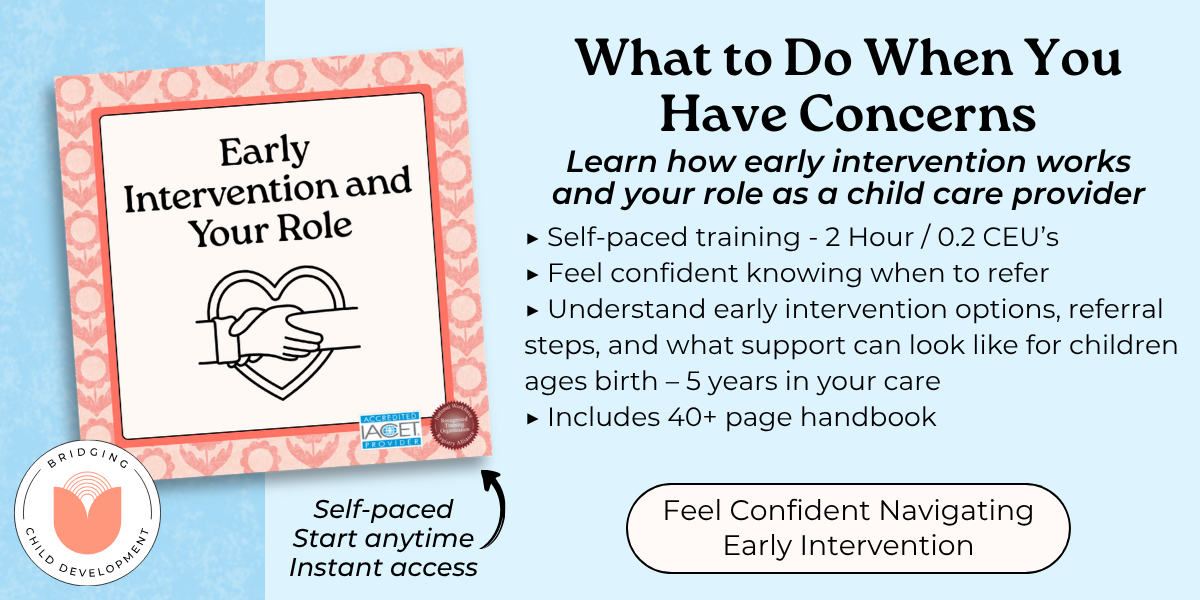
Our IACET-approved trainings count toward your state's required training hours — and you'll leave knowing exactly what to say to a hesitant family and exactly what to do when the therapist walks through your door.
Frequently Asked Questions
Is early intervention free for families?
IFSP- Evaluations are always free. Service coordination and services are free in many states or provided on a sliding-scale fees based on income in some states. IEP- Evaluations and services are always free.
Can a daycare provider refer a child to early intervention?
Yes, a child care provider can make an early intervention referral when the child is under 36 months. Best practice is to talk with the family first and refer with their knowledge. Families can also self-refer, no doctor's referral is needed. If you refer, parents still have to consent to the initial evaluation.
Only the parent or guardian can make a referral if the child is 36 months and older.
What is the difference between an IFSP and an IEP?
An IFSP (Individualized Family Service Plan) covers birth through age 2 (it ends on the child's 3rd birthday) and includes goals for both the child and family. Services are provided in a coaching model. An IEP (Individualized Education Program) begins at age 3 and focuses on the child's educational needs in preschool and beyond. Services are provided in a direct service model.
Can children receive speech therapy at daycare?
Yes. Depending on the child's IFSP or IEP, speech therapy may occur in the child care classroom or another approved location.
Prefer to learn these tips in a training?
Find a format that works for you.
Get your state-approved hours and CEUs, a comprehensive handbook you'll reference forever, and strategies that’ll make a difference in the children you’re caring for.
Live Virtual Trainings
Real-time interaction, community with other providers, and the energy of learning together.
Self-Paced Trainings
Flexibility to learn on your own schedule, pause and rewatch as needed, with opportunities to learn and engage with others.
Private Trainings
A customized training for your entire staff, in-person or virtual, with hands-on activities built around your center's needs.
Hey, I’m kelly
Speech Language Pathologist, Early Intervention Specialist, Child Care Trainer, and Former Family Child Care Owner
I work alongside early childhood educators caring for children with a variety of needs. But these needs look very different than they did twenty years ago and you deserve trainings, resources, and tools that reflect that.
Trainings that are high quality, affordable, and worth coming back to.
That's why I built Bridging Child Development. Every training hour you earn here gives you strategies you can use the very next day in your classroom.
Login or sign up to start learningLogin to start learning