How to Read to Babies and Toddlers Who Won't Sit Still
Nov 19
/
Kelly Goldberg
One of the most common questions I hear is: 'How do I read to toddlers who won't sit still?' If reading time in your infant and toddler classroom feels chaotic, there’s a good chance you’re actually doing it right.
As a pediatric speech-language pathologist and early intervention specialist, I support early childhood education teachers in child care centers and homes every single week.
So about that question,“How do I get them to sit still during books?” And my answer is always the same: Sitting still isn’t the goal of reading for babies and toddlers, instead we want interaction and movement.
When story time doesn’t look calm or controlled, it’s easy to feel like you’re doing early literacy development wrong. But if your babies and toddlers are making noises, crawling or walking away, or trying to touch, pat, mouth, or turn all the pages, they are doing exactly what we expect developmentally!
In this blog, you’ll learn simple, realistic strategies to support language and literacy development during reading without needing babies and toddlers to sit still.
Can Babies and Toddlers Learn Without Sitting Still?
Yes!
When we picture “story time,” we often imagine everyone sitting still, “quiet hands”, staying on the carpet, and eyes on the book. But for infants and toddlers, that’s just not how learning works. In fact, expecting babies and toddlers to sit quietly through an entire book is not developmentally appropriate. Especially in a child care setting, where you may have 10 toddlers at once, reading rarely looks calm or predictable!
At this age, books are less about listening to every word and more about interactions. Learning happens when children touch pages, flip ahead, point to the same picture 10 times, vocalize, or wander back and forth while you talk about what they notice.
That's because during the infant and toddler years, children are learning through:
Movement
Touch and play
Short bursts of attention while following the child's lead
Back and forth interactions and language modeling
Expecting toddlers to sit for every word on the page of a book is like expecting them to write before they can hold a crayon. Sitting for an entire story is not even an early literacy skill.
What Happens If We Don't Meet Their Developmental Needs?
The broccoli effect! Just like broccoli, books are “good for you.” But when they’re forced or paired with stress, some children start to avoid them altogether.
Research shows that a surprising number of young children, especially those with language delays, don’t naturally enjoy being read to at first. If reading time becomes about sitting still, answering questions, or “finishing the book,” children may learn that books are work instead of joy.
Obviously as early childhood educators, that’s not what we want. Read more here!
The goal in the early years isn’t compliance, it’s positive experiences. When children associate books with warmth, movement, play, and connection, they’re far more likely to engage with them long-term.
3 Simple Strategies for How to Read to Toddlers Who Won’t Sit Still
When we talk about how to read to toddlers, we’re really talking about interactive reading. Interactive reading is a conversation about the book, where both you and the child are active participants.
Basically, children learn more when reading looks like a back-and-forth exchange instead of a performance.
Strategy #1: Follow Their Lead
In reading to babies and toddlers, always start with what captures their attention, this is called following their lead.
Why this works: Think about if you were reading a blog about physics (and you have no interest in physics) would you enjoy reading about it? No! It's the same thing with babies.
If a child is focused on the ball in the picture but you’re talking about the dog on the opposite page, that word isn’t likely to stick.
How to follow their lead:
Open the book and wait. Watch what captures their interest.
Ask yourself, What are they looking at? What are they pointing to? What are they trying to say or do?
Talk about that and let them linger on favorite pages.
It's ok if they flip back and forth if they want. When they’re ready to move on, turn the page and keep going.
Babies and toddlers learn the words they’re interested in first.
Strategy #2: Say Less, Pause More
Pausing or giving wait time is one of the most powerful tools in shared reading but it is likely one you will need to practice (even though it sounds easy!)
Why this works:Pausing teaches turn-taking and gives children processing time to respond. They learn, ok, my teacher said something but now it's quiet and she's looking at me, I better make a sound too! That is literally the foundation of communication, you say something and someone else responds! But it takes babies some time to organize their brain and body to respond, wait time gives them that!
How to give wait time:
When looking at a picture, say a word, sound, (or sign) Want to learn more about sign, start here.
Then pause. Count to 10 in your head before you make another sound or say another word.
While you are paused, look at them expectantly so they know it is their turn to fill in that silence.
Strategy #3: Add Movement
If you feel like your babies and toddlers are moving around or crawling and walking away, build the movement it into reading time.
Why it works: They’re moving anyway, let’s give that movement meaning. At this age, a book can and should be both a book and a play experience.
How to add movement: If the book invites movement, lean into it. This might look like having the children:
stomp like elephants
jump like frogs
spin like a wheel
crawl like animals
If the book does not invite movement, find ways to incorporate it!
Lift the flaps.
Add toys that match the book. (Reading hungry caterpillar, add some toy food from your kitchen area and let the kids feed the caterpillar)
Babies and toddlers attention goes where their hands go, so keep those hands busy during book reading activities!
What About Reading to a Whole Group of Toddlers?
You likely don't have one toddler in your class, that's ok, these strategies still apply! Here are a few extra suggestions to make your story time even better!
Make story time come-and-go. Announce the book, start reading with whoever shows up, and let children drift in and out. A toddler stacking blocks across the room is still hearing your language. That counts as a literacy activity!
Read the same book to 2–3 children at a time instead of the whole group. Three two-minute readings beat one chaotic ten-minute one every time.
Put duplicate books in their hands. If you have two copies of Brown Bear, let a toddler hold one while you read the other. Turning "their" pages keeps hands busy and teaches book handling.
Keep a "story time basket" with props that match your favorite books, so any teacher can grab it and go.
What to say when a child wanders off mid-book
Nothing! Keep reading with enthusiasm for the children who stayed. Wandering off is not a behavior problem, developmentally attention spans are short at this age, seriously it's ok!
It might look like this:
"I'm reading the truck book over here!" (Four toddlers come. Two leave halfway through.) They like looking at the page with the digger and stay on that page for 2 minutes. You made lots of truck sounds and they imitated. Then you gave each toddler a car and they drove their cars on the page. It lasted all of 5 minutes.
What Are the Best Books for Toddler Story Time?
Before you change how you read, take a quick look at what you're reading. Some books set you up for success and some set you up for a wrestling match. The best books for babies and toddlersare simple.
Look for books that are:
Short — 5 to 10 sturdy pages you can finish (or not!) in 2–5 minutes
Simple — one or two clear pictures per page, few words
Interactive — flaps, textures, mirrors, holes to poke fingers through
Repetitive — predictable phrases toddlers can start to fill in
About their world — babies, animals, food, trucks, dogs
Skip the long storybooks with paragraphs of text — save those for the preschool room. And if you're stuck with a wordy book? Forget the words! Point to a picture, say "Dog! Woof woof!" and call it reading. Because it is.
Infant and Toddler Literacy Training For Early Childhood Educators
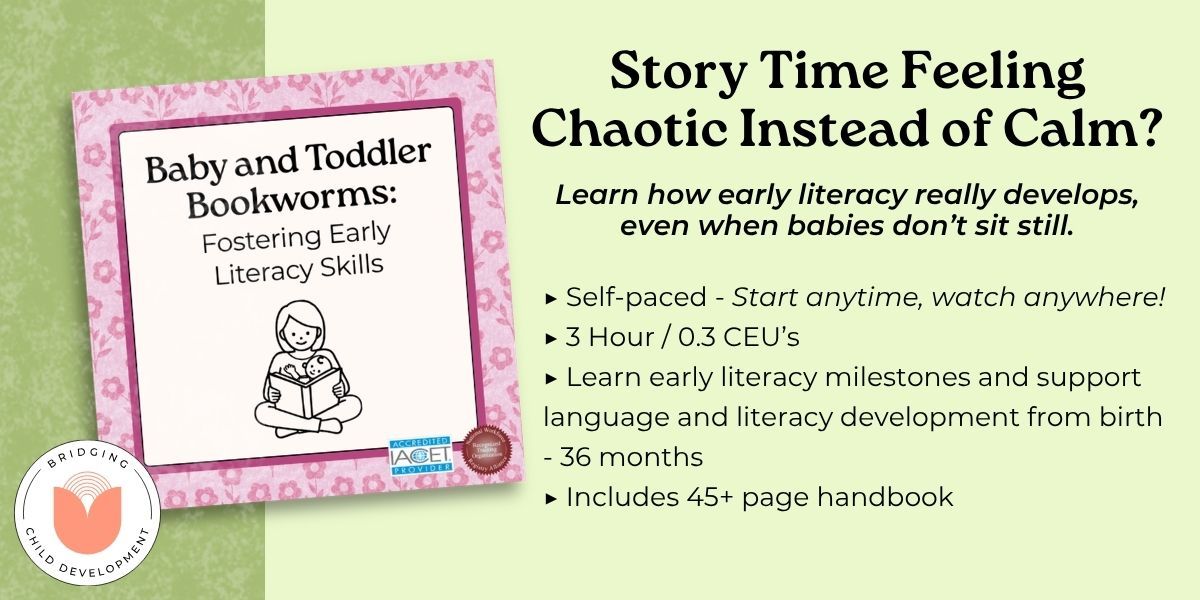
Our IACET approved training organization allows you to meet your states required training hours. Join the Baby and Toddler Bookworms training and leave with a full toolkit for wiggly readers, plus what to do about book throwers, page rippers, and the child who only wants one book
Empty space, drag to resize
Frequently Asked Questions
How long should story time be for infants and toddlers?
Just 2–5 minutes! Short, frequent reading moments throughout the day build more language than one long sit-down session. And yes — reading the same short book three times counts as three books.
Should I make toddlers sit during circle time reading?
No. Requiring toddlers to sit still can actually backfire! When books get paired with stress and correction, some children learn to avoid them (the broccoli effect!). The goal in the early years is positive experiences with books, not compliance. Let children stand, rock, hold a prop, or wander and return.
How do I read to a group of toddlers in child care?
Keep it come-and-go. Read to whoever shows up, let children drift in and out, offer duplicate books for little hands to hold, and try 2–3 mini reading sessions instead of one long whole-group story. Children playing nearby are still absorbing your language.
What if a child never seems interested in books at all?
Start where they are. Offer books as play! Put books in the block area, books with matching toys, books about their obsessions (trucks! dogs!). If a child over 18 months consistently avoids books and shows limited interest in back-and-forth interaction, it's also worth watching their overall language development.
Empty space, drag to resize
References
Kaderavek, J., & Justice, L. M. (2002). Shared storybook reading as an intervention context. American Journal of Speech-Language Pathology. http://doi.org/10.1044/1058-0360(2002/043)
Prefer to learn these tips in a training?
Find a format that works for you.
Get your state-approved hours and CEUs, a comprehensive handbook you'll reference forever, and strategies that’ll make a difference in the children you’re caring for.
Live Virtual Trainings
Real-time interaction, community with other providers, and the energy of learning together.
Self-Paced Trainings
Flexibility to learn on your own schedule, pause and rewatch as needed, with opportunities to learn and engage with others.
Private Trainings
A customized training for your entire staff, in-person or virtual, with hands-on activities built around your center's needs.
Hey, I’m kelly
Speech Language Pathologist, Early Intervention Specialist, Child Care Trainer, and Former Family Child Care Owner
I work alongside early childhood educators caring for children with a variety of needs. But these needs look very different than they did twenty years ago and you deserve trainings, resources, and tools that reflect that.
Trainings that are high quality, affordable, and worth coming back to.
That's why I built Bridging Child Development. Every training hour you earn here gives you strategies you can use the very next day in your classroom.
Login or sign up to start learningLogin to start learning