If you work in child care or preschool, you've probably experienced this moment. A child excitedly tells you something... and you have absolutely no idea what they just said.
Some teachers laugh and say, "They sound like a minion!" While it's often said jokingly, it leads to the question: "How much of a child's speech should I actually understand?"
As a pediatric speech-language pathologist and Early Intervention specialist, this is one of the most common questions I hear from child care providers, preschool teachers, and early childhood educators.
Understanding speech intelligibility, or how clearly a child can be understood, helps you know what is developmentally expected, when to continue monitoring, and when it may be appropriate to share concerns with a family.
In this guide, you'll learn speech intelligibility by age, why it matters in the classroom, and what to do when a child is difficult to understand.
Before we dive into speech intelligibility, it’s important to clarify one common misconception:
Speech and language are not the same thing. Although these terms are often used interchangeably, they refer to two very different areas of development.
Language refers to what a child understands and uses to communicate. This includes:- Understanding directions
- Using words, gestures, and sentences
- Expressing wants, needs, and ideas
Speech refers to how clearly a child produces sounds in words. This requires:- Coordination of the lips, tongue, jaw, and breath
- Accurate production of speech sounds
A child can have strong language skills, they talk in full sentences,
but if you cant understand a word they say, that would indicate a speech concern. And vice versa,
if a child isn't talking yet and you feel concerned, you would be concerned about their language development, not their speech.Speech intelligibility refers to how much of a child's speech another person can understand.
Speech intelligibility is different from producing sounds “perfectly.”
If you want to know what sounds develop when, read this blog.Speech Intelligibility focuses on overall clarity not sounds specifically.
Although every child develops at their own pace, researchers have established general speech intelligibility norms that can help teachers know what is expected.
From the What To Do When You Don't Understand What A Child Says handbook included with your training.
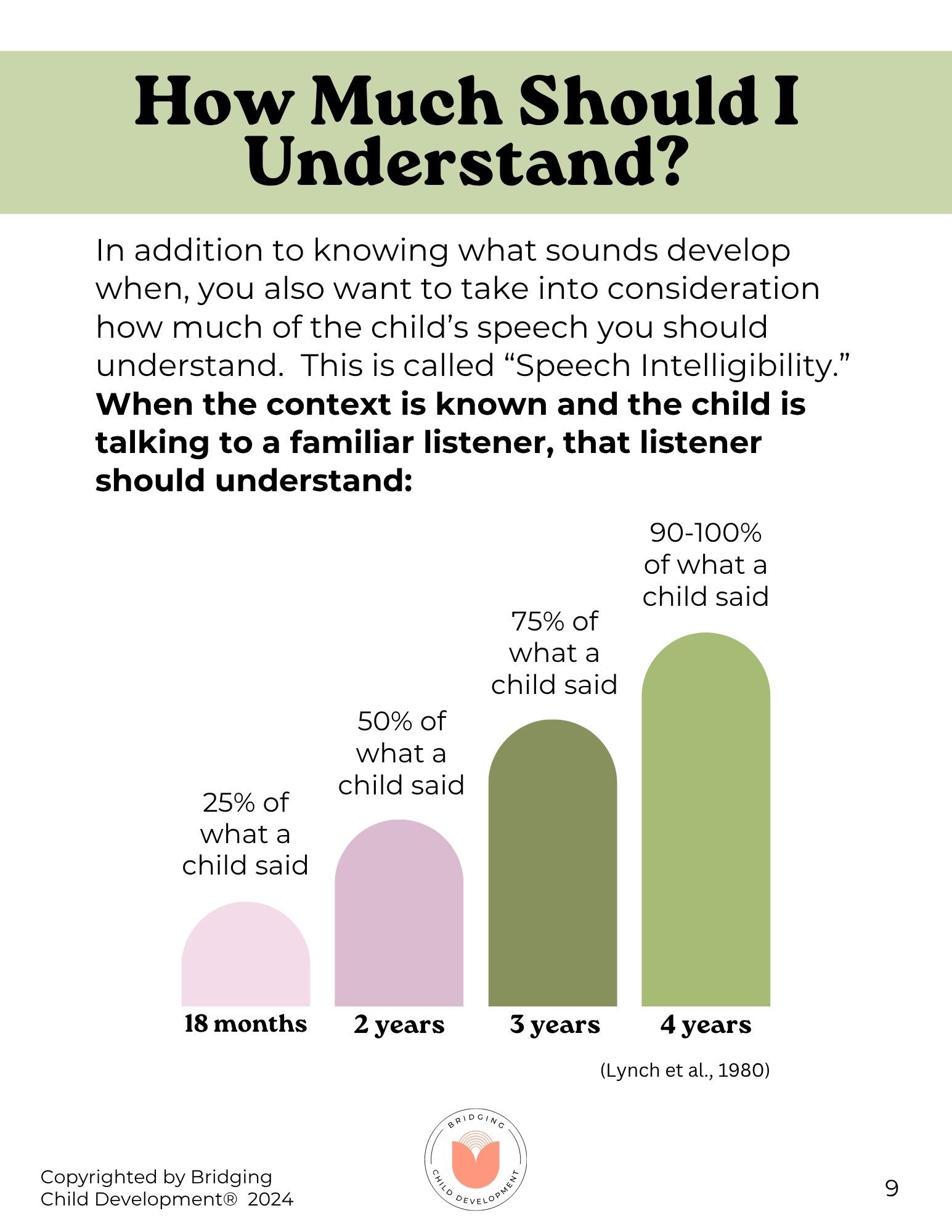
When a child is speaking to a familiar listener and the context is known, you can use this rule of thumb:
The quarter rule:
- 1 year = 1 quarter (about 25% understood)
- 2 years = 2 quarters (50% understood)
- 3 years = 3 quarters (75% understood)
- 4 years = a full dollar (90–100% understood)
Not every child who is hard to understand has a speech disorder.
Many speech sound errors are developmentally appropriate, especially in toddlers and young preschoolers. In fact, many children will have speech sound errors well into elementary school.
However, there are some some general guidelines you can use to help guide you on if you should be concerned:
- If the child is 2 and you understand between 0-25% of what they say.
- If the child is 3 and you understand 50% of less of what they say.
- If a child is 4 and you understand 75% or less of what they say.
- The child becomes frustrated when others don't understand them. Frequent communication breakdowns can lead to tears, giving up, or using behaviors instead of words to get their needs met.
- Peers have difficulty understanding the child. When classmates regularly ask, "What did you say?" or avoid conversations because they can't understand their friend, it can affect social interactions and play.
- Speech isn't becoming clearer over time. You should expect to notice steady progress and speech should get easier to understand, not harder.
Your observations provide valuable information that can help families decide whether they should discuss their concerns with their child's healthcare provider or seek a speech-language evaluation.
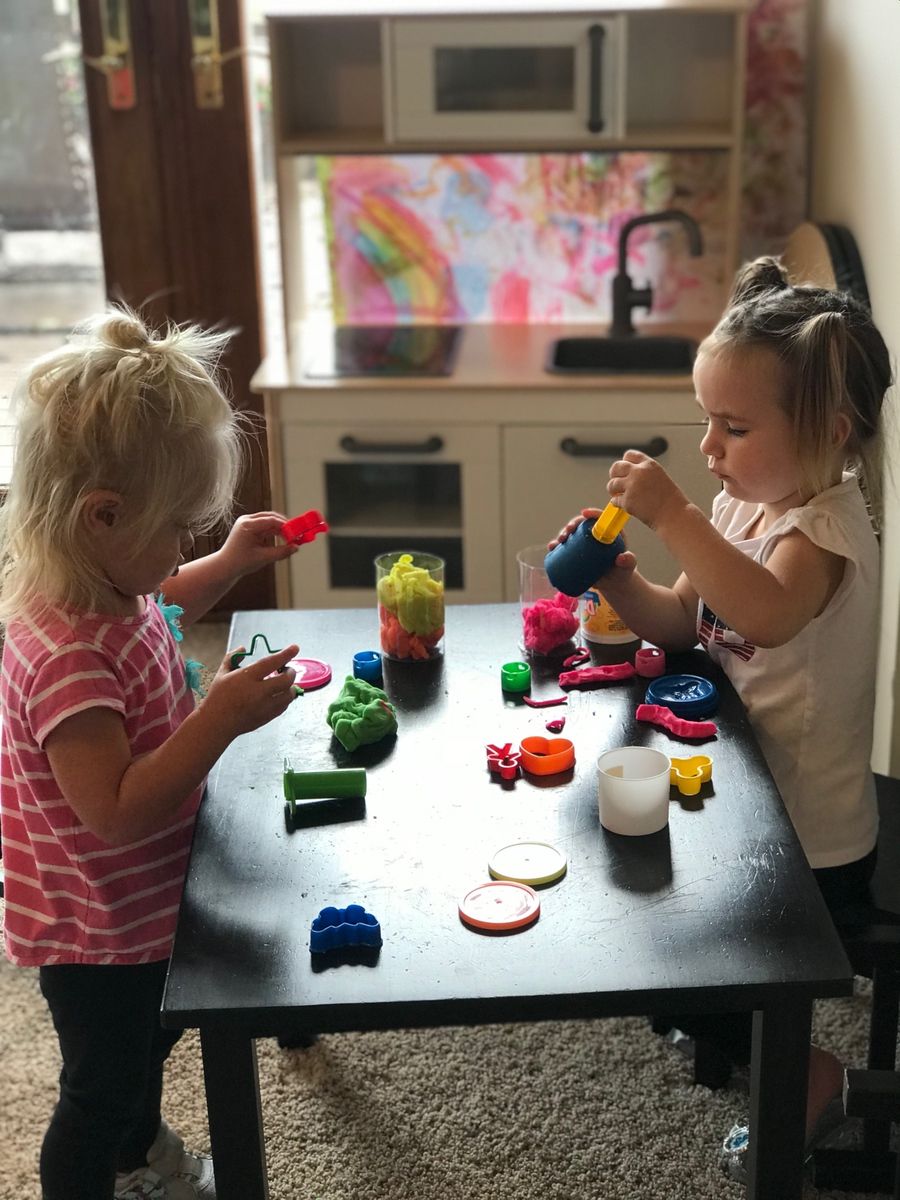
In a busy preschool classroom or child care setting, being understood affects almost everything a child does, from making friends and participating in circle time to asking for help and solving conflicts with their peers.
When children are difficult to understand:
- They may become frustrated
- They may talk less, even if they have a lot to say
- They may rely more on behaviors to communicate
On the other hand, when teachers understand what is typical for speech intelligibility, they are better able to:
- Respond in a way that makes children want to keep trying
- Respond in ways that reduces frustration during communication breakdowns
Every preschool teacher and child care provider has experienced this situation. A child excitedly tells you something, but despite listening carefully and asking them to repeat themselves a couple times, you literally just can't understand what they're saying.
In these moments,
the most important thing to remember is that your goal isn't to make the child "say it correctly." That's the speech therapists job! Instead, your goal is to help them feel heard while supporting successful communication.
Here are a few simple strategies you can use when you don't understand a child.
If you're unsure what they're trying to tell you, invite them to point, gesture, or show you the object they're talking about.
For example:
The child says, ekhjfkjhf adhfo adhp sufhfs. You say, "Show me?"
As long as what the child is talking about is in the room or there is something they can reference in the room, this strategy is great! But if it is not in the room, you will get a puzzled look when you say, show me and that gives you important information too!
If you understood part of their sentence or even just one word, repeat that back to the child.
For example:
The child says, mahdkj kldjslkjfd alkdjsflKJ ball dsakjhk asdhoij. You say, "Ball!"
This lets the child know you were listening and gives them a starting point to explain the rest of their message. Honestly sometimes this is just enough to satisfy the child and they are off and playing!
This strategy works if they have the language skills to use other words. Instead of saying, "What?" try:
"Can you tell me another way?" or "Tell me with different words." or "Tell me about it, describe it."
If a child is not able to understand those questions or does not have the vocabulary or language skills to use different words, skip this strategy!
Also, children don't have to communicate using spoken words alone. Gestures, pointing, facial expressions, pictures, and
sign language are all effective ways to share a message.
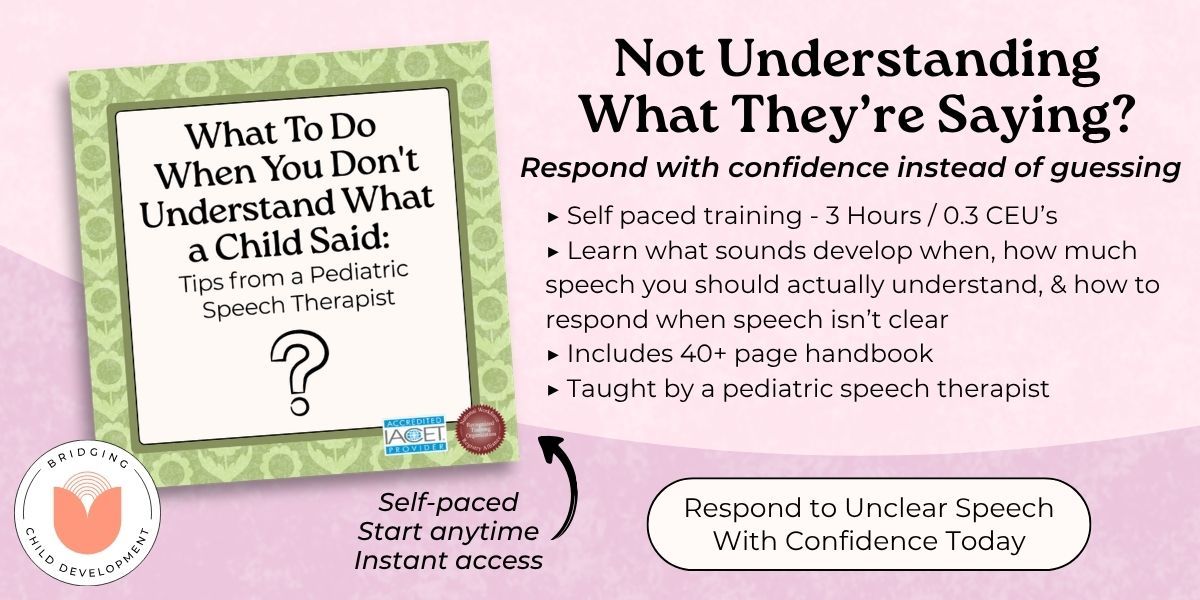
In our course, What to Do When You Don't Understand What a Child Says, you'll learn more practical, classroom-ready strategies to confidently respond when communication breaks down.
You'll discover how to support children without asking them to "say it again" over and over, reduce frustration, and encourage communication in ways that build confidence.