23 Easy Phonemic Awareness Activities for Preschool
Nov 2
/
Kelly Goldberg
Looking for phonemic awareness activities you can use tomorrow, without printing, laminating, or cutting a single thing? You're in the right place.
Every activity in this list takes less than two minutes and uses your voice, your hands, or things already in your classroom. They're organized by skill, so you can pick the one you're working on and go. Each activity is labeled "No prep" (just your voice) or "Low prep" (something already in your room).
What Is Phonemic Awareness?
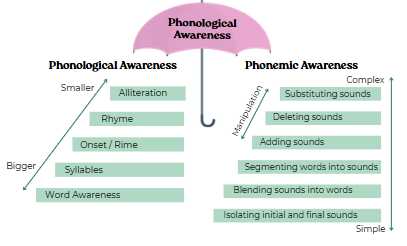
Phonemic awareness is the most advanced part of the phonological awareness umbrella. It's the ability to hear, blend, and pull apart the single sounds in words, like knowing "sun" is /s/ /u/ /n/. Blending and segmenting these sounds is the skill most connected to learning to read, which is why phonemic awareness in preschool matters so much.
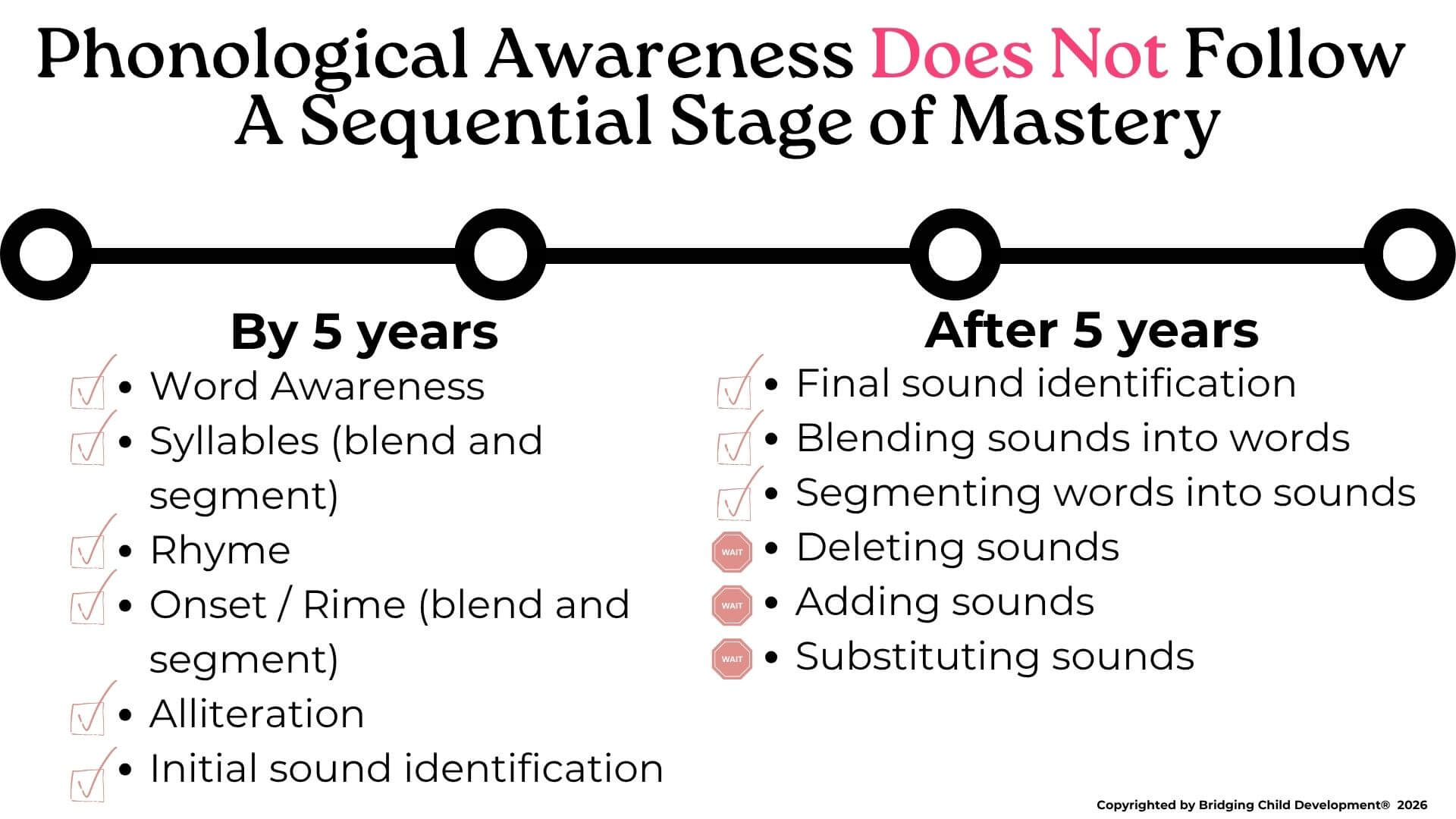
1. Keep it short. A couple of minutes, a few times a day, beats one long lesson. 2. Pick 1 or 2 skills at a time. You don't have to do every phonemic awareness activity on this list at once. 3. It is not a stair step of skills. You can work on any of these skills in any order. 4. Prioritize blending and segmenting. They have the strongest link to learning to read. You'll find them at every level below. 5.Model first. The best way to teach is: I do (As in, you do it and model or talk through how to do it), we do (As in, you and the children do the skill together), and last, you do (As in, the child does the activity independently). 6. Say sounds, not letter names,and snip the extra sound. Say /m/, not "em" or "muh."
Phonemic Awareness Activities: Isolating the First and Last Sounds in Words
When it comes to isolating the initial and final sounds of words, here are a few tips:
Work on the first sound in a word first
Then work on the last sound in a word.
The middle sound(s) are the hardest, so work on having a child isolate those sounds last.
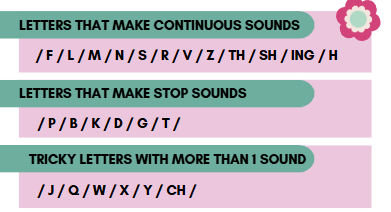
Start with letters that make a continuous sound or "stretchy sounds". /f/, /l/, /m/, /n/, /s/, /r/, /v/, /z/, /sh/, /ing/, /h/ and /th/ can be held out: "mmmmom." or "ffffffffish" when working on either the initial or final sounds in words. This makes it easier for kids to isolate that first and last sound.
1. I Spy With Sounds (No prep) Routine: a walk, the playground, or lunch Try this: 1. "I spy something in the sky. It starts with /sss/." 2. If they need help, add clues. "It's yellow. It's hot. It's the..." (Sun!) 3. Once first sounds are easy, try last sounds: "I spy something that ends with /t/."
2. Is There a /s/? (No prep) Routine: any transition Try this: 1.Ask yes/no questions. "Is there a /k/ in cat?" (Yes!) "Is there a /m/ in sun?" (No!) 2. Children answer with thumbs up or thumbs down. 3. This is a great one for children with speech delays, because they can show what they hear without having to say the sound.
3. Sound Clue Directions (No prep) Routine:getting ready to go outside Try this: 1. "It's cold today. Put on something on your head that starts with /h/." (Hat!)" 2. Now something on your hands that starts with /m/." (Mittens!) 3. Use it all day: "Grab something to drink with that starts with /k/." (Cup!)
4. Sound Actions (No prep) Routine: circle time Try this: 1. Give sounds a personality. /s/ is a hissing snake. /z/ is a buzzing bee. /sh/ is the "be quiet" sound. 2. Say a word. If it starts with /s/, children wiggle their arm like a snake. "Sun!" Wiggle! "Ball!" Still. 3. Add one new sound personality at a time.
5. Find the Same (Low prep) Routine: arrival Try this:1. Put one object on the table, like a toy sock. "Sock starts with /s/." 2. Children find something else in the room that starts with /s/ and add it to the table. 3. Check each one together. "Spoon. /s/. Yes!"
6. Guess My Dessert (No prep) Routine: dramatic play kitchen Try this: 1. Join children in the kitchen area. "I want something for dessert. It starts with /k/." 2. Add clues if needed. "It's vanilla. You put icing on it." (Cake!) 3. Let children be the chef and give you a first-sound clue.
7. Mirror Mouths (Low prep) Routine: table time Try this: 1. Give each child a small hand mirror. 2. Say a sound together and watch your mouths. "/m/. Our lips press together!" "/f/. Our teeth touch our lip!" 3. Then play "What's my first sound?" while they watch their mouths in the mirror.
Sounds to target based on "continuous" or "stop" sounds
Phonemic Awareness Activities: Blending Sounds
Blending (and segmenting) are most connected to learning to read! Put your eggs in this basket if you are not sure where to start! Here are a few more tips:
Start with C - V words (consonant - vowel)
Then move to V - C words (vowel - consonant)
Last do C - V - C words (consonant - vowel - consonant)
Pick words with sounds that have continuous sounds (the chart is above)
8. Robot Roll Call (No prep) Routine: arrival or circle time Try this: 1. "I'm going to say a name like a robot. You say it fast!" 2. "/k/ /e/ /l/ /ee/." Class: "Kelly!" 3. Go through every name. Kids LOVE the silliness.
9. Snail Talk (No prep) Routine: waiting in line Try this: 1. "I talk slow like a snail. But you're a fast cheetah! Blend my snail sounds fast." 2. "Sss... uuu... nnn." (Sun!) 3. Try: no, she, up, in, fun, pat.
10. Simon Says Sounds (No prep) Routine:circle time Try this: 1. "Uh oh, Simon is having trouble talking. Listen carefully!" 2. "Simon says touch your /t/ /oe/ /s/." (Toes!) 3. Try: /h/ /ea/ /d/ (head), /n/ /o/ /z/ (nose), /l/ /e/ /g/ (leg).
11. Mystery Bag (Low prep) Routine: circle time Try this: 1. Hide a few small objects in a pillowcase or bag. 2. Instead of describing the object, say its sounds. "/k/ /u/ /p/." 3. When a child blends it ("Cup!"), pull it out and let them hold it.
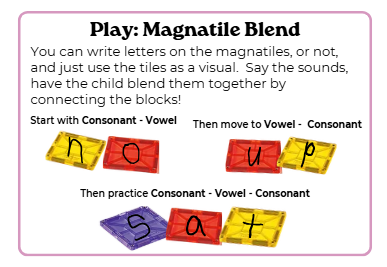
12. Magnatile Blend (Low prep) Routine: play Try this: 1. Provide the child with magnatiles. 2. Say the sounds in the word. 3. Have the child smash or stack the tiles as they blend the sounds together to make the word.
13. Arm Slide (No prep) Routine:any transition Try this: 1. Say a word in sounds. Children tap their shoulder, elbow, and wrist for each sound: "/s/ /o/ /k/." 2. Then they slide their hand down their arm as they blend: "Sock!" 3. On the playground, do the same thing on the slide: you say the sounds, they blend the word on the way down.
14. Bad Connection (No prep) Routine: arrival Try this: 1. Everyone holds up a pretend phone (or an old phone from home). 2. "Uh oh, we have a bad connection! Who's here today? /m/ /a/ /r/ /ee/ /o/." (Mario!) 3. Use syllables for younger children ("Mar-i-o") and single sounds for older 4s and 5s.
15. Say the Word Song (No prep) Routine: circle time Try this: 1. Sing to the tune of "If You're Happy and You Know It": If you can put my sounds together, say the word! (Sing it twice.) 2. Then say the sounds: "/f/ /i/ /sh/." 3. Everyone shouts, "Fish!"
16. Sound Scavenger Hunt (Low prep) Routine:arrival or free play Try this: 1. Hide a few toys around the room that have 2 or 3 sounds: hat, cat, boat, top. 2. Give each child a clue in sounds: "/h/ /a/ /t/." 3. They blend the word and go find it.
Phonemic Awareness Activities: Segmenting Sounds
Segmenting means pulling a word apart into its sounds. It's the flip side of blending and a little harder. But remember, blending (and segmenting) is so so important when it comes to learning to read!
Start with two-sound words, then three.
Words that start with stop sounds or "quick sounds" like /p/, /b/, /k/, /d/, /g/, and /t/ can be easier for some children to pull apart. (see chart above)
17. You Be the Robot (No prep)
Routine: any transition
Try this:
1. "Now YOU talk like a robot! Say 'pig' in robot talk."
2. Model it first: "/p/... /i/... /g/."
3. Children take turns robot-talking a word for the class to blend.
18. Head, Shoulders, Knees, and Toes (No prep)
Routine:circle time
Try this:
1. Say a word. Children touch their head for the first sound, shoulders for the next, and so on.
3. Works best with 2- to 4-sound words. "Green" gets all four: /g/ /r/ /ee/ /n/.
19. Stretch It Out (No prep)
Routine: waiting in line
Try this:
1. Put your palms together. Say the word: "Sun."
2. Pull your hands apart slowly as you say each sound: "/sss/... /uuu/... /nnn/."
3. Children copy you. A rubber band or slinky makes it even more fun.
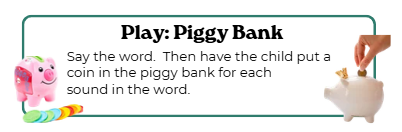
20. Piggy Bank (Low prep)
Routine: dramatic play or table time
Try this:
1. Grab a toy piggy bank and some play coins.
2. Say a word. Children drop in one coin for each sound. "Cat. /k/ (clink) /a/ (clink) /t/ (clink)."
3. Count the coins together: "Three sounds!"
21. Finger Count (No prep)
Routine: any transition
Try this:
1. Say a word. Children hold up one finger for each sound they hear.
2. "Shop. /sh/ /o/ /p/. How many fingers?" (Three!)
3. Point out that "sh" is just one sound, even though it feels big.
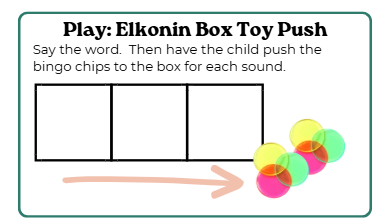
22. Elkonin Box Toy Push (Low prep)
Routine:table time
Try this:
1. Draw two or three boxes in a row on any paper. Give each child a few small toys or bingo chips.
2. Say the word: "Tip."
3. Children push one toy into a box for each sound: "/t/... /i/... /p/." Then sweep a finger under the boxes and say the whole word.
23. Password to Pass (No prep)
Routine: outside
Try this:
1. Stand at a spot on the playground. You're the gatekeeper!
2. Give each child a word. To get past, they say its sounds. "Pig." "/p/ /i/ /g/!"
3. Try: tap, kid, dog, bed.
What About Letters?
You don't need them. Preschoolers who are still building sound awareness didn't benefit from adding letters to these activities (Rehfeld et al., 2022; Rice et al., 2022). For older 4s and 5s who already know some letter sounds, adding a letter can help. "You heard /m/ at the beginning of mom. This is the letter M!"
What About Deleting, Adding and Substituting sounds
In this blog, we are not going to talk about phoneme manipulation activities (i.e., adding, deleting, and substituting sounds) for a few reasons: 1. These are the most complex skills and research points to this being more than what is actually required for children to learn to read. 2. Blending and segmenting are most important! AKA- For preschool age children- put your efforts there and not in adding, deleting, or substituting sounds!
Learn How to Teach Phonemic Awareness Skills and Earn CEUs
Want to see these activities in action? Join the training!
Phonemic Awareness Activities FAQs
What are the best phonemic awareness activities for preschool?
Blending and segmenting games, because they have the strongest link to learning to read. Robot Roll Call, Snail Talk, Simon Says Sounds, and Elkonin Box Toy Push are great places to start.
Where should I start when it comes to phonemic awareness in preschool?
Pick the one skill you feel most comfortable with. Add about three quick activities a day into your routines. Once that feels natural, add another skill.
What do you mean, "Snip the extra sound"?
When we say a sound by itself, it's easy to add an extra vowel. "Buh" instead of /b/. That extra "uh" makes blending really confusing. (Try blending "buh-lue." Doesn't sound like "blue," does it?)
References
Edelen-Smith, P. J. (1997). How Now Brown Cow: Phonological Awareness Activities. Reading Rockets.
Gritt, A., & Standish, K. (2024). Word Play Throughout the Day: Phonological Awareness in the Preschool Classroom. NAEYC.
Paulson, L. H. (2025). 9 Easy Activities to Boost Syllable and Phoneme Awareness. Brookes Publishing.
Head Start ECLKC. Phonological Awareness: Effective Practice Guide.
Ehri, L. C., et al. (2001). Phonemic awareness instruction helps children learn to read. Reading Research Quarterly. https://doi.org/10.1598/rrq.36.3.2
Prefer to learn these tips in a training?
Find a format that works for you.
Get your state-approved hours and CEUs, a comprehensive handbook you'll reference forever, and strategies that’ll make a difference in the children you’re caring for.
Live Virtual Trainings
Real-time interaction, community with other providers, and the energy of learning together.
Self-Paced Trainings
Flexibility to learn on your own schedule, pause and rewatch as needed, with opportunities to learn and engage with others.
Private Trainings
A customized training for your entire staff, in-person or virtual, with hands-on activities built around your center's needs.
Hey, I’m kelly
Speech Language Pathologist, Early Intervention Specialist, Child Care Trainer, and Former Family Child Care Owner
I work alongside early childhood educators caring for children with a variety of needs. But these needs look very different than they did twenty years ago and you deserve trainings, resources, and tools that reflect that.
Trainings that are high quality, affordable, and worth coming back to.
That's why I built Bridging Child Development. Every training hour you earn here gives you strategies you can use the very next day in your classroom.
Login or sign up to start learningLogin to start learning