33 Easy Phonological Awareness Activities for Preschool
Oct 28
/
Kelly Goldberg
Looking for phonological awareness activities you can use tomorrow, without printing, laminating, or cutting a single thing? You're in the right place.
Every activity in this list takes less than two minutes and uses your voice, your hands, or things already in your classroom. They're organized by skill, so you can pick the one you're working on and go. Each activity is labeled "No prep" (just your voice) or "Low prep" (something already in your room).
Phonological Awareness Activities: A Quick Refresher
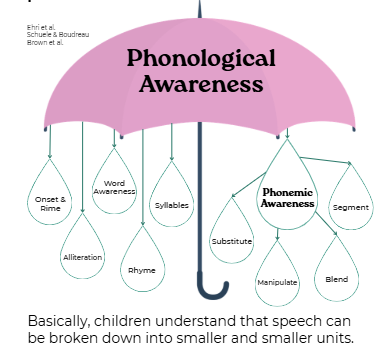
Phonological awareness is an umbrella term for the ability to recognize and play with the sound structure of spoken language. It includes noticing that sentences are made of words, words can be broken down into syllables as well as broken down into the onset and rime (not to be confused with rhyme). Phonological awareness also includes rhyming (different from rime) and alliteration. At the most advanced level, phonological awareness also includes hearing the individual sounds that make up words. This is called phonemic awareness. Phonemic awareness includes segmenting and blending sounds as well as manipulating and substituting sounds.
Basically, phonological awareness is a child's ability to learn that speech can be broken down into smaller and smaller units. New to phonological awareness? Start with our blog onwhat is phonological awareness and how to teach it. This blog is specifically phonological awareness activities. But if you are looking for phonemic awareness activities, we have those too.
Before You Start: 5 Quick Reminders
1. Keep it short. A couple of minutes, a few times a day, beats one long lesson. 2. Pick 1 or 2 skills at a time. You don't have to do every phonological awareness activity on this list at once. 3. Prioritize blending and segmenting. They have the strongest link to learning to read. You'll find them at every level below. 4.Model first. The best way to teach is: I do (As in, you do it and model or talk through how to do it), we do (As in, you and the children do the skill together), and last, you do (As in, the child does the activity independently). 5. Say sounds, not letter names,and snip the extra sound. Say /m/, not "em" or "muh."
Word Awareness Activities
Word awareness means knowing a sentence is made of separate words. Start with 2-word sentences and build up to 5. Say them naturally, without long pauses between words.
1. Snack Words (Low prep) Routine: snack Try this: 1. Say, "I'm going to say a sentence. Push a cracker forward for every word you hear. 2. "Model: "Kelly ran." Push two crackers. "Two words!" 3. Together: "I like waffles." Then let them try: "You have two dogs." Then they get to eat their words!
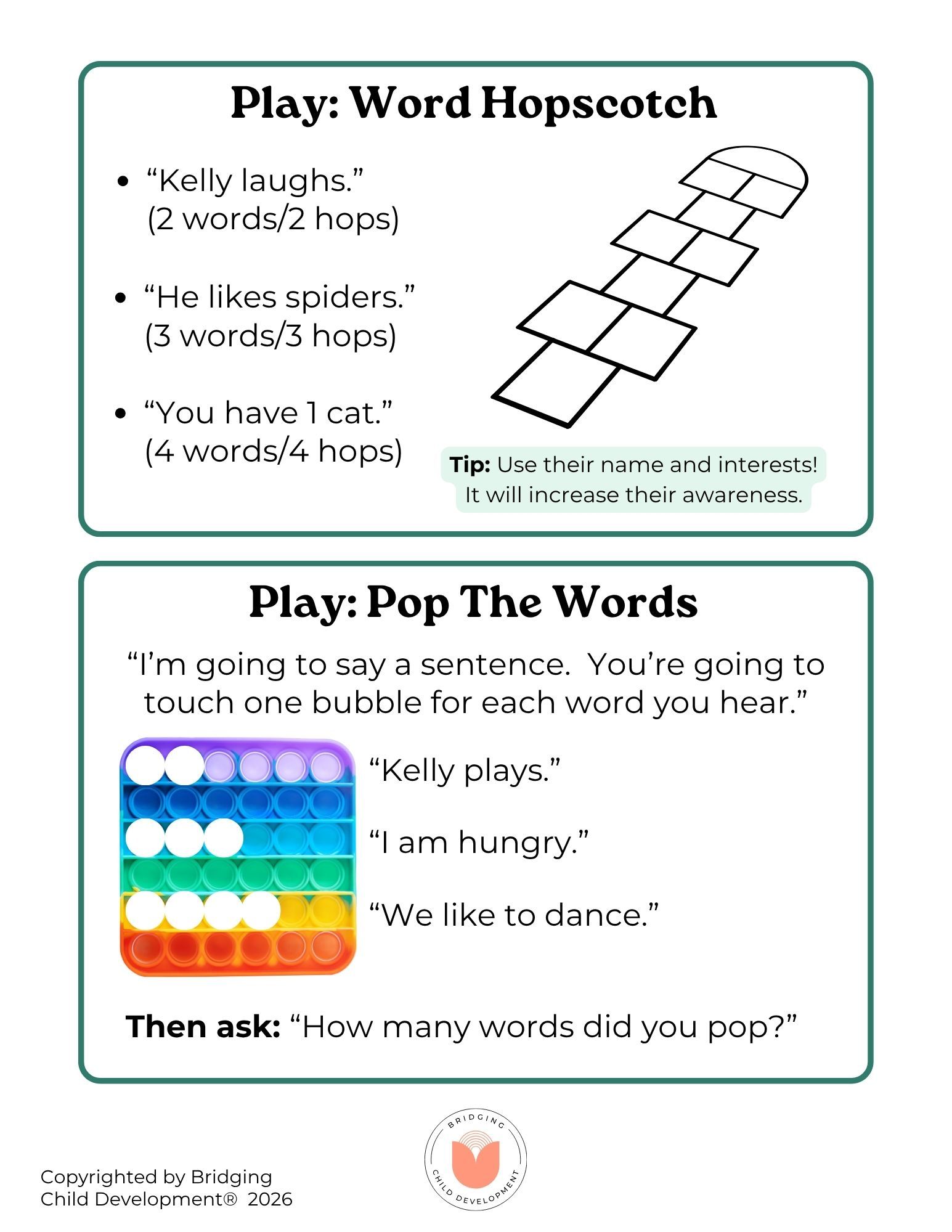
2. Count the Directions (No prep) Routine: any transition Try this: 1. Give a direction and count the words on your fingers as you say it. "Time to get our coats." 2. Ask, "How many words did I say?" (Five!) 3. Let a child hold up fingers while you say the next one. 3. Word Hop (No prep)
Routine: outside or lining up
Try this: 1. Say a sentence. "Kelly laughs." Everyone hops once for each word. Two hops! 2. Use their names and interests: "Leo likes spiders." Three hops!
From the Teach Phonological Awareness Through Play in Pre-K course handbook included in course purchase.
4. One Word or Two? (No prep) Routine: circle time or waiting in line Try this: 1. Say, "I'm going to say two things. Which one has two words?" "Cream... or ice cream?" (Ice cream!) "My dog... or donkey?" (My dog!) 2. Have them hold up one or two fingers to answer.
5. Word Toss (Low prep) Routine: outside or gym Try this: 1. Stand in a circle with a basket of soft balls. Say a short sentence. As you say the sentence, toss one ball to a different child for each word. "We. Go. Outside." Three tosses, three words (3 kids caught a ball).
6. Build a Sentence (No prep) Routine: circle time, for older 4s and 5s Try this: 1. Say, "Can you make a sentence with three words?" 2. Help them: "I see... Mom!" Clap each word together. 3. Then try four words, then five.
Syllable Activities
Syllables are the parts of the word that contains a vowel or a vowel sound. Syllabication is the ability to separate a word into syllables (e.g., cake (1 syllable), cow-boy (2 syllables), ba-na-na (3 syllables). Start with compound words (cowboy), then 2-syllable words (flower), then 3 or more (strawberry). Blending (putting parts together) is easier than segmenting (pulling them apart), so start there.
7. Clap Your Name (No prep) Routine: arrival or attendance Try this: 1. Say each child's name and clap the parts together. "Gi-o-van-na. Four claps!" 2. Ask, "Who has a one-clap name? Who has three?" 3. Switch it up: stomp, pat knees, or tap shoulders.
8. Robot Directions (No prep) Routine: any transition Try this: 1. Give directions in a robot voice, one syllable at a time. "Get your... back-pack." 2. Children blend the word and do the action. Try: "Wash your... fin-gers." "Sit on the... car-pet."
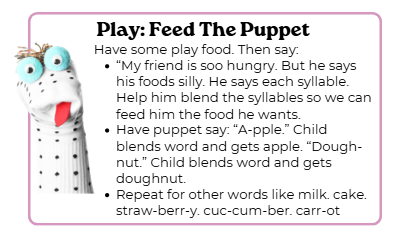
9. Feed the Puppet (Low prep) Routine: dramatic play kitchen Try this: 1. Grab any puppet or stuffed animal and some play food. 2. Say, "My friend is hungry, but he talks in a silly way. Help him put his words together!" 3. Puppet says, "A-pple." Child blends it and feeds him. Try dough-nut, straw-ber-y, car-ot.
From the Teach Phonological Awareness Through Play in Pre-K course handbook included in course purchase.
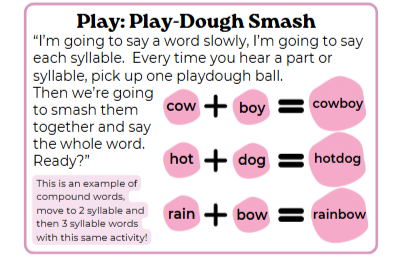
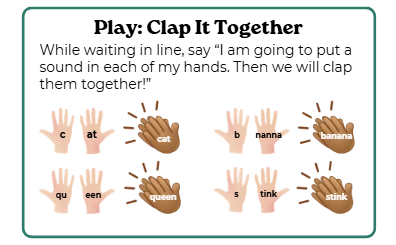
10. Playdough Smash and Pull Apart (Low prep) Routine:table time Try this: 1. Smash (blending): Children hold a small ball for each part you say. "Cow... boy." Smash them together: "Cowboy!" 2. Pull apart (segmenting): Give one big ball. "Flower." Children pull off a piece for each part. "Flow... er!" 3. Move from compound words to 2-syllable words to 3-syllable words.
11. What's in the Box? (Low prep) Routine:circle time Try this: 1. Put a few toys in any box or bag. 2. Sing to the tune of "Twinkle, Twinkle, Little Star": What's in the box? Let's take a peek. Pull out a toy, what could it be? Clap the sounds, nice and slow. Let's count the beats, ready, go! 3. A child pulls out a toy and the group claps its parts. "Din-o-saur. Three claps!"
12. Hoop Hop (Low prep) Routine:outside Try this: 1. Lay a few hula hoops (or chalk circles) in a row. 2. Say a word. Children jump into one hoop for each part. "Wa-ter-mel-on!" Four hoops! 3. Let children call out words from the playground: "slide," "swing-set," "sand-box."
13. Mixed-Up Words (No prep) Routine: waiting in line, for older 4s and 5s Try this: 1. Say a compound word backwards. "Bow... rain." 2. Ask, "Uh oh, I mixed it up! What's the real word?" (Rainbow!) 3. Try: "cake... cup," "ball... foot," "man... snow."
From the Teach Phonological Awareness Through Play in Pre-K course handbook included in course purchase.
Rhyming Games for Preschool
These rhyming activities for preschool start easy and build to the hardest rhyme skill, making up rhymes. Teach rhyming in this order: 1. First have the children decide whether two words rhyme (Literally "yes" or "no". Do these two words sound the same at the end, yes or no?) 2. Then say 3 or 4 words and have them find the one word that doesn't rhyme with the others (e.g., Car, far, dog, What word does not rhyme, it sounds different at the end.) 3. Next move to matching rhymes (e.g., You say a word and they have to find something that rhymes with that word) 4. Last, have the children make up a rhyme on their own. Silly made-up words always count!
14. Thumbs Up, Thumbs Down (No prep) Routine: circle time or waiting in line Try this: 1. Say, "Rhyming words sound the same at the end. Nose, rose. They rhyme!" 2. Say two words. Thumbs up if they rhyme, thumbs down if they don't. "Hat, cat?" "Bed, car?" 3. Have children repeat the rhyming pairs out loud.
15. Odd One Out (No prep) Routine:waiting in line Try this: 1.Say four words. Three rhyme and one doesn't. "Weed, bead, pill, seed." 2. Ask, "Which one doesn't belong?" (Pill!) 3. Start with three words for younger children: "cat, hat, sun."
16. Rhyming Riddles (No prep) Routine: snack or lunch Try this: 1. "I'm thinking of something you eat with a spoon. It rhymes with nogurt." (Yogurt!) 2. "I'm thinking of something you drink every day. It rhymes with pater." (Water!) 3. "I'm thinking of something you go down at the playground. It rhymes with flide." (Slide!)
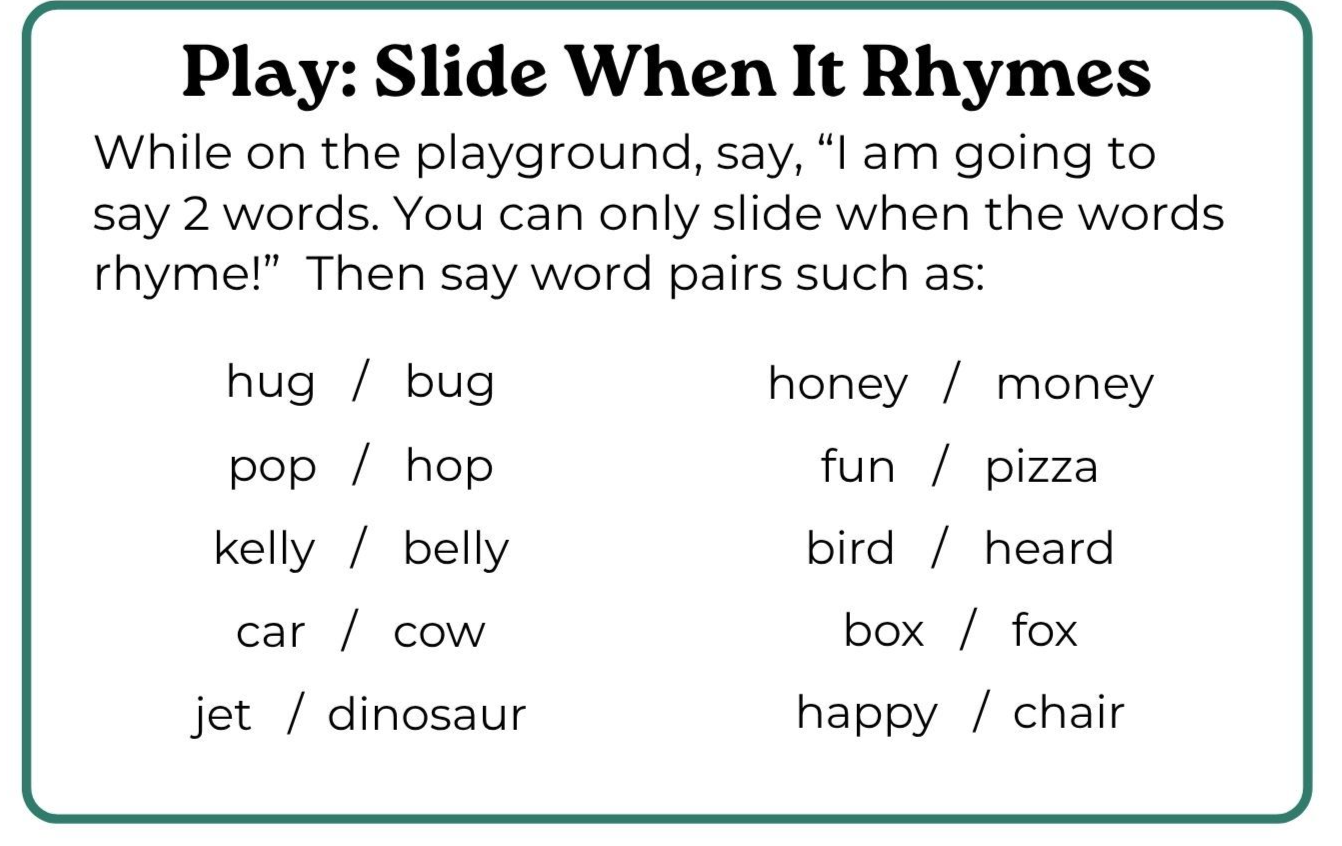
17. Slide When It Rhymes (No prep)
Routine: playground
Try this:
1. Stand at the bottom of the slide. "You can only slide if my words rhyme!"
From the Teach Phonological Awareness Through Play in Pre-K course handbook included in course purchase.
18. Rhyme Hunt (No prep) Routine:clean up Try this: 1. "Can you find something that rhymes with cook?" (Book!) 2. "Find something that rhymes with rock." (Block!) That child puts it away. 3. Try: "rink" (sink), "boar" (door), "hair" (chair).
19. Rhyme Call (No prep) Routine:transitions Try this: 1. Instead of calling a child's name, say a word that rhymes with it. "This spot is for someone whose name rhymes with dawn." (Shawn!) 2. That child gets to line up, wash hands, or pick a seat. 3. Made-up words work great: "Rhymes with Bia... Mia!"
20. Rhyme Roll Call (No prep) Routine:lining up Try this: 1. "I'll start us off. Mop, hop..." 2. Each child adds one rhyming word as they get in line. "Top!" "Stop!" "Dop!" 3. When you run out, start a new rhyme. "Bug, rug..."
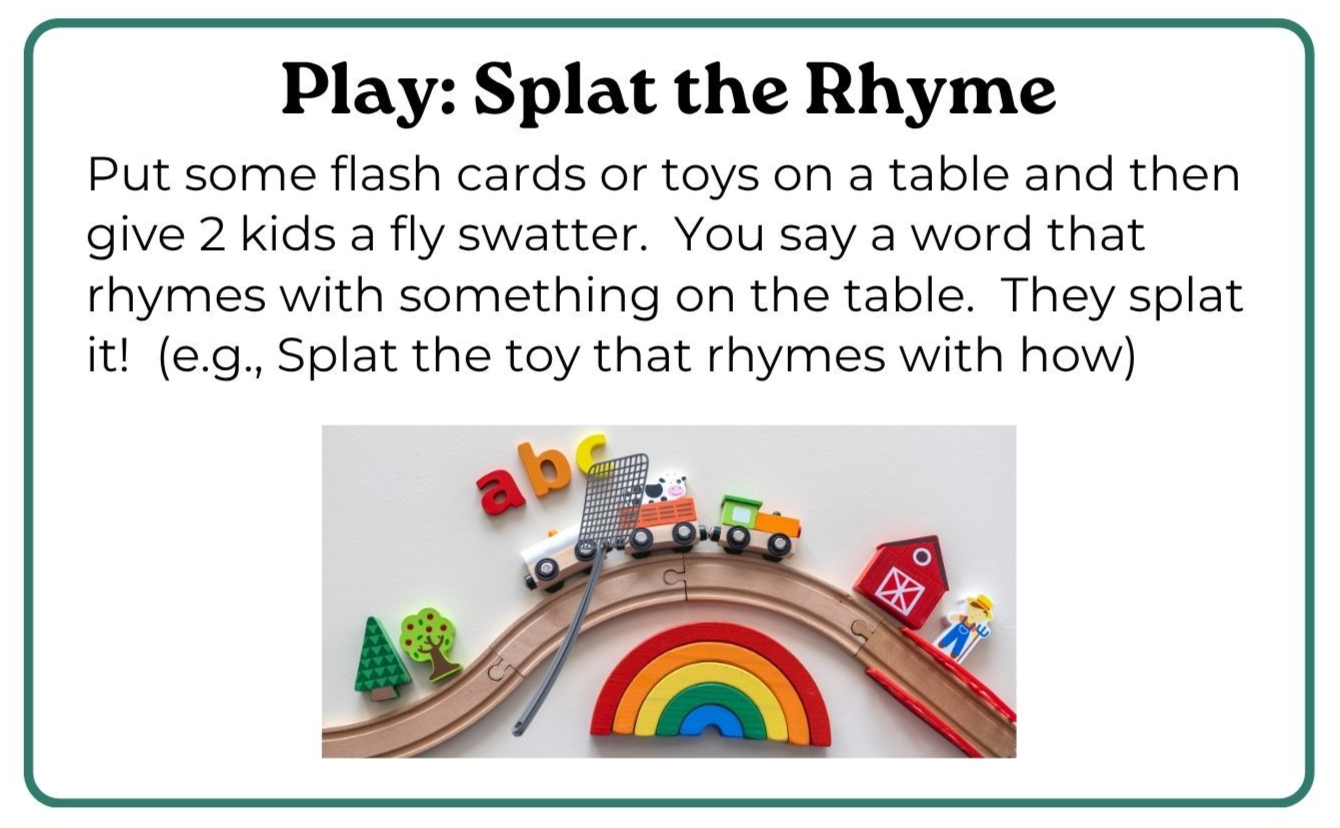
21. Splat the Rhyme (Low prep) Routine: table time Try this: 1. Put a few toys on the table: a cow, a car, a block. 2. Give two children a fly swatter (or let them use their hands)." 3. Splat the toy that rhymes with how!" (Cow!)
From the Teach Phonological Awareness Through Play in Pre-K course handbook included in course purchase.
Alliteration Activities for Preschool
Alliteration is when words close together start with the same sound.Listen to the sound, not the letter!! "Phone" and "fish" start the same, but "shoe" and "sun" don't.
22. Match and Move (No prep) Routine: waiting in line Try this: 1. "If both words start with the same sound, jump! If not, freeze like a statue." 2. "Cows moo." Jump! "Run fast." Freeze! 3. Try: "bees buzz," "soft blanket," "more milk," "monkeys dance."
23. Which One Starts Different? (No prep) Routine: circle time Try this: 1. Say four words. Three start the same, one doesn't. "Bus, bat, cow, book." 2. "Which one starts with a different sound?" (Cow!) 3. Try: "fast, fall, nose, feet" and "mom, money, move, top."
24. Popcorn Sounds (No prep) Routine:handwashing or lining up Try this: 1. "When you hear a word that starts like your name, pop up like popcorn!" 2. "Car!" Everyone whose name starts with /k/ pops up and goes. 3. Keep going: "Sun!" "Tape!" "Milk!"
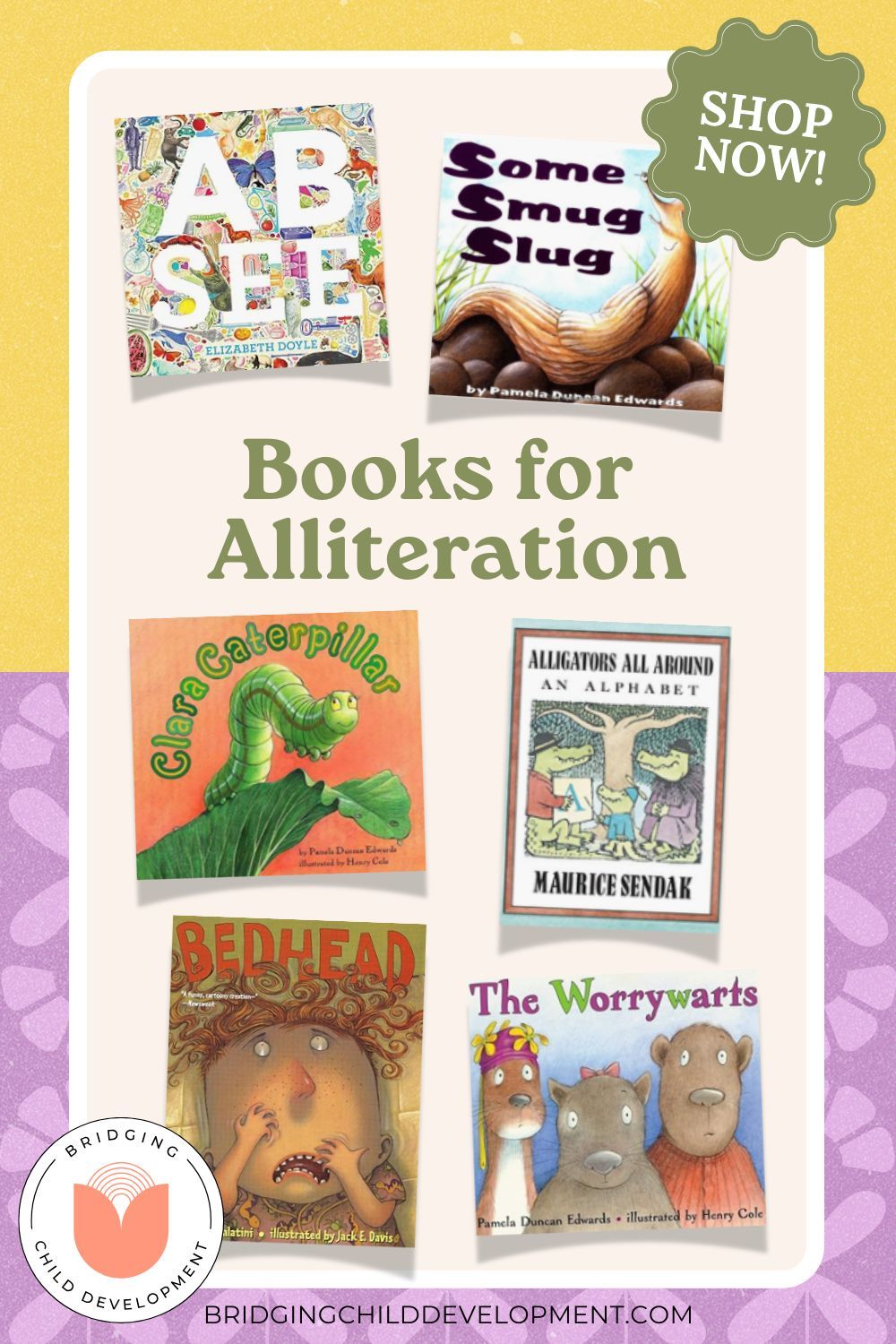
Click to see all books. Affiliate Link.
25. Silly Name Game (No prep) Routine:arrival or circle time Try this: 1. Add a word that starts with the same sound as each child's name. "Jumping Jada! Charming Charles!" 2. Stretch the first sound so they hear it. "Mmmighty Mmmarcus." 3. Let children make up silly names for their friends.
26. Sound Snack (Low prep) Routine:snack Try this: 1. Serve a snack where everything starts with the same sound. "Today we have carrots, crackers, and cookies!" 2. Ask, "What sound do all our snacks start with?" (/k/!) 3. "Can you think of another food that starts with /k/?" (Cake! Corn!)
27. Tongue Twister Time (No prep) Routine: any transition Try this: 1. Make up a short tongue twister with a child's sound. "Talia takes tiny tacos." 2. Say it together slowly, then fast. 3. Ask, "What sound did you hear over and over?" (/t/!)
Onset and Rime Activities
The onset is the first sound of a word. The rime is the rest. /sh/ + ip = ship. This is the bridge between syllables and single sounds, and it's a great place to practice blending and segmenting.
28. The Name Game (No prep)
Routine:transitions
Try this:
1. "I'm thinking of a friend. Their name starts with /n/ and ends with -athan."
2. The class blends it: "Nathan!"
3. Nathan gets to line up, wash hands, or grab his coat.
29. Finish the Word (Low prep)
Routine: circle time
Try this:
1. Hold up a toy or point to something in the room.
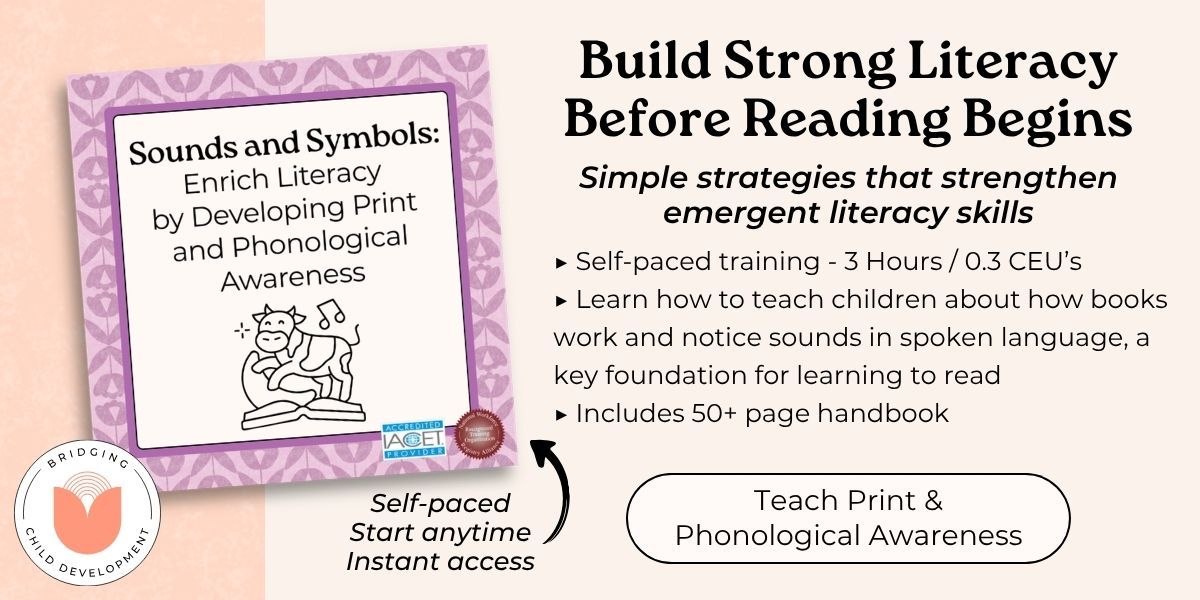
Learn How to Teach Phonological Awareness and Earn CEUs
Want to see these activities in action? Join the training.
Frequently Asked Questions About Phonological Awareness Activities
How many phonological awareness activities should I do each day?
A few quick ones, each a couple of minutes long. Pick one or two skills and tuck an activity into three or so routines a day. Short and often beats long and rare.
Do I need materials for phonological awareness games?
No. Most of the activities on this list use only your voice and your body. A few use things you already have, like playdough, toys, or a bag. If you prefer using books, there are so manyphonological awareness booksyou can use too.
Should I use letters during these phonological awareness activities?
You don't need to. Preschoolers who are still building sound awareness don't benefit from adding letters. For older 4s and 5s who already know some letter sounds, adding a letter can help.
What if a child can't answer out loud?
For children with speech delays, ask yes/no questions ("Is there a /k/ in cat?"), let them point to pictures, or have them push a block instead of saying the sound. They may hear the sound perfectly even if they can't say it yet.
Is phonological awareness different from print awareness?
Yes! Print awareness is an equally important early literacy skill. You can learn more about print awareness in this blog!
References
Edelen-Smith, P. J. (1997). How Now Brown Cow: Phonological Awareness Activities. Reading Rockets.
Gritt, A., & Standish, K. (2024). Word Play Throughout the Day: Phonological Awareness in the Preschool Classroom. NAEYC.
Paulson, L. H. (2025). 9 Easy Activities to Boost Syllable and Phoneme Awareness. Brookes Publishing.
Head Start ECLKC. Phonological Awareness: Effective Practice Guide.
Ehri, L. C., et al. (2001). Phonemic awareness instruction helps children learn to read. Reading Research Quarterly. https://doi.org/10.1598/rrq.36.3.2
Prefer to learn these tips in a training?
Find a format that works for you.
Get your state-approved hours and CEUs, a comprehensive handbook you'll reference forever, and strategies that’ll make a difference in the children you’re caring for.
Live Virtual Trainings
Real-time interaction, community with other providers, and the energy of learning together.
Self-Paced Trainings
Flexibility to learn on your own schedule, pause and rewatch as needed, with opportunities to learn and engage with others.
Private Trainings
A customized training for your entire staff, in-person or virtual, with hands-on activities built around your center's needs.
Hey, I’m kelly
Speech Language Pathologist, Early Intervention Specialist, Child Care Trainer, and Former Family Child Care Owner
I work alongside early childhood educators caring for children with a variety of needs. But these needs look very different than they did twenty years ago and you deserve trainings, resources, and tools that reflect that.
Trainings that are high quality, affordable, and worth coming back to.
That's why I built Bridging Child Development. Every training hour you earn here gives you strategies you can use the very next day in your classroom.
Login or sign up to start learningLogin to start learning