What Is Phonological Awareness and How To Teach It In Preschool
Oct 21
/
Kelly Goldberg
Phonological awareness is a child's ability to hear and play with the sounds in spoken language. Before children can match letters to sounds, they have to hear those sounds first. In other words, want strong readers? Start with their ears.
As a speech-language pathologist and early intervention specialist, I am in child care centers every week. I see teachers working so hard on teaching letters but rarely see them playing with sounds. Yet,phonological awareness skills are the strongest predictor of reading and spelling success.
In this blog, I'll answer what is phonological awareness, break down the skills that matter most for 3 to 5 year olds, bust some common myths, and show you exactly how to teach phonological awareness skills in preschool during the routines you already have. No new curriculum. No worksheets. Just your voice and a little silliness.
What Is Phonological Awareness?
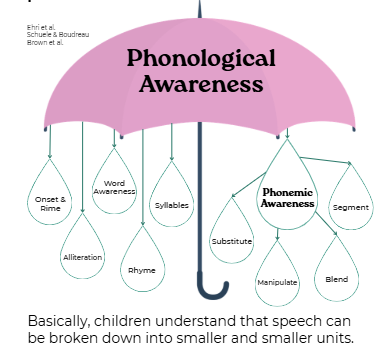
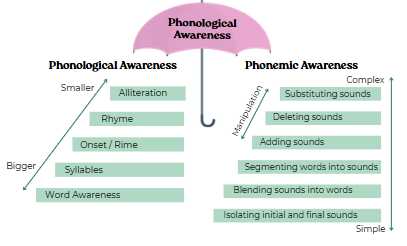
Phonological awareness is an umbrella term for the ability to recognize and play with the sound structure of spoken language. It includes noticing that sentences are made of words, words can be broken down into syllables as well as broken down into the onset and rime (not to be confused with rhyme). Phonological awareness also includes rhyming (different from rime) and alliteration. At the most advanced level, phonological awareness also includes hearing the individual sounds that make up words. This is called phonemic awareness. Phonemic awareness includes segmenting and blending sounds as well as manipulating and substituting sounds.
Image from handbook included in CEU training
Where Phonological Awareness Fits in Early Literacy
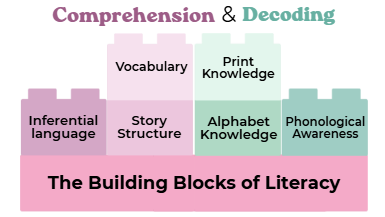
Phonological awareness is one of the building blocks of emergent literacy, the skills children build before they read and write. Those building blocks fall into two groups: 1. Comprehension (understanding what we read)
Vocabulary
Story structure
Inferential language
2. Decoding (how to read the words)
Print knowledge
Alphabet knowledge
Phonological awareness
Children need both sets of skills - comprehension and decoding to become a reader. This blog focuses on phonological awareness. If you missed it, we also have a full blog onhow to teach print awareness.
Phonemic Awareness vs Phonological Awareness vs Phonics
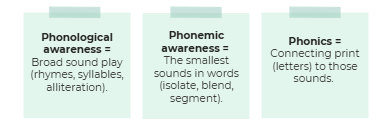
These three terms often get used interchangeably like they're the same thing; however, they are related, but not the same.
The smallest sounds in words: isolating, blending, and segmenting single sounds
"What sound do you hear first in sun?" /s/
Phonics
Connecting letters to those sounds
"This letter S says /s/. Let's find the letter S!"
Phonological awareness vs phonemic awareness:
Phonemic awareness lives under the phonological awareness umbrella. It's the most advanced part, where children work with single sounds.
Phonological awareness vs phonics:
Phonological awareness and phonemic awareness are about sounds you hear, with no letters needed. Phonics brings in the letters.
You can have phonological awareness without phonics, but you can't have phonics without phonological awareness. If a child can't isolate the /s/ sound in sun, the letter S has nothing to connect to.
The Phonological Awareness Skills Preschoolers Need
Here are the phonological awareness skills under the umbrella, from bigger chunks of sound to the smallest sounds or you can think of it from least complex to most complex. Phonological awareness (bigger sound chunks) Word awareness: knowing sentences are made of separate words. "I like big horses" = 4 words. Syllables: the beats in a word. Cake (1), cow-boy (2), ba-na-na (3). Rhyme: words that sound the same at the end. Cat, hat, mat. Alliteration: words close together that start with the same sound. "She sells seashells." Onset and rime: the first sound (onset) and the rest of the word (rime). /sh/ + ip = ship.
Phonemic awareness (the smallest sounds) Isolating the first and last sound: hearing a single sound in a word. "Tap" starts with /t/ and ends with /p/. Blending: putting sounds together to make a word. /s/ /u/ /n/ = sun. Segmenting: pulling a word apart into its sounds. sun = /s/ /u/ /n/. Manipulating: adding, deleting, or swapping sounds. "Say mat without the /m/."
Even though the image above makes it look like staircase of skills, where one has to be mastered before moving to the next, it is not. One more time, louder in the back, this is not a staircase of skills where children have to master a lower step before going to a higher step. Children generally notice bigger chunks (words, syllables, rhyme) before the smallest sounds. But these skills don't develop one step at a time. They overlap and spiral (Anthony et al., 2003). That means you don't have to wait for a child to master rhyming before you play blending games. Children can grow in several skills at once.
The Two Skills That Matter Most: Blending and Segmenting
If you only remember one thing from this blog, this is it: Blending and segmenting have the strongest link to word reading and later reading comprehension (Ehri et al., 2001). That's true at every level: blending and segmenting words, syllables, onset and rime, and single sounds. So, if there was ever a basket to put your phonological awareness eggs into, it's the blending and segmenting basket! Put your energy there!
How to Teach Phonological Awareness: 7 Best Practices
Here's what research says makes teaching phonological awareness work. Good news, none of it requires any kind of extensive lesson planning and you can use what you are already doing every day!
Teach through play. This should feel like a quick, silly game, not "drill and kill." It is never a test.
Use micro bursts. Just a couple of minutes, several times a day. Short bursts help children most (Carson et al., 2013).
Build it into routines you already have. Arrival, lining up, handwashing, snack, clean up, outside time. You don't need fancy materials.
Focus on 1 or 2 skills at a time. The most effective instruction targets just one or two tasks, not everything at once (Ehri et al., 2001).
Go from bigger to smaller. Start with words and syllables, then move toward single sounds.
Use I do, we do, you do. Model it first. Then do it together. Then let the child try on their own.
Make it multi-sensory. Clap, stomp, hop, push blocks, squish playdough. Give children a hand mirror so they can watch their mouth make sounds.
And one more thing that takes a lot of pressure off: it works in whole group, small group, with teachers, aides, parents, and SLPs (Rehfeld et al., 2022; Rice et al., 2022). Do what works for your classroom and do it consistently.
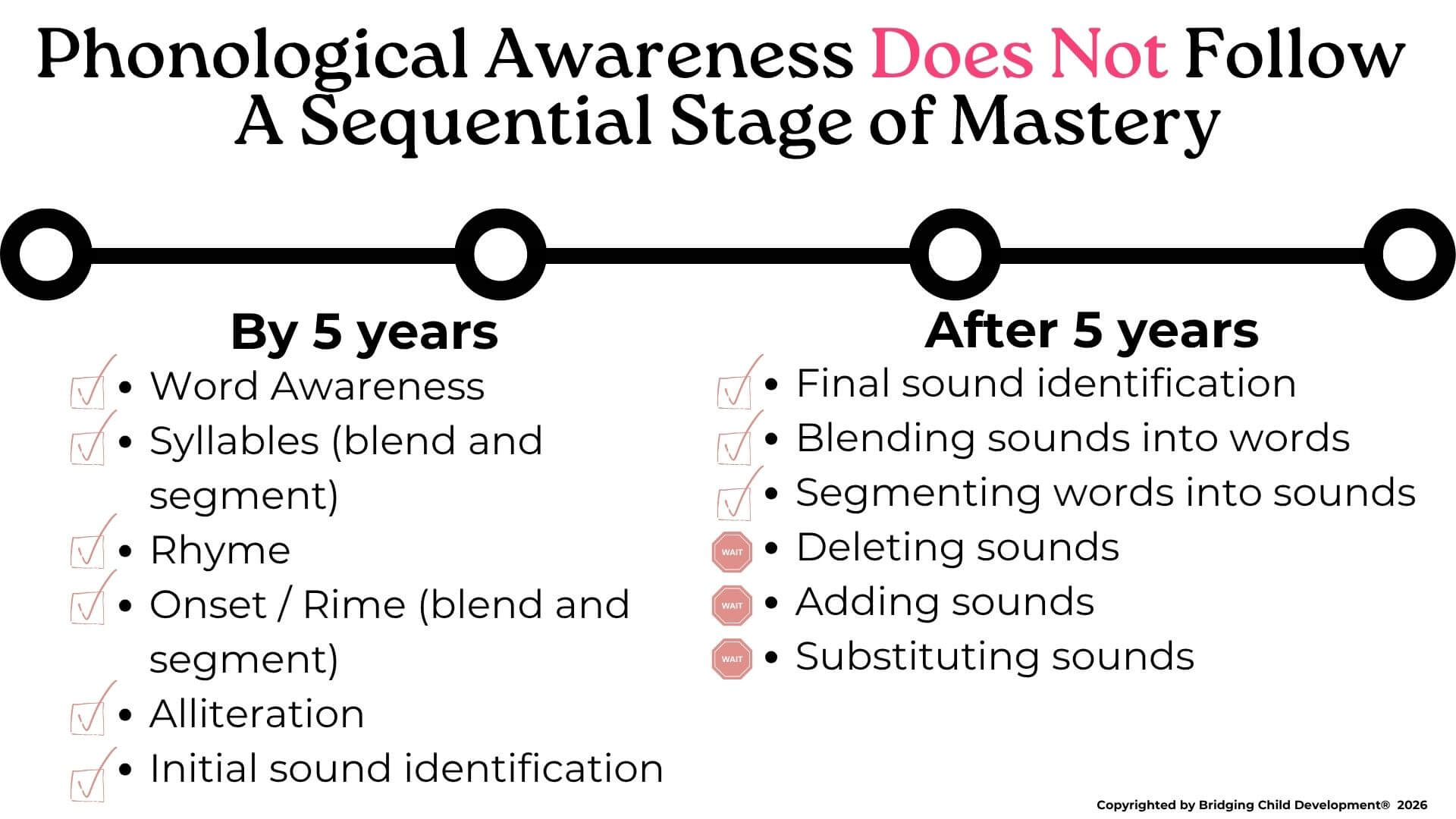
This is a loose guide and a wide range of ability is normal. Remember, it is not a stairstep, they can work on many of these skills at the same time and you can work on by 5 and after 5 skills together.
The skills with a "wait" sign are no off-limits per se, but we just don't expect mastery in preschool and they may not even need to work on those more complex phonemic awareness skills and still be able to successfully learn to read and spell.
Supporting Children Who Need a Little More
Phonological awareness instruction benefits everyone! Literally everyone- typically developing children, children at risk for reading difficulties, children with disabilities, and multilingual learners (Ehri et al., 2001; Rice et al., 2022). If you are suspecting a child may have a delay in these skills, first ask yourself: Have they had the chance to practice?We can't call it a delay if a child has never been taught or given chances to practice. That's another reason to start now. If we never work on these skills, we won't even know which children actually need extra help.
If you are doing phonological awareness activities and the child is struggling, scaffold down.
Go back to "I do" and "we do." If segmenting is too hard, try blending. If blending single sounds is too hard, blend syllables.
If you have a child with speech delays, modify the activity. These are children who are talking, but you have a hard time understanding them. Speech sound difficulties and reading are closely connected. About 25% of children with a speech disorder also have a reading disorder, even with speech therapy (Tambyraja et al., 2020). If a child says "wun" for "run," they may know the word starts with /r/ and just can't produce it yet. Try:
Ask yes/no questions. "Does run start with /r/?"
Use pictures. "Point to the one that starts with /r/."
Let them push a block or point instead of saying the answer.
If you have multilingual learners don't stress rhyming. Blending, segmenting, and syllable skills transfer across languages. Rhyming is the exception. Rhyme is very English-centric and rare in some languages. If a multilingual learner struggles with rhyme, don't assume a delay, and don't spend a lot of time there. Move on to blending and segmenting, where the biggest benefit is anyway.
Don't Forget Hearing In one study, 54% of children with reading impairments failed a hearing screening, compared with 21% of children with typical reading skills (Werfel et al., 2020). Even a mild hearing loss can make sounds "fuzzy." If a child is struggling, a hearing screening is a smart first step.
And as always: refer and see, don't wait and see. For children birth to 3, anyone can make a referral to your state's early intervention program. For children 3 to 5, families can contact Child Find through their local school district.
Myth Busting: 7 Things Teachers Hear About Phonological Awareness
Myth 1: "Phonological awareness, phonemic awareness, and phonics are the same thing." Fact: They're related, but not the same. Phonological awareness is broad sound play, phonemic awareness is the smallest sounds, and phonics connects sounds to letters.
Myth 2:"Kids will pick it up naturally if we read and sing enough." Fact: Phonological awareness does not develop naturally. Books and songs are a great start, but children need you to point out the sounds and play with them on purpose.
Myth 3:"It has to be a whole-group lesson led by the lead teacher." Fact: It works in whole group, small group, and one-on-one, led by teachers, aides, parents, or SLPs (Rehfeld et al., 2022; Rice et al., 2022). Do it however is efficient and consistent for you.
Myth 4: "Kids have to master rhyming before they can learn harder skills." Fact: Development overlaps; it's not a staircase. You don't have to wait for a child to rhyme before playing blending and segmenting games.
Myth 5:"Kids must master every level, including deleting and swapping sounds." Fact: The big winners for reading are blending and segmenting (Ehri et al., 2001). Children become strong decoders without tricky tasks like "Say smile without the /s/."
Myth 6:"I should be teaching sight words with flashcards." Fact: Memorizing whole words is part of how we got into this reading crisis. Even a child's first "sight word," their name, is made of sounds. When children learn to notice the sounds and the tricky parts of a word instead of memorizing its shape, they read it more accurately (Colenbrander et al., 2022).
Myth 7: "I need a sound wall in my classroom." Fact: Children have to hear, blend, and pull apart sounds out loud before a sound wall means anything. There are no published studies showing a sound wall on its own improves reading. Mouth pictures can help when you actively teach with them, but stapling them to the wall won't do the work (Becker & Sylvan, 2021). You'll get way more bang for your buck from the activities in this blog.
Learn How to Teach Phonological Awareness and Earn CEUs
Want the whole system? In Sounds and Symbols: Enrich Literacy by Developing Print and Phonological Awareness, I walk you through every skill in this blog, show you videos of the activities in action, and give you a handbook packed with games tied to your daily routines. You'll leave with ideas you can use the very next day.
Phonological Awareness FAQs
What is the difference between phonemic awareness and phonological awareness?
Phonological awareness is the big umbrella. It covers words, syllables, rhyme, alliteration, and onset and rime. Phonemic awareness is the most advanced part of that umbrella: hearing, blending, and segmenting the single sounds in a word, like knowing "sun" is /s/ /u/ /n/.
Is phonological awareness the same as phonics?
No. Phonological awareness is all about sounds you hear, with no letters. Phonics connects those sounds to letters. Children need phonological awareness first, because phonics only makes sense once they can hear the sounds.
What phonological and phonemic awareness skills should I focus on most with my preschool class?
Blending and segmenting. They have the strongest link to learning to read. Practice them with syllables first, then onset and rime, then single sounds with your older 4s and 5s.
How much time should I spend teaching phonological awareness?
Just a couple of minutes at a time, several times a day. Short micro bursts during transitions, snack, and outside time work better than one long lesson.
What if a child in my class can't rhyme?
That's okay. Keep playing, but don't get stuck there. Rhyming isn't a required first step, and it doesn't transfer across languages for multilingual learners. Move on to blending and segmenting games, which matter more for reading.
References
Anthony, J. L., Lonigan, C. J., Driscoll, K., Phillips, B. M., & Burgess, S. R. (2003). Phonological sensitivity: A quasi-parallel progression of word structure units and cognitive operations. Reading Research Quarterly, 38, 470–487.
Becker, R., & Sylvan, L. (2021). Coupling articulatory placement strategies with phonemic awareness instruction to support emergent literacy skills in preschool children. Language, Speech, and Hearing Services in Schools. https://doi.org/10.1044/2020_lshss-20-00095
Carson, K. L., Gillon, G. T., & Boustead, T. M. (2013). Classroom phonological awareness instruction and literacy outcomes in the first year of school. Language, Speech, and Hearing Services in Schools, 44, 147. https://doi.org/10.1044/0161-1461(2012/11-0061)
Colenbrander, D., et al. (2022). Teaching children to read irregular words: A comparison of three instructional methods. Scientific Studies of Reading, 26(6), 545–564. https://doi.org/10.1080/10888438.2022.2077653
Ehri, L. C., Nunes, S. R., Willows, D. M., Schuster, B. V., Yaghoub-Zadeh, Z., & Shanahan, T. (2001). Phonemic awareness instruction helps children learn to read. Reading Research Quarterly. https://doi.org/10.1598/rrq.36.3.2
National Early Literacy Panel. (2008). Developing early literacy: Report of the National Early Literacy Panel. National Institute for Literacy.
Rehfeld, D. M., Kirkpatrick, M., O'Guinn, N., & Renbarger, R. (2022). A meta-analysis of phonemic awareness instruction provided to children suspected of having a reading disability. Language, Speech, and Hearing Services in Schools. https://doi.org/10.1044/2022_lshss-21-00160
Rice, M., Erbeli, F., Thompson, C. G., Sallese, M. R., & Fogarty, M. (2022). Phonemic awareness: A meta-analysis for planning effective instruction. Reading Research Quarterly. https://doi.org/10.1002/rrq.473
Tambyraja, S. R., Farquharson, K., & Justice, L. (2020). Reading risk in children with speech sound disorder: Prevalence, persistence, and predictors. Journal of Speech, Language, and Hearing Research. https://doi.org/10.1044/2020_JSLHR-20-00108
Werfel, K. L., Peek, L., Reynolds, G., & Bassard, S. (2020). Hearing screening failure among students with reading impairment. Perspectives of the ASHA Special Interest Groups. https://doi.org/10.1044/2020_PERSP-19-00163
Prefer to learn these tips in a training?
Find a format that works for you.
Get your state-approved hours and CEUs, a comprehensive handbook you'll reference forever, and strategies that’ll make a difference in the children you’re caring for.
Live Virtual Trainings
Real-time interaction, community with other providers, and the energy of learning together.
Self-Paced Trainings
Flexibility to learn on your own schedule, pause and rewatch as needed, with opportunities to learn and engage with others.
Private Trainings
A customized training for your entire staff, in-person or virtual, with hands-on activities built around your center's needs.
Hey, I’m kelly
Speech Language Pathologist, Early Intervention Specialist, Child Care Trainer, and Former Family Child Care Owner
I work alongside early childhood educators caring for children with a variety of needs. But these needs look very different than they did twenty years ago and you deserve trainings, resources, and tools that reflect that.
Trainings that are high quality, affordable, and worth coming back to.
That's why I built Bridging Child Development. Every training hour you earn here gives you strategies you can use the very next day in your classroom.
Login or sign up to start learningLogin to start learning