
Challenging Behaviors in Child Care: A Teacher's Complete Guide
Jul 22
/
Kelly Goldberg
As a pediatric speech-language pathologist and early intervention specialist, I'm inside child care classrooms every single week.
Challenging behavior is the number one thing teachers ask me about, by a land slide. So this guide pulls together everything I share during my early intervention visits: Why challenging behaviors happen, how to prevent most of them, exactly what to say in the moment, and what to do when a behavior needs more support than strategies alone.
Challenging behavior is the number one thing teachers ask me about, by a land slide. So this guide pulls together everything I share during my early intervention visits: Why challenging behaviors happen, how to prevent most of them, exactly what to say in the moment, and what to do when a behavior needs more support than strategies alone.
What Counts as a Challenging Behavior?
A challenging behavior is any repeated behavior that interferes with a child's learning, relationships, or safety or the learning and safety of the children around them.
In child care, the big ones are:
However, I want you to know that basically all the behaviors on this list are actually totally developmentally expected at some point in early childhood, not that this makes the behavior any less challenging, these are all very hard when managing an entire classroom but it's important to have a strong understanding of what is "normal" at each age.
In child care, the big ones are:
- Biting
- Hitting, kicking, pushing, scratching
- Throwing toys or materials
- Screaming
- Running away from the group or eloping
- Refusing to participate in routines or just overall non-compliance
- Destroying materials or other children's work
- Cussing and other disrespectful language
However, I want you to know that basically all the behaviors on this list are actually totally developmentally expected at some point in early childhood, not that this makes the behavior any less challenging, these are all very hard when managing an entire classroom but it's important to have a strong understanding of what is "normal" at each age.
What's Developmentally Expected? Behavior by Age
Infants (0–12 months):
I'm just going to put it out there, an infant cannot behave badly. Mouthing everything, dropping food off the tray repeatedly, crying when you walk away, pulling hair, hitting, making loud screeching noises — all totally expected.
Young toddlers (18 month olds):
The behavior of a young toddler can be summed up in two words... "Me do" (IYKYK). Here are challenging behaviors that likely feel like misbehavior but are totally developmentally expected at 18 months.
They:
They:
- Want independence which means “No!” is a very important word to them so they use it...a lot.
- Want to give the orders and make the decisions
- Do the opposite of most instructions given
- Do not typically follow a verbal command
- Can be rigid and inflexible- they want things the way they want
- Are not able to wait - things need to happen right away and has no patience
- Have a very short attention span
- Will step on, push, hit others- including babies and not feel bad about it
- Have no concept of sharing
- Have unlimited energy
- Want to touch and explore everything
Older toddlers (2 year olds):
The behavior of older toddlers can also be summed up in two words... "Opposite extremes". What I mean is they make a choice but what they actually want is something totally different. Here are more challenging behaviors that likely feel like misbehavior but are totally developmentally expected at 2 years old.
They:
They:
- Want what they want, when they want it, and have almost no patience, "wait a little while" is not possible
- Want everything to be exactly the way they want it (and their preferences change)
- Like routine, which means they like to wear the same clothes, play with the same toys, or eat the same foods and this can make changing from one activity to another hard
- Are demanding and have strong emotions, which can lead to hitting or biting because they are trying to get their wants or needs met right away
Young Preschoolers (3–4 years):
The behavior of young preschoolers can also be summed up in one word..."Why?" They are deeply curious about the world around them but this also leads to testing boundaries often. Here are more challenging behaviors that likely feel like misbehavior but are totally developmentally expected at 3 years old.
They:
They:
- Whine, cry, question everything, and frequently complain
- May say, “I hate you” when frustrated by limits
- May make demands to control like, “Don’t look!” “Don’t talk!” “Don’t laugh!”
- Demand all the attention to be on them, "Watch me!" and get jealous when you give attention to others
Older Preschoolers (4-5 years):
The behavior of older preschoolers can also be summed up in one word..."poopyhead." They loooovvveeee potty talk, "doo-doo head" and "fart face" are used and they are looking for the shock value reaction. Here are more challenging behaviors that likely feel like misbehavior but are totally developmentally expected at 4 years old.
They:
They:
- Like to begin something and move on quickly to the next thing, finishing is not their priority
- May use swear words because they get a rise out of people
- Will hit, kick, or spit when angry
- Laugh and cry easily, their emotions fluctuate quickly
- Are more persistent and demanding and it seem they are doing things for the purpose of being obnoxious
- May lie

Behavior IS Communication
Every challenging behavior is a child communicating something they don't yet have the skills to say. Think about a typical two year old: They understand way more than they can say, have anywhere from 50-250 words, and their ability to actually use those words when they have big feeling is pretty much non-existent. (Seriously, I can think of some grown adults that struggle to "use their words" when they are mad.)
So when a 2 year old child wants the red truck another child is holding, they have two options:
- Independently generate the sentence, "Can I have a turn when you're done?" (Which would not even be developmentally appropriate- it would sound more like, "Want truck")
- Grab it
Grabbing works faster. Until a child has the developmental ability to use that language or we teach a better way that works just as well, the grabbing (or hitting, or biting, or screaming) will continue, because this form of communication works.
This is also why challenging behaviors and language delays show up together so often. A child who is behind in language doesn't stop having wants, needs, and big feelings. They just have fewer tools to express them — so their body does the talking. If you have concerns about a child's development, check out our early intervention blog.
4 Reasons Behind Every Challenging Behavior
Every challenging behavior serves a purpose, we call this the "function of the behavior". There are usually four functions.
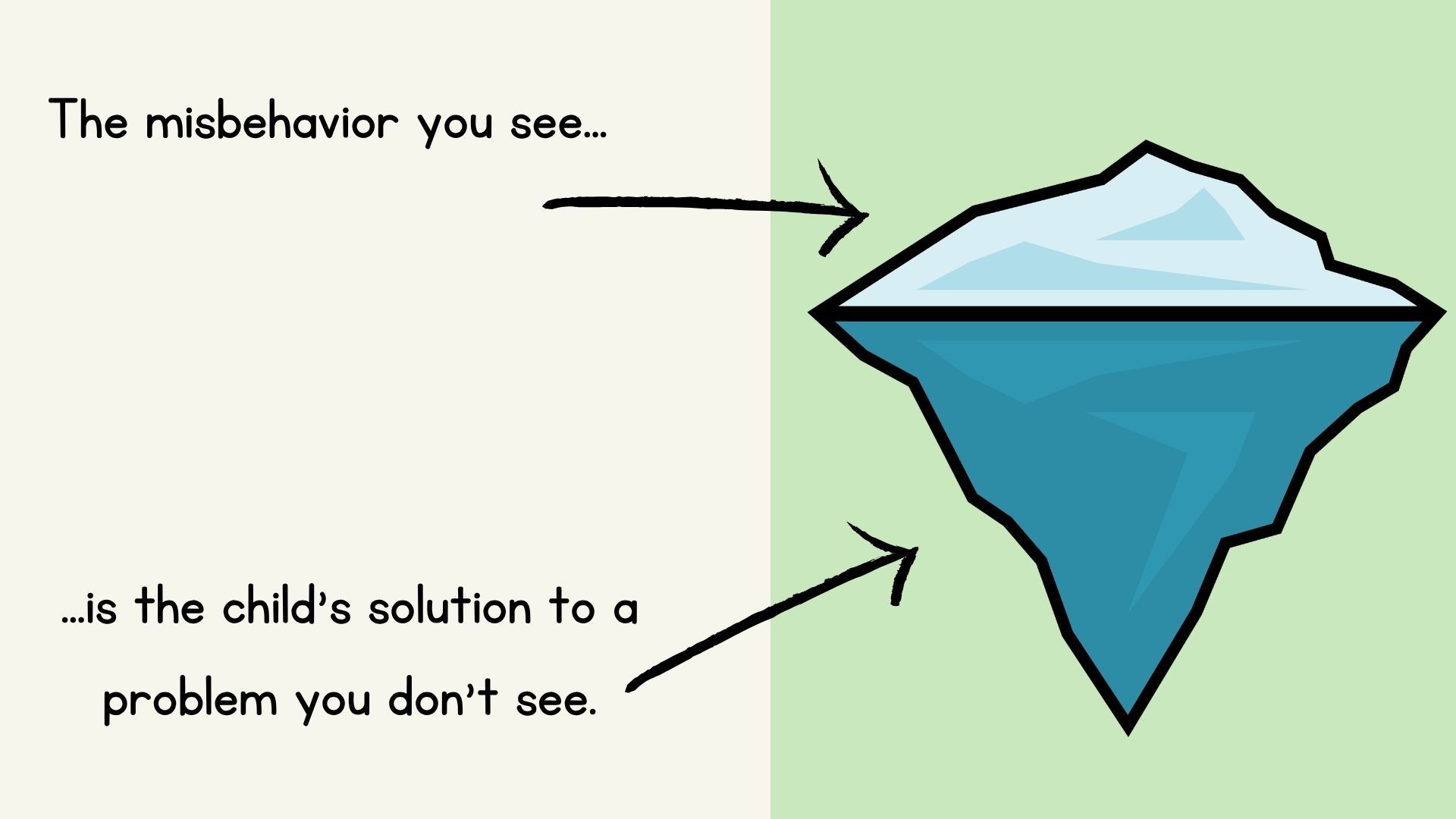
1. To get power
Looks like: "You can't make me!", digging in their heals over tiny things, bossing you or their peers around, just general non-compliance, or doing the opposite of what you asked.
What doesn't work: Trying to actually win the power struggle and digging your heals in right back.
2. To get connection
This looks like: Repeating a behavior while watching for your reaction, suddenly "forgetting" how to do things they mastered months ago, or fussing they need help with everything.
What doesn't work: Constant reminders, doing it for them, and big reactions. If a child gets thirty seconds of your undivided attention every time they throw a toy, and almost none when they play quietly, throwing is a great strategy for them to get connection with you. Children don't care if it is negative attention or positive attention.
What doesn't work: Constant reminders, doing it for them, and big reactions. If a child gets thirty seconds of your undivided attention every time they throw a toy, and almost none when they play quietly, throwing is a great strategy for them to get connection with you. Children don't care if it is negative attention or positive attention.
3. To get something or get back at someone
This looks like: The child wants a toy, a turn, a spot on the slide and boom they are hitting or grabbing OR someone took their toy or cut in line in front of them and bam, they are hitting or biting.
What doesn't work: Time outs, lectures, advice, or you taking their behavior personally.
4. To meet a sensory need
This looks like: Crashing into things, mouthing toys, dumping bins to hear the sound, or spinning. Sometimes the child is seeking input (the spinner and crasher) or sometimes they're escaping input (the eloper or the hitter when the room gets too loud).
What doesn't work: Trying to get them to stop the behavior and not meeting their sensory needs.
What doesn't work: Trying to get them to stop the behavior and not meeting their sensory needs.
4 ways to prevent challenging behaviors in child care
Since most challenging behaviors in child care are related to the reasons above, it means we can do some things to prevent them.
1. Check your environment
1. Break up your open spaces to create small nooks- Wide open spaces create opportunities for kids to run, step all over each other, and throw stuff, which is going to lead to a bigger problem.
Try: Break up your space with shelves, pull things away from the wall to create little nooks they can go in, and try to mix in some larger pieces.
2. Look at your materials- Three children, one popular toy? You will have grabbing. Shelves crammed with a whole bunch of choices? You will have dumping.
Try: Having fewer toys out and rotate them often. This supports children with sensory needs too.
3. Have a cozy or calm down corner- Just like you might need a quiet moment with your morning coffee, children need a dedicated space to process their feelings. It is more than just a carpet and pillow in the corner of the room and it is not a time out. Read this blog to learn how to set up and use a calm down corner.
4. Avoid having kids wait without purpose- Children spend a lot of time waiting — in line, at the table before food arrives, on the carpet before circle time starts. This is often where behavior happens.
Try: Break up your space with shelves, pull things away from the wall to create little nooks they can go in, and try to mix in some larger pieces.
2. Look at your materials- Three children, one popular toy? You will have grabbing. Shelves crammed with a whole bunch of choices? You will have dumping.
Try: Having fewer toys out and rotate them often. This supports children with sensory needs too.
3. Have a cozy or calm down corner- Just like you might need a quiet moment with your morning coffee, children need a dedicated space to process their feelings. It is more than just a carpet and pillow in the corner of the room and it is not a time out. Read this blog to learn how to set up and use a calm down corner.
4. Avoid having kids wait without purpose- Children spend a lot of time waiting — in line, at the table before food arrives, on the carpet before circle time starts. This is often where behavior happens.
Try: Give purpose when waiting. Can they do wall push ups? Look at books? Do phonological awareness activities like clapping syllables or listening for rhyming words while they wait in line? Give them something to do (and usually keeping their hands busy means they are not hitting)
2. Master your transitions
Transitions cause more challenging behaviors than any other part of the child care day and often once we have some good transition strategies in place, the behaviors significantly decrease.
Try:
Try:
- Giving a visual warning not just the verbal "Two more minutes." This could be a count down timer or an actual action such as "two more slides, then we go in."
- Giving every child a job "You carry the blocks bucket!" or something to do between the moment of transition. You can try, "Walk like a penguin to the bathroom." “Bear crawl to the cubbies!" “Bunny hop to circle time!"
- Singing the same transition song every single time so children know what to expect, and make it a game. "Can we get cleaned up before the song ends?"
3. Focus on connection
Attention seeking behaviors are connection seeking behaviors. We do not want to ignore the child when these behaviors happen, because then we are not meeting the underlying need and the behaviors will just continue.
Try:
Try:
- Give the child ten minutes of genuine, child-led play where you are playing what they're playing, narrating what they're doing and making zero demands. This should be fun! You are down on the floor smiling, laughing, and connecting!
- Look for moments of good and point them out all throughout the day. It might sound like, "Wow you used a lot of color on your art work!" or "You held the door for Kelly, that was kind and thoughtful." When children feel good, they do good, so we want to build these opportunities in!
4. Give children power
1. Offer choices all throughout the day. Giving choices is a way to give some power back to a child in a developmentally appropriate way. We want these choices to always be between two great choices.
Example: "Red cup or blue cup?" "Walk or hop to the sink?" NOT "clean up or time out." (That is not two great choices, that’s forcing power and control on them and will 100% lead to heals being dug in)
2. Have class jobs. I don't care if you are 4 or 44, being asked to help feels better than being told what to do. Lean into this!
Examples: Door holder, meteorologist, janitor (wipes tables) snack counter, time keeper, horticulturalist (plant waterer).
Example: "Red cup or blue cup?" "Walk or hop to the sink?" NOT "clean up or time out." (That is not two great choices, that’s forcing power and control on them and will 100% lead to heals being dug in)
2. Have class jobs. I don't care if you are 4 or 44, being asked to help feels better than being told what to do. Lean into this!
Examples: Door holder, meteorologist, janitor (wipes tables) snack counter, time keeper, horticulturalist (plant waterer).
3. Have routines and visuals. A child’s brain is wired through repetition and consistency so routines create safety, consistency, and belonging. Really look at your routine. If there is a part of your day that is especially challenging, change it! That might look like changing what time of day you do that activity or maybe looking at what comes before or after that is making that part of the day hard. Also, can you change your schedule to make less transitions? (This is usually where power struggles happen.) Do they have to clean up at every transition or can the mess stay until the end of the day?
Tip: Whatever schedule you decide on, make a visual. There are tons of free visuals online, ones you can purchase, or just take pictures of your class in those routines, laminate them, and use them as a visual.
How to respond in the moment of a challenging behavior
Below are so many different ways we can respond when a child is having a hard time. It sort of depends on the behavior itself as to which will work best, so there is some trial and error here. Don't give up! Behavior is very much a rollercoaster and what works for one child may not work for another. Give a couple strategies a try and adjust as needed.
1. Say what TO do, not what to stop doing. When we tell a child to "Stop running" or "No throwing" all that child is hearing is, run and throw. Also, developmentally, we don't expect kids to understand "no" and "stop" (negatives) actually mean to do something totally different. What I mean is, if we say, "No throwing." a child has to process that to mean, "I need to put the toy down and start playing with it." That is a really hard skill that comes later!
Try: "Walk" or "Drive the car." or "Stack the blocks."
2. Keep your language short. Lectures and long explanations do not work during the early childhood years. Notice the examples above were 1-3 words. Keep you language there!
Try: "Walk" or "Drive the car." or "Stack the blocks."
2. Keep your language short. Lectures and long explanations do not work during the early childhood years. Notice the examples above were 1-3 words. Keep you language there!
3. Tend to safety first. If someone was hurt, your attention should go to the hurt child first for a couple reasons. 1. We want to make sure the behavior does not get extra attention (remember kids don't care if it is positive or negative attention) and 2. We want to model empathy, you can't just teach kids to be empathetic, they need a model and they have to experience it.
4. Redirect into the behavior: First: Suggest a different, more appropriate activity *that serves the same purpose* Next: Join in. Participate in the new activity with the child to connect and model appropriate behavior.
Example: “You can throw this ball. Lets try to get it in the laundry basket or should we see who can throw it farthest?” (instead of throwing toys)
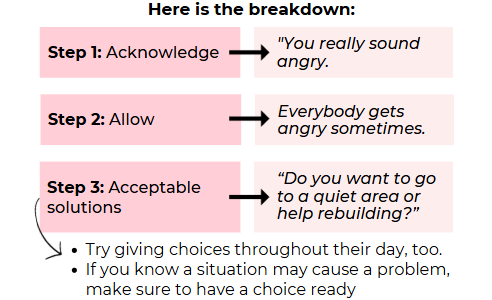
5. The 3 A's. Basically, we want to avoid trying to rationalize with an emotional child, their brain is literally not capable in that moment. Instead we want teach them HOW to talk about their feelings by modeling a feelings word, validate them (like yeah we have all felt this way) and then help them come up with what to do instead.
5. The 3 A's. Basically, we want to avoid trying to rationalize with an emotional child, their brain is literally not capable in that moment. Instead we want teach them HOW to talk about their feelings by modeling a feelings word, validate them (like yeah we have all felt this way) and then help them come up with what to do instead.
How to respond after the moment of a challenging behavior
If hitting was how a child asked for a turn and we take away hitting but we didn't teach them what to do instead, all that happens is the hitting comes back or a new behavior (like biting or screaming) takes its place. And we can do this without making children feel bad or shame.
The goal isn't to stop a behavior, we have to teach them what to do instead.
These moments come during small or whole group activities.
Example- Grabbing toys: Teach "Can I have a turn when you're done?" Have the kids practice this. Have some toys and you model the language. Have kids role play. Then come up with "'Things you can do while you wait for a turn." and practice those too!
If someone was hurt, we need to teach the repair.
An apology is more than words. It requires genuine understanding and an attempt to fix the problem.
Example- Start with comforting the “victim” first. “I can see how upset you are about your tower. What words could you say to your friend? Is there something they could do to help fix the problem?”
Example- Start with comforting the “victim” first. “I can see how upset you are about your tower. What words could you say to your friend? Is there something they could do to help fix the problem?”
Followed by talking to the child that hit, bit, or in this case, knocked down someone's tower: “I bet that was fun to watch the tower fall. But look at your friends face. How do you think she is feeling? Can you think of something that might help fix the problem?”
The Big 5 Challenging Behaviors in Child Care- Quick Guide
Each of these deserves (and will get) its own deep-dive post, but here's your fast reference.
Biting
This one is the worst but also developmentally common in the 12–30 month range. Biting is communicating a want, frustration, teething, or an unmet sensory need. Shadow the biter, especially during high-risk times and teach the replacement using strategies above. Also, in your policies, have a plan for communicating biting with families — the biter's family and the bitten child's family.
Hitting
What is the function of the behavior? Are they hitting to get a toy, hitting to escape an activity, or hitting for your reaction because they want some connection? The function changes your reaction.
- They want something or they are mad someone took something: Teach "Can I have that when you are done?" or "I am playing with that now, you can have it when I'm done." The key is to practice this skill often! If they can't use these words when they are calm, they will not use them when they are dysregulated.
- Sensory: Change your environment and offer sensory supports throughout your day. A calming corner is a great place to start and can have sensory supports within it.
Throwing
What is the function of the behavior? Are they throwing because it feels good (sensory?) or because they want attention or are they trying to get some power?
- Sensory- Offer deep input activities like wall pushups or animal walks, or less toys.
- Attention- Remember they want connection! "I wont let you throw the cars but we can play this throwing game."
- Power- Give choices of what they can do. We can throw beanbags into a basket or the basketball into the hoop. What do you choose? Throw with them, and make it fun!
Eloping
What is the function of the behavior? Are they eloping to escape the sensory environment or is it a game to them and being chased is giving them attention? You can see how these would require two different responses.
- Sensory- Offer deep input activities like wall pushups or animal walks, offer noise reducing headphones or quiet nooks.
- Attention- Remember they want connection! Offer an obstacle course you can do with them, have a tunnel for them to crawl through, turn it into a game- who can run faster or slowest?
Tantrums and meltdowns
While these terms are sometimes used interchangeably, tantrums and meltdowns are two totally different things that require two different ways of supporting.
- A tantrum has a goal and an audience, and ends when the goal is resolved (example: They want a toy. Have a tantrum. Get the toy. Tantrum stops).
- A meltdown is a dysregulated nervous system, there's no goal and no audience required. Tantrums need calm limits ("I know. The answer is still no.") while meltdowns need fewer words, lower lights, a safe space, and time.
When to get extra support
Most challenging behavior in child care is developmentally expected and when the tips in this guide are used consistently, you should see some change (it's not linear, you will have good days and bad days, but you should see some change). However, there are times when more support is needed. This could be from Early Intervention or any programs your county or state has available. Here are a few instances when you may want to seek support:
- Behaviors that are frequent, intense, and NOT improving after 4–6 weeks of consistent strategies
- A child whose language is noticeably behind their peers
- Reactions that seem enormous compared to the trigger, nearly every time
- Behaviors driven by sensory experiences that interfere with the child's whole day
- A child who was progressing and has aa sudden loss of skills
- Aggression in a preschooler that looks like a two-year-old's aggression (frequency and intensity that should have faded by now)
Talking to Families About Challenging Behavior
I personally think behavior conversations are harder to have than the "I'm concerned their not talking yet." conversations. Below are a few things I have found helpful when talking to parents about behavior concerns.
- Start with something positive. "Kelly had the best morning in the sensory bin and played there for twenty minutes."
- Describe the concern and be specific. "She's been hitting when someone has a toy she wants." (Not "She's hitting." That is opening the door for debate)
- Share what YOU'RE doing. "When it happens, we say 'Hands are for building' and we redirect to the toy. We're also teaching her to say 'Can I have a turn when you are done?"
- Ask what works for them. "Have you seen anything like this at home? What works for you? Have any other ideas of what would help?" makes them a part of the supporting their child and not feel like they have to defend their child.
Challenging Behaviors Training for Pre-School Teachers
Our IACET-approved behavior trainings give you the full toolkit of how to respond before, during, and after challenging behaviors and are broken down into how to support a child seeking power, attention, or they want to gain access or get back at someone.
Our trainings provide you with CEU hours that count toward your state's required training.
Our trainings provide you with CEU hours that count toward your state's required training.
Frequently Asked Questions:
Why do toddlers have so many challenging behaviors?
Because their wants and feelings are enormous while their language and self-regulation skills are just beginning. When a toddler doesn't have fast, reliable words, their body communicates instead — grabbing, hitting, biting, and screaming all "work" faster than words they don't have yet.
Why do children misbehave even when they know the rules?
Because rules are not internalized yet. Plus knowing a rule and having the skills to follow it are two different things, especially mid-big-feeling. (I can think of grown adults that struggle with this!)
Should I use time-outs in my child care classroom?
No. 1. Time-outs don't teach anything. A child sent to sit on a chair alone is not reflecting on what they did wrong and saying, "Gee, I don't like sitting here. Next time I will..." That's not happening so no behavior is changing. 2. What changes behavior at this age is calm limits, teaching them what to do instead, and lots of prevention. A calm-down space a child can choose is different from a time out.
Prefer to learn these tips in a training?
Find a format that works for you.
Get your state-approved hours and CEUs, a comprehensive handbook you'll reference forever, and strategies that’ll make a difference in the children you’re caring for.
Live Virtual Trainings
Real-time interaction, community with other providers, and the energy of learning together.

Self-Paced Trainings
Flexibility to learn on your own schedule, pause and rewatch as needed, with opportunities to learn and engage with others.



Hey, I’m kelly
Speech Language Pathologist, Early Intervention Specialist, Child Care Trainer, and Former Family Child Care Owner
I work alongside early childhood educators caring for children with a variety of needs. But these needs look very different than they did twenty years ago and you deserve trainings, resources, and tools that reflect that.
Trainings that are high quality, affordable, and worth coming back to.
That's why I built Bridging Child Development. Every training hour you earn here gives you strategies you can use the very next day in your classroom.

Subscribe to BCD's Teacher Tea Monthly Newsletter
1 email a week with weekly trainings updates, tips, and a monthly freebie!


Copyright © 2025 Bridging Child Development ® • All rights reserved