Sign Language for Toddlers: Keep Signing Even as They Start to Talk
Apr 25
/
Kelly Goldberg
Sign language doesn't stop being useful when toddlers start talking. If you work with toddlers, you already know this stage is equal parts magical and chaotic. One minute a child is proudly combining two words for the first time, and the next they're face-down on the rug because you handed them the blue cup instead of the green one.
At this stage in language development, children often understand more than they can express. We also know at this age, their speech can sometimes be hard to understand. This can create frustration for toddlers. This is exactly why I tell toddler teachers to lean on sign language. Yet, almost every time, I get the same question back:"But they're starting to talk now… is signing even still helpful?"
Yes. Honestly, this is the age I love using signs and see so many benefits!
Why Sign Language Still Matters for Toddlers
There is a lot going on during toddler development. They are learning independence, putting words together to make phrases and sentences, they are learning how to regulate their big feelings, and so much more.
Signs support development in all of these area.
4 Benefits of Sign Language for Toddlers
1. Less Frustration and Fewer Tantrums
Many challenging behaviors happen because children don't yet have an effective way to communicate. Sign language provides one.
A toddler who can sign "again," "help," or "all done" doesn't have to cry, scream, or grab to get their needs met. In a room full of toddlers, this is important.
2. Signs Clarify Speech You Can't Understand Yet
Here's something many people outside the speech-language therapy world don't realize: Even toddlers who are meeting every milestone can be hard to understand.
By age 2, listeners typically understand only about 50% of what a child says. Children aren't fully intelligible until closer to age 4. That's typical development! (If you want to learn more about speech sound development and if your toddlers and preschoolers are on track, click here.)
So when your two-year-old says "muh" at the snack table, is it "more"? "Milk"? "Mine"?
Now picture that same word paired with the sign for "milk." You obviously know what they want, can give it to them, and potentially prevent a meltdown.
3. Signs Support Spoken Language Development
Signs reinforce the spoken words you toddler class is just starting to learn.
When you pair a sign with a spoken word, children hear the word, see the sign, and connect both to the meaning of the moment. That multisensory input strengthens the connection.
Also, if you are feeling nervous that signs will delay language or a child will become dependent on signs, that is a common myth. Once a toddler can say "more" easily, the sign naturally fades. Speech is efficient, and toddlers move toward whatever communicates fastest. You never have to "wean" a child off signing.
There are a lot of myths around this topic and more, you can read more here!
4. Signs Support Late Talkers and Multilingual Learners
Language is an abstract skill. We use all these different sounds, we put sounds together to make words, and those words have meaning. And we have to do this all auditorily! That's hard for multilingual learners and late talkers.
Signs add an additional layer of multi-sensory learning, basically when you pair a word with a sign, you make that abstract concept more visually concrete.
One thing to note: Signs support talking, but they aren't a substitute for monitoring spoken language overall. By 24 months, children should use at least 50 spoken words and begin combining two words together.
A toddler who signs happily but isn't adding spoken words over time or who is well past two with only a handful of words is a child worth discussing with your director and the family, because an early intervention evaluation may be an appropriate next step.
Best First Signs to Teach Toddlers
One of the most common questions I get is: "Which signs should I start with?"
Start with words toddlers actually need throughout the day, words that help them get their wants and needs met. Here are some ideas:
Again
All done
Help
Eat / Drink
Wait
Open
Stop
Potty / Wash hands
Notice what's not on this list: colors, shapes, letters.
Those words and signs have their place especially in preschool,but they don't solve a toddler's most urgent need, which is communicating wants and needs right now.
Can Sign Language Help with Potty Training?
Signs aren't just for infants. (but if you have infants in your class, read this blog too.)
If your classroom is the one where potty training happens, try adding signs. This can add in making a brand new skill more concrete and easier to understand. Toddlers who are working on toileting may benefit from signs like:
potty
bathroom
wash
help
wet
all done
How to Teach Sign Language to Toddlers
Toddlers learn through repetition, routines, and play—not flashcards or drills. Here are tips for teaching signs to your toddler class. Say and Sign
Always pair the spoken word with the sign.
Repeat, Repeat, Repeat
Use the same sign, with the same word, in the same routine, every time.
Toddlers learn language through consistent, meaningful repetition. Your routines provide it automatically.
Pause and Wait
After you model a sign, give the child about 5 seconds of wait time to invite a toddler to imitate that sign.
Follow Through
If a child signs "drink," offer the drink. If they sign "help," provide help.
We want toddlers to make the connect that my words get me a response.
Respond to Every Attempt
When you notice intentional, consistent hand movement, even if it looks nothing like the adult version of the sign, respond to it: "More! You told me more!"
Bring Signs Into Play
Toddlers rehearse life through pretend play, so use signs there too.
Sign "eat" while a child feeds a baby doll. Sign "sleep" when the stuffed animal goes down for a nap. Sign "help" when the toy truck gets stuck.
You don't have to:
Physically move a child's hands to make them sign
Quiz them
Withhold a snack or something they want until the child produces the sign.
Remember, model, wait, and respond. Consistency does the rest.
Where Signs Fit in Your Toddler Day
The best part about signing with toddlers is that you don't add anything to your schedule, you just fold signs into the moments you're already living:
Snack and meals: "more" when you refill the bowl, "all done" as you start cleanup
Transitions: "all done" or "help" to smooth the move from one activity to the next (and we both know transitions are where toddler chaos loves to live)
Playtime: "help" and "again" to support sharing and requesting instead of grabbing
Story time: toss signs onto the repeating words in a favorite song or book; toddlers eat this up, and it cements the meaning
One thing I'll say over and over: Say the word out loud every single time you make the sign. Toddlers need to see it and hear it together for the connection to stick, and saying the word is also what keeps signing from ever competing with talking.
Not every toddler is going to pick up signs at the same time, and that is completely fine. Some children imitate signs within a day or two, others will watch you for weeks or months before they try. Neither is a problem. You may also see sign approximations.
A sign approximation is when a toddler's "more" might look like clapping, or tapping their fists together, or one general hand movement toward the snack bowl. A sign doesn't have to look "correct" to count! If they're using it consistently to mean "more," it's a signed word!
Just like we accept "wawa" for water, we accept a child's sign approximation while continuing to model the adult version ourselves. Their hands will refine over time, the same way their speech does.
Want to Add Sign Language To Your Toddler Classroom?
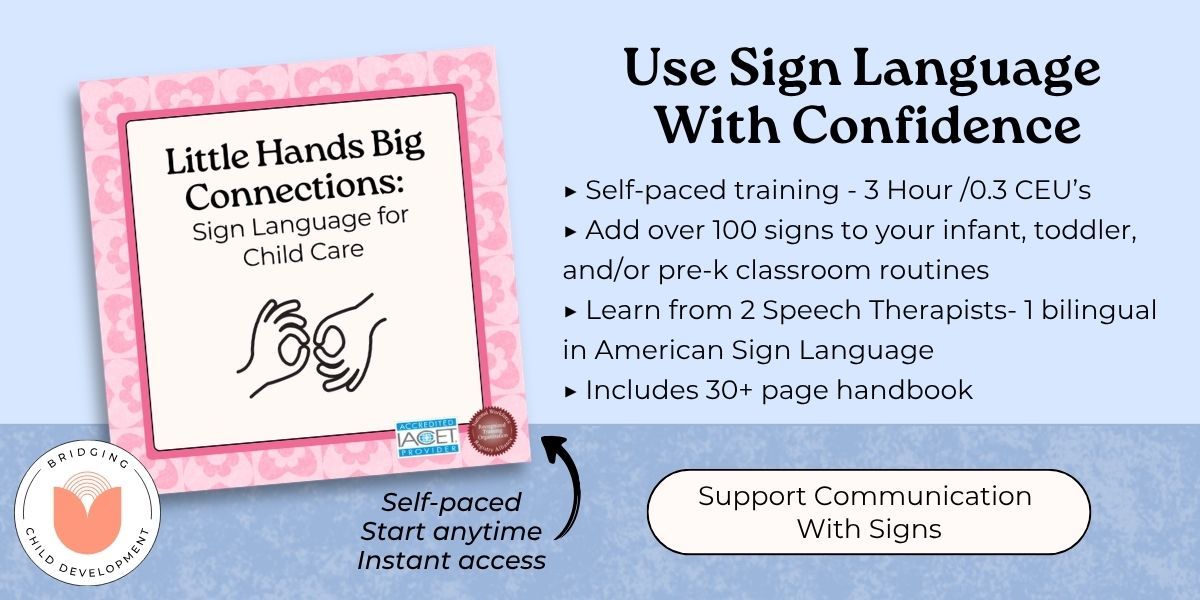
If you'd love a clear, doable way to start signing with your toddlers, which signs to use, how to model them, and how to weave them into your day, this IACET approved training is for you!
Frequently Asked Questions:
Does sign language delay speech and language development in toddlers?
No. Research consistently shows that sign language does not delay speech or language development. In fact, spoken words typically appear within a few months of a child learning the sign. The key is always saying the word while you sign.
Do I need to know ASL to sign with toddlers?
No. Most early childhood programs use individual ASL signs paired with spoken English. You're borrowing vocabulary, not teaching a full language, so you only need to learn the signs you'll actually use.
Should I correct a toddler's sign if they make it wrong?
No. Respond to the communication itself and keep modeling the correct version yourself. Sign approximations are just like word approximations—consistency from you does the correcting over time.
Prefer to learn these tips in a training?
Find a format that works for you.
Get your state-approved hours and CEUs, a comprehensive handbook you'll reference forever, and strategies that’ll make a difference in the children you’re caring for.
Live Virtual Trainings
Real-time interaction, community with other providers, and the energy of learning together.
Self-Paced Trainings
Flexibility to learn on your own schedule, pause and rewatch as needed, with opportunities to learn and engage with others.
Private Trainings
A customized training for your entire staff, in-person or virtual, with hands-on activities built around your center's needs.
Hey, I’m kelly
Speech Language Pathologist, Early Intervention Specialist, Child Care Trainer, and Former Family Child Care Owner
I work alongside early childhood educators caring for children with a variety of needs. But these needs look very different than they did twenty years ago and you deserve trainings, resources, and tools that reflect that.
Trainings that are high quality, affordable, and worth coming back to.
That's why I built Bridging Child Development. Every training hour you earn here gives you strategies you can use the very next day in your classroom.
Login or sign up to start learningLogin to start learning