Visual Supports for a Calm Down Corner That Actually Work
Dec 12
/
Kelly Goldberg
The right visual supports can turn a calm down corner from a place children ignore into a space they actually know how to use.
Have you ever found yourself saying, “I want them to use their words to tell me what’s wrong”? You’re not alone. As a pediatric speech therapist and early intervention specialist who supports child care providers every week, I hear this all the time.
Of course we want children to use their words, but the reality is: When toddlers and preschoolers experience big feelings, those words aren’t always available. And honestly, we as adults struggle with this too! Expecting a child to use words when they are mad is not realistic. It’s not realistic for an adult to do either.
Why Every Calm Down Corner Needs Visual Supports
Picture a time you were so frustrated you just needed a minute to get yourself together but someone kept pressing: “You look upset. Tell me what’s wrong. Use your words.”
Did you feel like calmly explaining? Probably not. You may have wanted space, a snack, or even to curl up in a blanket before you could talk.
Children feel the same way. When emotions run high, words don’t always come first. Calm brains talk, upset brains can’t. This doesn’t mean language isn’t important. It means we need to give children tools to communicate without words in the moment. This is where visuals come in.
Visual Supports Help Emotional Regulation
Visual supports do so much more than decorate a calm down corner. They actually make it easier for children to regulate their emotions because they reduce the demands on a child's brain during stressful moments.
Think about it...when a child is upset, we're often asking them to listen, process our words, remember what to do, figure out how they're feeling, and then explain it back to us. That's a lot for a little brain that's already overwhelmed. Visual supports take some of that work off their plate and meet children where they are.
Reduce language demands.
Children don't have to find the perfect words when they can't access them. They can simply point. In addition, visuals build feelings vocabulary words making it easier for them to access as they practice.
Reduce cognitive overload.
Instead of trying to remember what they're supposed to do, the visual shows them. Seeing the same visuals over and over also helps children remember calming strategies even when emotions are running high.
Makes choices concrete.
"Calm down" is an abstract idea. A picture of taking deep breaths or squeezing a stuffed animal is something a child can actually do. Choices also give children a sense of control (which calms the nervous system)
Builds independence over time.
Work across ability levels, so they are perfect for teachers with mixed ages, multilingual learners, and children with speech and language delays.
Visuals don't replace co-regulation. They support it. With lots of modeling and practice, those pictures gradually become words, and those words become lifelong emotional regulation skills.
Best Visual Supports for a Calm Down Corner
Not every visual is created equal. The best visual supports are simple, easy to understand, and give children something they can actually do when they're feeling overwhelmed. If your wall is covered with dozens of visuals that no one uses, it's probably time to simplify. A few meaningful visuals that children know how to use are far more effective than twenty they ignore.
These are the visual supports I recommend most often when I'm helping child care providers set up calm down corners.
A feelings chart
Simple faces showing mad, sad, happy, scared, frustrated, tired. Keep it to a handful of core emotions for toddlers, and add nuance ("disappointed," "nervous") as preschoolers grow their feelings vocabulary. We must model using these if we want kids to understand them!
When you're reading a book, stop and say, "Look at his face. I think he feels frustrated. Here's our frustrated picture." When you're excited about something, point to the happy face and model it yourself.
The more children see you using the feelings chart during everyday moments, the more likely they are to use it when their own feelings get big.
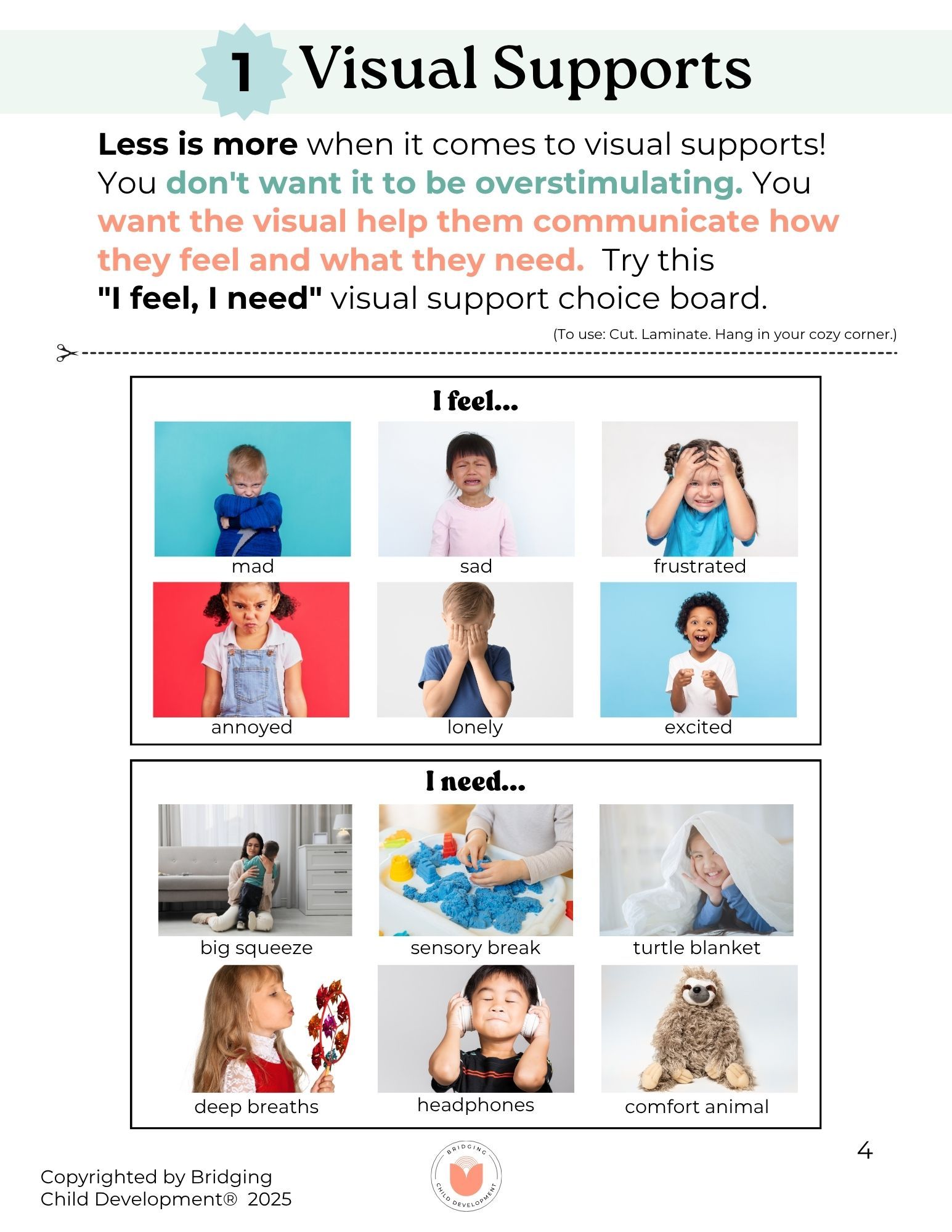
"I Feel, I Need"
The two-step bridge from emotion to action described above, my personal favorite. On one side, a child points to how they feel. On the other, they point to what would help — a turtle blanket, a squeeze, a drink of water, deep breaths, etc.
(This is page 3 of the free guide! See the end of the blog to download it.)
At first, you'll have to model using this tool. It might look and sound like a child getting frustrated so you get the visual and say, "You look frustrated. Your body is tight and you are throwing toys. We can say, I feel mad (point to picture). I need a deep breath (point to picture)." Then take some deep breaths with them. Then later, after lots of models, the same child may simply point to a picture, and that's a huge success! With lots of modeling and practice, they'll begin to pair the visual with the words: "I feel mad. I need the turtle blanket."
Think of visuals as the bridge between a big emotion and the words that eventually describe it. They don't replace language, they build it.
Calm-down strategy choice cards
Picture choices for how to regulate big feelings. It might be things like:
Take 5 deep breaths,
squeeze a stuffed animal
push the wall
drink water
look at a book
Choices give children control. Again, we have to model using them! It might sound like, "I feel so annoyed, I am going to squeeze my stuffy. This make my body feel calm"
Breathing Visuals
Let's be honest. Telling a three-year-old to "take a deep breath" usually isn't very helpful. Showing them how is.
A breathing visual turns an abstract idea into something children can actually follow.
Some favorites include:
tracing a star with their finger while breathing
smelling a flower and blowing out a candle
rainbow breathing
The picture becomes a guide that helps children slow their breathing without needing lots of verbal directions.
Step-by-Step Calm Down Cards
Sometimes children aren't sure what they're supposed to do once they enter the calm down corner.
A simple picture sequence removes the guesswork.
For example:
Come to the calm down corner.
Choose a calming tool. Need calm down corner tool suggestions? Read this blog.
Help your body feel calm.
Return to play when you're ready.
This gives children a predictable routine they can learn through repetition.
And just like everything else in a calm down corner, don't expect them to know the steps automatically. Practice them together often during calm moments.
Teacher tip: Real photographs (including photos of your own students modeling each strategy) are often easier for young children to understand than cartoon clip art and they make the corner feel like it belongs to your class.
How to Teach Children to Use Calm Down Corner Visuals
A visual taped to the wall doesn't teach itself. Here's how to set children up to use it:
Introduce it when everyone is calm! Never try any behavior support for the first time mid-meltdown. Why? If they can't use it when they are calm, they will never be able to use it when they are dysregulated. Practice during circle time, book time, play.
Model, model, model. Narrate your own feelings out loud and "use" the visual yourself. Children learn self-regulation by watching trusted adults do it first and doing it together with that person, that's co-regulation.
Pair the picture with the word every time, so the language grows alongside the visual.
Be patient. This is a skill that's built over weeks and months, not days. (Lets be real, we all know grown adults that don't regulate their feelings, kids need time and patience to learn these skills!)
Common mistakes to avoid when using calm down visuals
Too many visuals at once.
A cluttered wall overwhelms an already-overwhelmed child. Start small. Also, if you have visuals on your walls now and kids are not actively using them, take them down! If they are not actively supporting regulation find something that is or maybe they just need the blank space, that's ok! Before adding visual supports, you'll want a calm down corner that's set up for success. Read my guide on how to create a calm down corner that actually works.
Only using them during meltdowns.
This skill takes so much time and support to master. We need to use them during the calm moments too otherwise they will never reach for them in the dysregulated moments. Visuals work when they're familiar!
Expecting independence too soon.
Children need lots of co-regulation before they can self-regulate. I can't stress this enough, coregulation leads to self regulation!
Skipping the modeling.
Also can't stress this enough. Kids learn by watching! Their brain is literally wired to copy what we do. If you as the adult are not actively using the visuals, children won't either. I have an entire blog on this here!
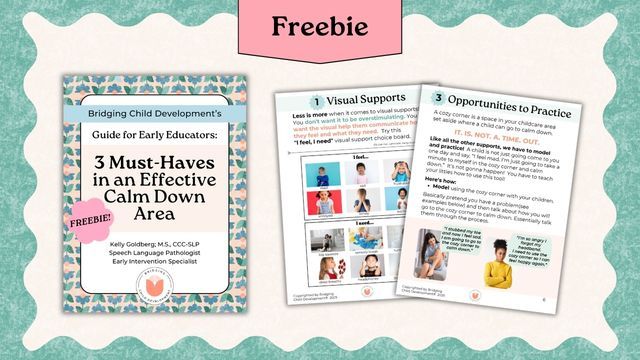
Download the Free Guide: 3 Must-Haves in an Effective Calm Down Area
Visual supports are one of the 3 must-haves in every effective calm down corner, but they're not the only one.
Want to know the other two essentials? Download your free guide: 3 Must-Haves for an Effective Calm Down Area, and start building a cozy corner that actually works for toddlers and preschoolers.
Frequently Asked Questions
What is a calm down corner in a preschool classroom?
A calm down corner (also called a calming corner or cozy corner) is a small, designated space where children can go to regulate their big feelings with a teacher's support. It's not a punishment or time-out — it's a proactive tool that helps children build emotional regulation skills over time.
What visuals help toddlers calm down?
The most effective visual supports include a feelings chart, an "I Feel, I Need" board, calm-down strategy cards, a simple breathing visual, and a step-by-step "what to do here" sequence. Real photos of your own students modeling each strategy work especially well for young children.
Why won't children just use their words when they're upset?
Because they literally can't. A calm brain talks and upset brains can't access that language. When emotions run high, the part of the brain responsible for language goes offline. Visual supports give children a way to communicate without words in the moment — and with modeling, they help build the words for next time.
How do I teach toddlers to use a calming corner?
Introduce it when children are calm, model using it yourself, and accept pointing as real communication. Toddlers need a lot of co-regulation — a calm adult alongside them — before they can regulate on their own. Patience and repetition are everything.
Prefer to learn these tips in a training?
Find a format that works for you.
Get your state-approved hours and CEUs, a comprehensive handbook you'll reference forever, and strategies that’ll make a difference in the children you’re caring for.
Live Virtual Trainings
Real-time interaction, community with other providers, and the energy of learning together.
Self-Paced Trainings
Flexibility to learn on your own schedule, pause and rewatch as needed, with opportunities to learn and engage with others.
Private Trainings
A customized training for your entire staff, in-person or virtual, with hands-on activities built around your center's needs.
Hey, I’m kelly
Speech Language Pathologist, Early Intervention Specialist, Child Care Trainer, and Former Family Child Care Owner
I work alongside early childhood educators caring for children with a variety of needs. But these needs look very different than they did twenty years ago and you deserve trainings, resources, and tools that reflect that.
Trainings that are high quality, affordable, and worth coming back to.
That's why I built Bridging Child Development. Every training hour you earn here gives you strategies you can use the very next day in your classroom.
Login or sign up to start learningLogin to start learning