You know fine motor skills matter. You know those little hands are gearing up for kindergarten writing, among other skills. But the thought of adding elaborate, Pinterest-perfect fine motor activities to your day can feel like,
"Are you kidding me, another thing to do?!"
As a pediatric speech-language pathologist, early intervention specialist, and former child care owner, I totally get that "ugghhhh, it's just one more thing on my plate" feeling and that's the last thing I want you walking away with!
The great news is fine motor development doesn't require special time or elaborate setups. Some of the most effective fine motor activities take almost zero prep and use stuff you already have in your classroom. So let's not overcomplicate this!
For this blog, I called in our pediatric occupational therapist and early intervention specialist, Kaitlyn, who is sharing five simple activities that take minimal prep and have maximal impact on fine motor development.
Fine motor skills are the small muscles in the hands and fingers, the ones behind grasping and pinching. T
hey're the foundation for so much of what's coming: - Holding a pencil
- Using scissors
- Self-help skills like zipping a coat, buttoning, and using utensils
- Taking glue caps off/on or twisting lids
Strong little hands now mean less frustration with writing and cutting later, which is exactly why kindergarten expects these skills in place. The good news is that you can build them through play, no worksheets required.
(Even your arts and crafts time is building fine motor!)Hand children a spray bottle and let them water your classroom plants. That's it.
Why it works: Every squeeze builds the exact muscles kids need for pencil grip and scissor control.
How to make it work:
- Assign rotating "horticulturalists" throughout the week. Kids love a real responsibility, and you gotta love that vocabulary!
- Make it a math activity by having them count their sprays or measure how much water each plant got.
Create a simple choice board on chart paper or a whiteboard. As children arrive, have them
write their name under their choice.
How to make it work:
As they enter, have them "sign in" by voting. Depending on their level, this might be words or pictures:
🍓 or 🍌
🐶 or 🙀
📘 or 🎶
💙 or ❤️ or 💛 or 💚 or 💜
Talk about their responses during another part of your day (math, morning meeting, literacy). Before the end of the day, take literally one minute to write or draw a new prompt.
Why it works: Writing with purpose, like voting, gives them something to write about that feels important.
Pro tip: This works for toddlers and preschoolers too. Younger kids can scribble a mark or place a sticker next to their photo, tally, draw a shape, or write the first initial of their name.
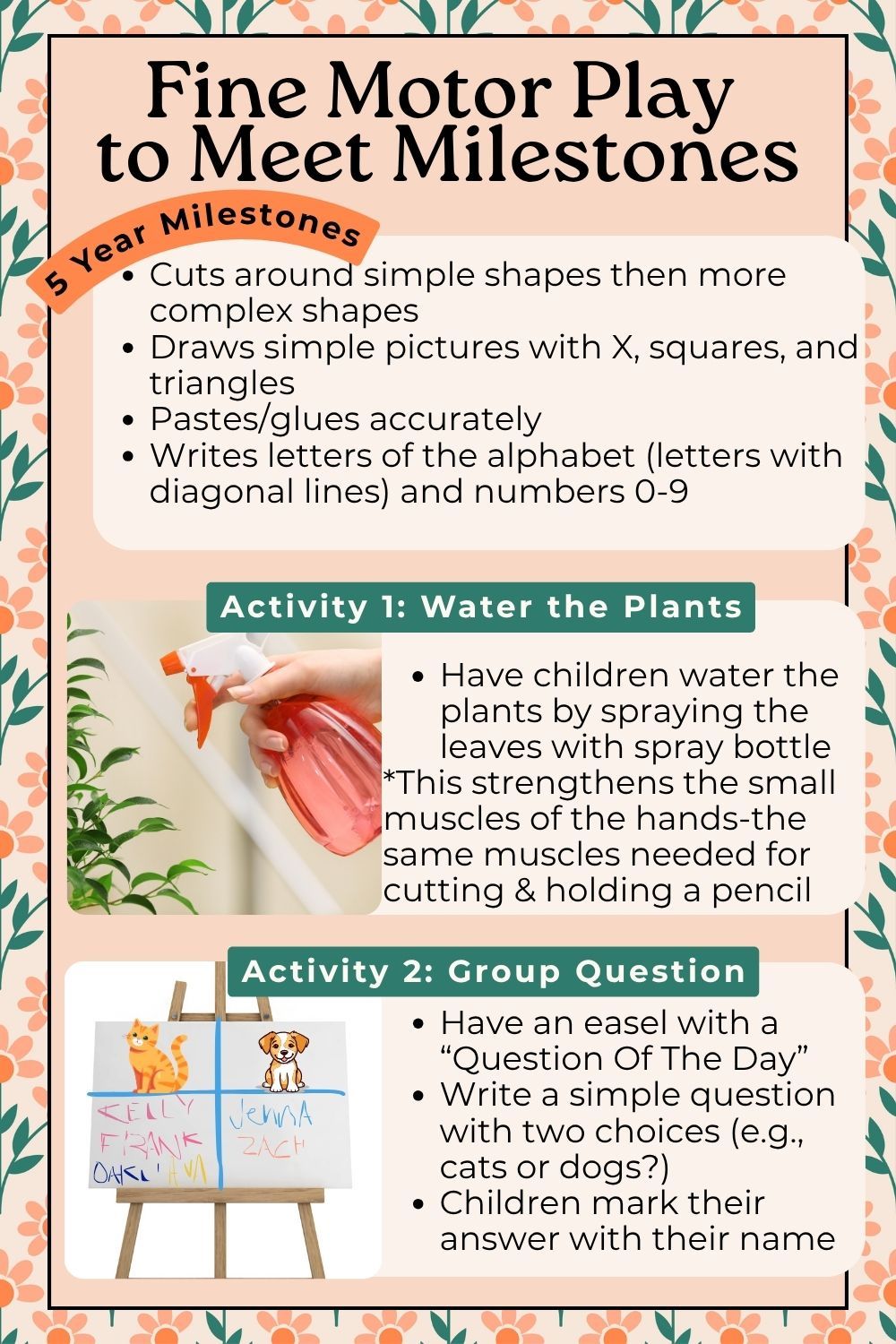
Screen shot this image and reference later!
Keep a basket of paper with shapes already drawn on it: Circles, thick lines, squares, triangles. Nothing fancy, just grab a marker and draw some shapes. During free play or transitions where kids need to wait, have them grab a sheet and cut.
How to make it work:
- Draw shapes in bulk once a week (or ask a parent to help!)
- Keep safety scissors accessible in a basket
- Let kids go at their own pace, some finish in seconds, others need more time, and both are fine
Pro tip: Kids still working on scissor grip should start by cutting thick lines.
Set up a corner with paper and markers or crayons (you probably already have this). Write simple prompts on index cards or a small whiteboard: "Draw a house," "Draw the sun," "Draw your pet." Kids choose a prompt and draw during free play.
Why it works: At this age, they're learning to put what's in their head onto paper.
How to make it work:
- Rotate prompts weekly to keep it fresh
- No judgment about how things look, a five-year-old's drawings don't need to look "right"
- Keep samples from September and May; you'll be shocked at the growth, and families love seeing it
Pro tip: Model this skill! Some kids will be drawing for the first time with you so model a few examples out loud: "I'm going to draw my house. It's a square, so I need four lines. The roof looks like a triangle on top. Now a window, it looks like a circle in the middle." (And can we appreciate all that language? This is exactly why OTs and SLPs love to collaborate!)
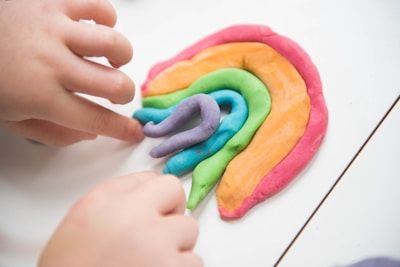
If you already have playdough, you're all set. Give kids a ball and simple challenges: "Roll a snake," "Make ten tiny balls with your fingertips," "Flatten it like a pancake."
Why it works: Playdough provides natural resistance that builds hand strength without feeling like exercise. Pinching, rolling, and squeezing target the exact muscles kids need for writing and cutting.
How to make it work:
- Make it a game, not a task: "I wonder who can make the longest snake in our class?"
- Rotate through different challenges
- Combine it with math, literacy, or STEAM: "Roll five balls," "Make a letter," "Build a house"
Pro tip: Playdough doesn't need fancy add-ons. A ball of dough and a challenge is plenty.
- Make it routine. Pick one activity to embed into your day, try plant watering on Fridays. Once that's a habit, add sign-in choices during arrival or playdough during play. Consistency matters more than variety.
- Keep it playful. Frame these as games and special jobs, not "work."
- Celebrate progress. Seriously, keep work samples. You won't regret it when you see the growth.
Pro Tip: Make sure to meet children where they are. If these activities are too frustrating, try our Fine Motor Activities for Your 3's Class and 4's Class.
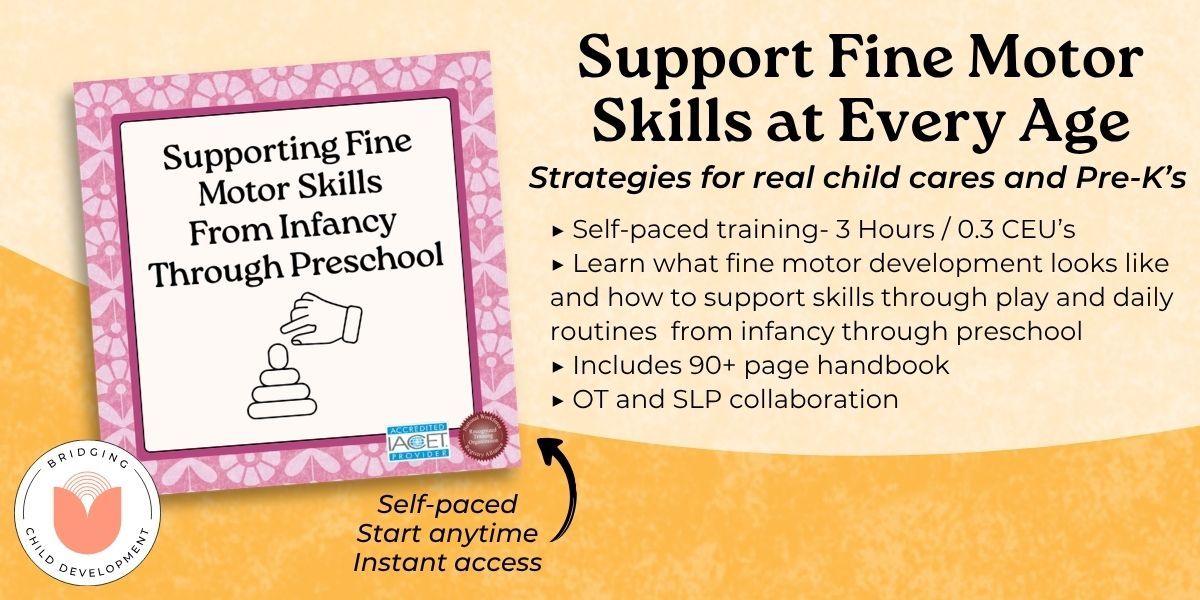
Love simple, doable fine motor practice? These five activities are just the start. If you want a clear developmental roadmap for supporting little hands from infancy through preschool, I built a training just for you:
Supporting Fine Motor Skills from Infancy through Preschool.
Inside, you'll learn how fine motor skills develop at every stage, get easy play-based activities to build hand strength and coordination, and know how to support children who need a little extra help.
These small-muscle skills are the foundation for writing, cutting, and self-help tasks like zipping, buttoning, and using utensils. Building hand strength and control in preschool means far less frustration when kindergarten expects kids to hold a pencil and cut shapes.
Short, frequent bursts beat long sessions. Embedding a little practice into your daily routine, arrival sign-in, a few minutes of playdough, cutting at a center, is far more effective than one big weekly activity. Consistency matters more than intensity.
- Cuts around simple shapes then more complex shapes
- Draws simple pictures with X, squares, and triangles
- Pastes/glues accurately
- Writes letters of the alphabet (letters with diagonal lines) and numbers 0-9
If a child consistently struggles with things their peers are managing, like holding a crayon, using utensils, or cutting, or gets very frustrated with hand-based tasks, it's worth a conversation with the family and the child's pediatrician. An occupational therapist can help when extra support is needed.